Wine, Food, and Other Vital Things

Month: July 2026

A Good Day for Tequila

Angela and I spent some time in Mexico in April, a week in Oaxaca, then several days in Mexico City on the way back to Los Angeles. Those days included the sampling of a good number of tequilas and mezcals and an afternoon at Lalocura, a palenque. The trip was good, and I came home determined to drink more tequila (I am more partial to mezcal.)

July 24 is National Tequila Day in the United States, so that gives me a great reason to write about two bottles that I sampled recently, a blanco and a reposado, the former from Mi Campo and the latter from Casa Noble.

Casa Noble and Mi Campo tequilas: 100 percent Blue Weber Agave.

First, for those who are not overly familiar with the terms, a primer: reposado, which means “rested” in Spanish, is aged in oak barrels for a minimum of two months but less than 12 months, while blanco (“white”) must be bottled within 60 days from when it comes off of the still. Both of these types are worthy of your attention, depending on your palate and preferences. (There is also añejo and extra añejo/extra aged, not to mention mixto versus 100 percent blue agave. I’ll leave these terms for another time.) Note: Both of these bottles are 100 percent Blue Weber agave.

Back to the tequilas of the day. I begin with the Mi Campo, which is fermented in open-air tanks then double-distilled before resting for as long as one month in French oak barrels that previously held chardonnay.

This would be perfect in a Margarita.

In a glass, the Mi Campo appears mostly clear, but held up to a light source a faint yellow hits the eye, a mark of resting in barrel. Aromas of coconut, toasted almond, and orange peel are evident, as well as a hint of vanilla and a beguiling note of chocolate. On the palate I appreciated orange and, to a lesser extent, honey. A touch of agave herbalness is there, but a touch only, and some might pick up green and black pepper, as well as bell pepper. Whether you find the finish sweet or not depends on your palate; the effects of the barrel are certainly there. This is a solid tequila for the price, around $25. Search here.

(I ran across conflicting sources when I attempted to determine if Mi Campo Blanco contains any additives. The brand says nothing is added, while some drinkers say that because Mi Campo is made at La Cofradia distillery (NOM 1137), a facility that produces both additive-free and additive-containing tequilas on a contract basis, there is bound to be some measure of additives in Mi Campo. Some even speak if the “Cofradia taste,” which they describe as “funky” or “solventy.”)

The Casa Noble Reposado spends 364 days in new French oak barrels, edging right up to the añejo neighborhood. It has a lovely muted amber color in the glass, one I find inviting. On the nose it is distinct, sharp, full of pepper and bitter orange, perhaps even burnt apricot. A taste offers hazelnut, a hint of cinnamon, closing with soft vanilla and chocolate. I did not find anything obtrusive about the effects of the barrel here.

Casa Noble Reposado is a fine sipping tequila.

I liked this tequila quite a lot, and can see myself sipping it on a regular basis. I think it would appeal to both casual drinkers of tequila and those who consider themselves aficionados, and that’s a good place for this bottle to be. It has an SRP of $49.99. Search for it here. I’ll likely sip the Casa Noble, and use the Mi Campo to make Margaritas, Ranch Water, and Palomas.

Wine Talk: Matthew Crafton Has Chateau Montelena In a Great Place

The estate is iconic. A stone winery constructed in 1888 by Alfred Lovering Tubbs is its centerpiece. Tubbs hired a French architect, who used French stonemasons and imported stones to create the A.L. Tubbs Winery. Spending a few hours there is something I recommend.

This building was added to the U.S. National Register of Historic Places in 2013.
(Chateau Montelena)

The estate, located in Calistoga, California, is now known as Chateau Montelena, and Matthew Crafton, the latest Wine Talk subject, is its president and winemaker. He’s been with the estate since 2008, and his guidance and vision are worthy of attention. Click here to read what Crafton has to say about the future of the wine industry, where he likes to drink a glass of wine when he’s not working, and other things.

Matthew Crafton has a degree in economics but found his love and passion in the wine world. (Chateau Montelena)

Wine Talk: Insights from Sea Smoke’s Don Schroeder

There’s something to be said for a winemaker’s long tenure at one estate. It would be a fine thing to, season after season, become one with a vineyard, with its vines and insects and rows and birds and microclimates. Don Schroeder, the winemaker at Sea Smoke, has been at the estate since 2003, and he knows every square inch of it.

I met Schroeder recently in Los Angeles at a Sea Smoke lunch tasting. The wines were very good, and I enjoyed speaking with him about his experiences in Alaska (we both once lived there), his education, his family, and his enthusiasm for Alsace, which I share. We also, of course, talked about the wines he makes.

Schroeder is the subject of the latest “Wine Talk,” which you can read here.

The Sea Smoke Estate shares an intimate relationship with the Pacific Ocean. (Courtesy Sea Smoke)

Spirits of ’76: Chateau Montelena Debuts a Sparkling Wine and Brandy

It was 1976, and a little thing we call The Judgement of Paris took place that year. In short, American wines largely bested their Gallic counterparts in the tasting, as determined by some fine French palates. The world noticed.

Chateau Montelena was one of the American producers involved in the tasting, and to commemorate the 50th anniversary of the auspicious event the estate is introducing a sparkling wine and a brandy in limited editions. These bottlings mark the first time that the estate has made a sparkling wine or a brandy.

The 2023 Blanc de Blanc and Brandy Release #01 go on sale today, July 3 (the brandy is available in California only). The wine is $125 for Chateau Montelena wine club members and $150 for everyone else, while the brandy sells for $75 (members) and $95 for non-members.

“The Blanc de Blancs and the brandy both trace back to the same ground that produced the 1973 Chardonnay,” said Matthew Crafton, president and winemaker at Chateau Montelena. “They aren’t recreations of that wine, nothing could be, but they are honest expressions of the same vineyards, approached with the curiosity and discipline that have always defined Montelena.”

Matthew Crafton, president and winemaker at Chateau Montelena, sits with some bottles at the estate. (Brockhaus Photography)

The sparkling wine’s fruit — 100 percent chardonnay — comes from Napa Valley’s John Muir Hanna Vineyard, which played a pivotal role in the 1973 Chateau Montelena selection that finished on top in the chardonnay category at The Judgement of Paris. The brandy was distilled from fruit (all chardonnay) harvested from the John Muir Hanna, Belle Terre, and Bacigalupi vineyards, the three sites that provided grapes for the famed 1973 vintage. Montelena plans to release nine additional bottlings of brandy over time.

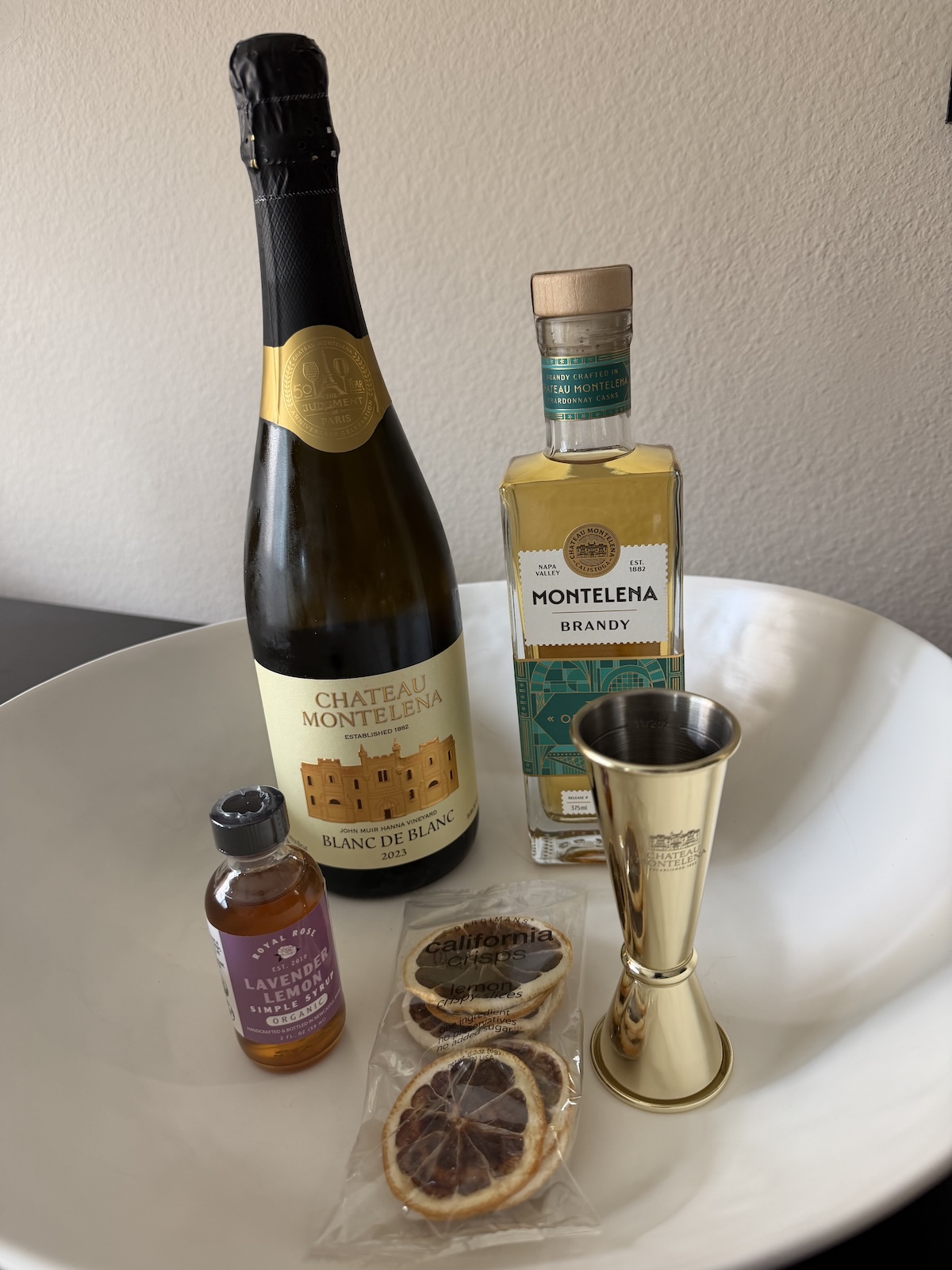
Speaking of the Spirit of 1976, Montelena put together a great kit for the sparkling wine and brandy that includes a bottle of each, along with all of the ingredients needed for the Montelena 76, a cocktail I am looking forward to try.

In honor of a grand occasion and a storied cocktail. (Brockhaus Photography)

If you want to get a bottle of the sparkling wine, click here beginning on July 3. As noted, the brandy is for the moment available solely in California — contact the winery for information on that.

© 2026 Mise en Place

Theme by Anders NorenUp ↑