Marcus Jernmark is making quite the impression with Lielle, his tasting-menu restaurant that premiered in February. It’s receiving glowing reviews from critics and diners alike. Bill Addison, of the Los Angeles Times, writes that Jernmark’s tasting-menu restaurant is “one of the decade’s most exciting and assured debuts … ” in Los Angeles. Jernmark is also the man behind Marée, where my partner and I celebrated our wedding anniversary this year.
Marée had been open but two weeks when we dined there on a Monday evening last month, and while I generally avoid visiting a restaurant until it’s been “broken in” for at least several months, I miss French bistros and decided to make an exception to my rule: after all, Marée calls itself a “California French Bistrot.” This is a first look at the restaurant.
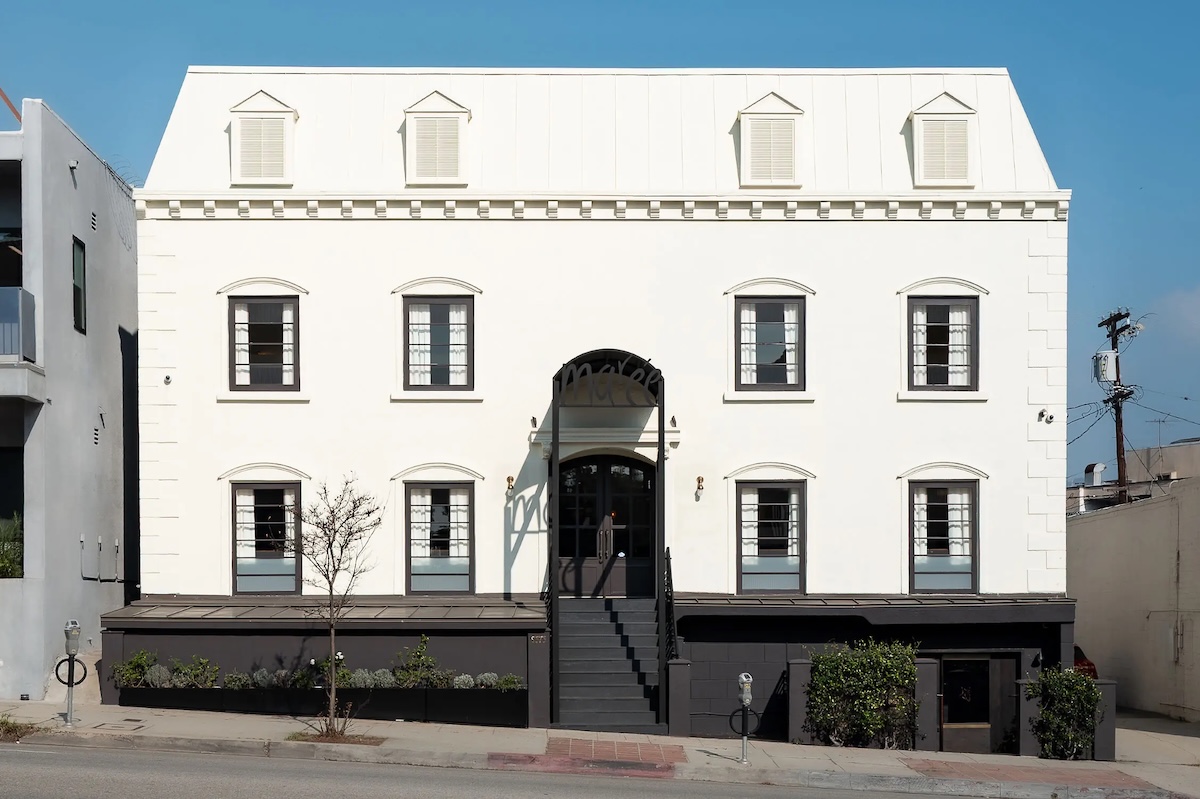
This building has seen a lot of culinary activity. (Brockhaus Images)
Marée is situated above Lielle in a building on West Pico Boulevard that has housed its fair share of restaurants over the years, including Osteria Romana Orsini, Sotto, Test Kitchen, and, most recently, Walter and Margarita Manzke’s Bicyclette, which I liked immensely — the République couple closed up shop there in 2024.
Jernmark’s creative partner, Andrea Jernmark, and Lovers Unite have given Marée’s interior an assured and inviting bistro feel. You’ll find, among other sights, textures, and surfaces, a zinc chef’s counter (weathered intentionally), vintage mirrors, a bar of green onyx marble, Fritz Hansen pendants, Thonet-style chairs, and Knoll velour-upholstered banquettes. The space is warm yet bright, in a wavelength proper for dining, drinking, and conversing.
Thonet-style chairs set a proper tone at Marée. (Andrea Jernmark Instagram)
An undulating bar leads the eye into one of Marée’s dining areas. (Photo by Kort Havens)
I like the colors of Marée; nothing offends the eye or the sensibilities. Some surfaces shine, others calm with their warmth. There’s gray — dark, dramatic gray — some copper, a touch of yellow at the entryway. And the walls, with their textured white expanses, make the other colors profound and true. It is a space that beckons and seeks. (Click here for more images of Marée at Lovers Unite.)
The zinc chef’s counter gives diners a perfect seat. (Photo by Kort Havens)
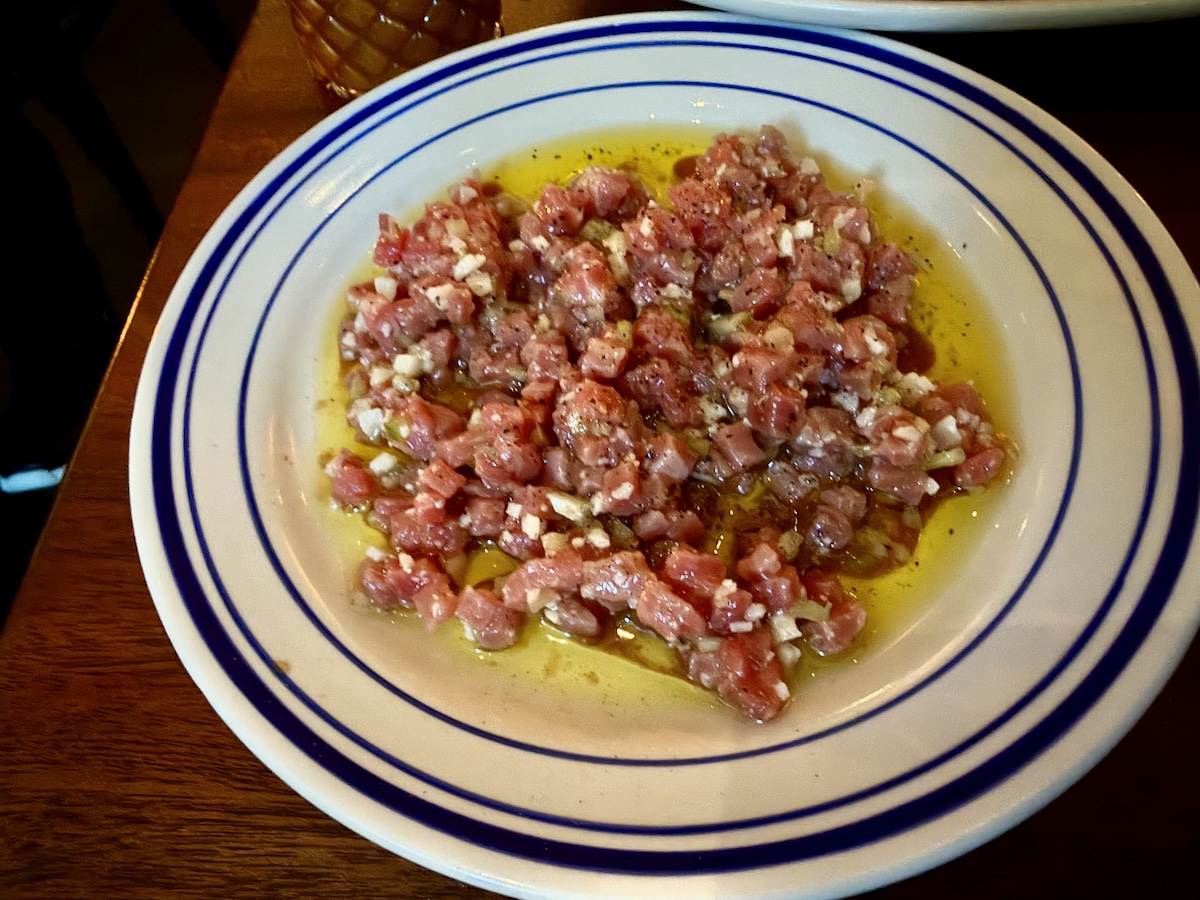
I order beef tartare as often as I can, and that was how I chose to begin my meal at Marée. It’s served on a round plate; pieces of finely diced celery dot the beef, along with parmesan and black pepper and olive oil. No egg yolk, which is a fine move by Jernmark. Earthy, rustic, pleasing texture, acid supplied by the olive oil and celery.
It’s my opinion that a dish of tartare should always be served with at least one piece of bread, even if the guest has not ordered bread service. We had not ordered the bread service, but my request for a piece of bread was granted. It was good bread, and with great pleasure I used it to eat the tartare; the bread soaked up the flavor-infused oil and I left nary a drop on the plate. A dish well prepared.
Beef, celery, and Parmesan combine in Marée’s tartare de boeuf. (Brockhaus Images)
A salad of figs and goat cheese was also on our menu that night, a small plate, figs and chèvre under dressed and crisp greens, figs meaty and slightly sweet, cheese creamy and tart. It was a good bite, altogether, to come after the tartare.
Tomatoes came to the table next, a Munak tomato salad with shiso vinegar and fig leaf oil. Fresh, lively, a clearing-of-the-palate dish that makes one wish peak tomato season lasted longer than it does. Touches of salt, along with the slightly savory fig oil and bracing vinegar, meld into something magical and alive.
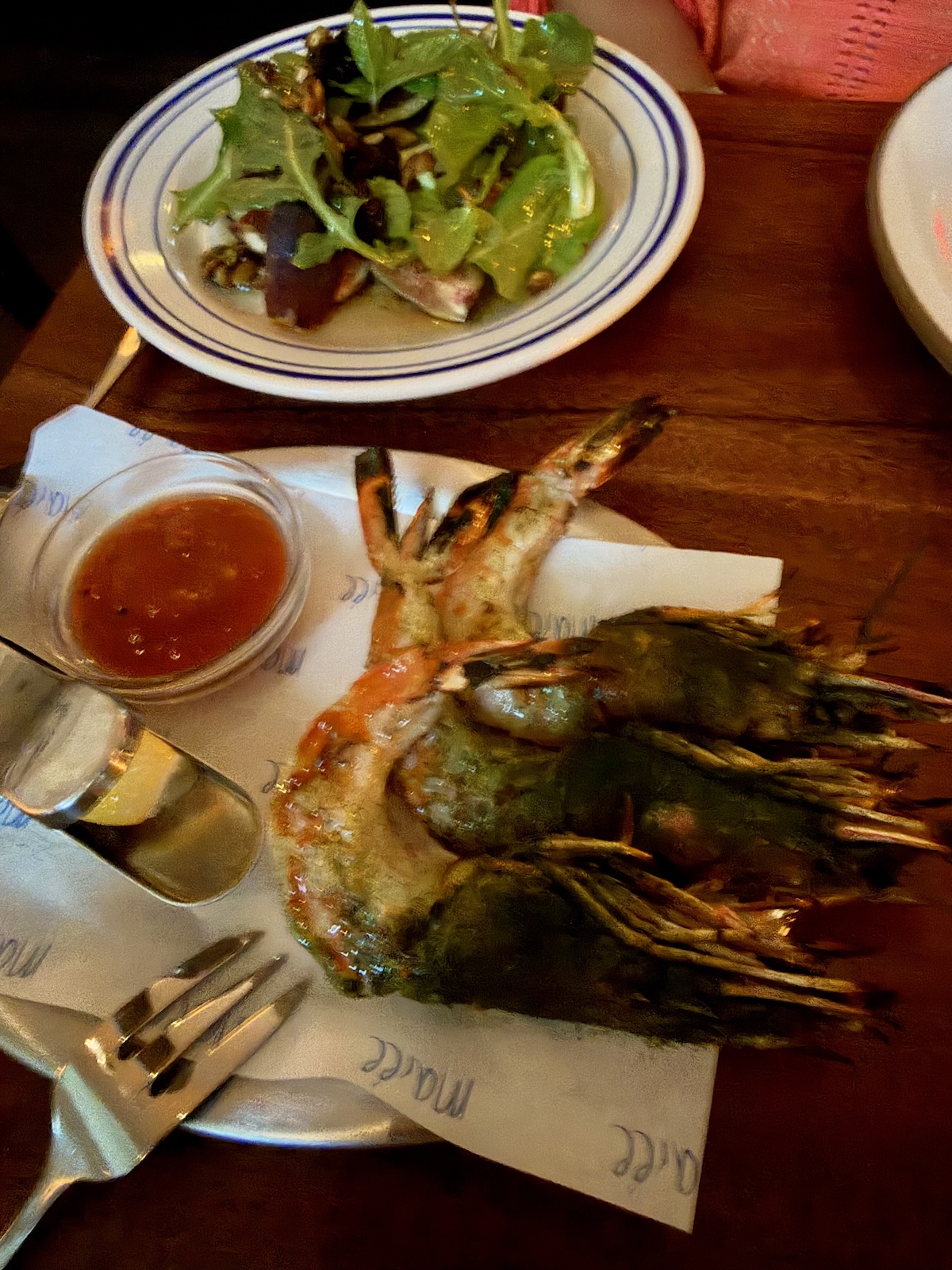
The Caledonian blue prawn cocktail was to our liking; heads on, cooked so that the flesh retained moisture and bite — overcooked prawn or shrimp or lobster is never fun — and served with a cocktail sauce comprised of Marée’s homemade hot sauce, ketchup, tomatoes, and horseradish. A lemon wedge completes the dish.
I like my prawns cooked the way they cook them at Marée: carefully, not too long. Tough prawns are a travesty. (Brockhaus Images)
I ordered the veal sausage, because I am a sausage person. It’s made at the restaurant, and I sensed some offal, which I love. It’s served over lentilles du Puy and baby cauliflower florets and it’s moist and rustic and savory and earthy. Some house-made grainy mustard is a fitting accompaniment.
A coiled link of veal sausage and lentils make a comforting meal. (Brockhaus Images)
Perhaps you have heard of the hamburger au poivre that’s on the menu at Marée? It’s been appearing on a good number of social media feeds. We ordered it. Whenever I select such a dish my mind automatically goes to one of my favorite examples of a burger, The Big Mec, which is served at Petit Trois L’Original.
Marée’s hamburger is good, really good. It’s brought to table cut in half, the cut side down on a platter that contains an ample amount of au poivre sauce. There are fried onion rings on this burger, along with fried kale chips, Espagnole sauce, and oyster mushrooms. There’s plenty of beef, and it’s finished over Japanese charcoal, a touch that imparts umami and a note of mystery. The rich, grilled bun took on the sauce in a delightful manner. We also ordered fries, which are worth the $16 price tag. They were hot, crisp, toothsome, and stood up well to the aioli and mustard I asked for. What good is a fry without both?
The hamburger au poivre at Marée. It’s more than a burger, in a good way. (Andrea Jernmark Instagram)
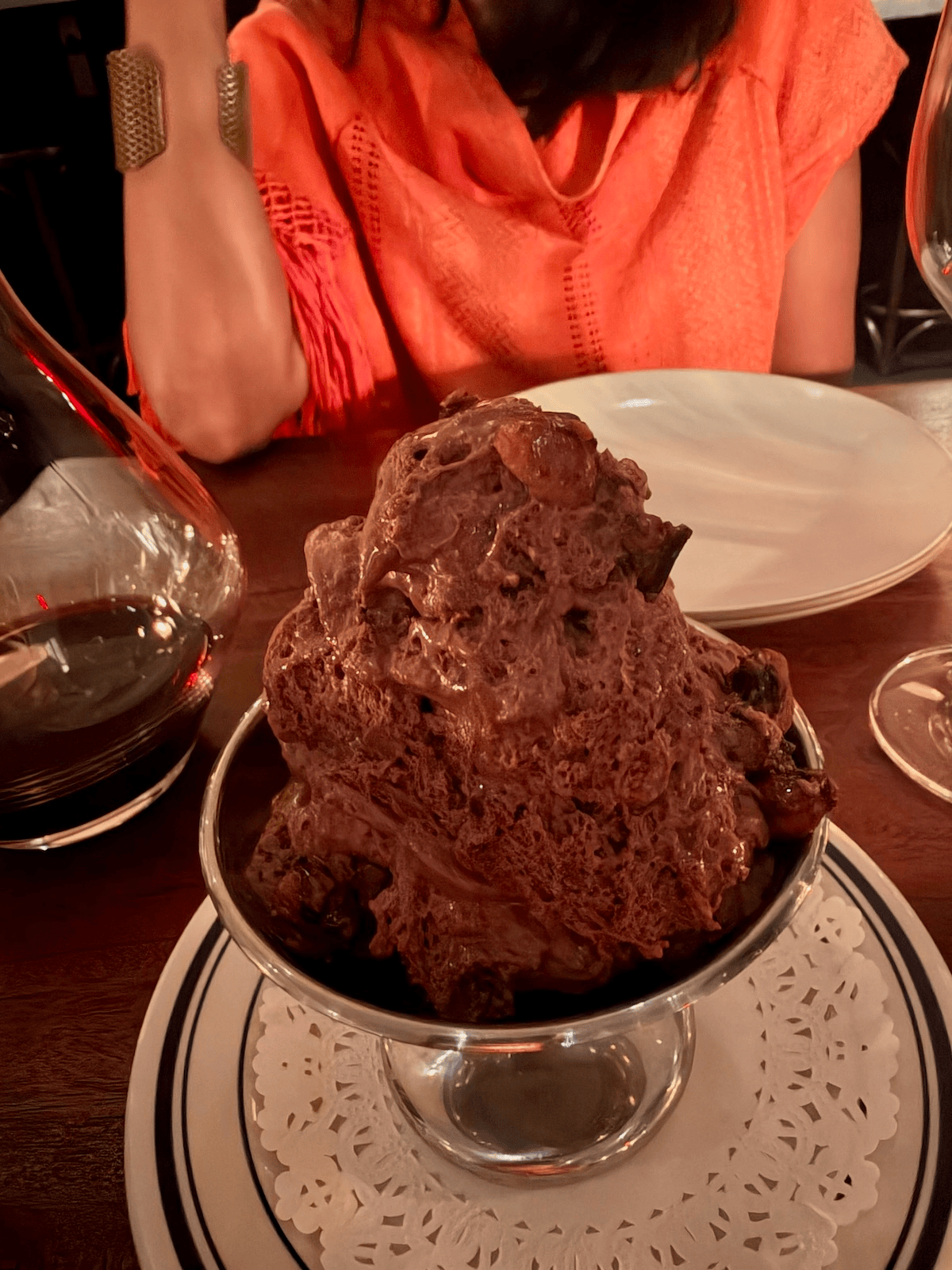
We closed the meal with a chocolate mousse studded with caramelized hazelnuts, a dessert that straddles a great line between sweet and savory. Not savory in a meaty way, but savory in a dark-chocolate acid-salty way. It is served towering in a small ice cream parlor dish, and sharing it was fun.
A dessert of chocolate mousse and caramelized hazelnuts. (Brockhaus Images)
Marée shares Lielle’s wine list, a 47-page offering that includes some great California bottles — Radio-Couteau Seabed Estate Chardonnay for $175, Littorai Mays Canyon Chardonnay for $275, Hirsch Vineyards San Andreas Fault Pinot Noir at $182 — along with abundant selections from Europe, zero-proof libations, and a smattering of spirits (grappa, cognac, armagnac, amaro). I appreciate any list that includes Philip Togni wines, and this one, put together by beverage director Phil South, does. Corkage at Marée is $50, and at Lielle it is $75; if you buy a bottle from the list the fee is waived for one bottle.
Marée is definitely a bistro, and, based on my one meal there, it is a good one. You’ll pay $42 for the burger, and the veal sausage costs $48. If you have a meal at Marée you’ll have to assess whether the food is worth the money. I must be honest and state that I have had meals in bistros in France that cost much less and were just as good, but this is Los Angeles and that burger is damned good.
Ilove talking about wine with people who share my passion for it. We open bottles, we trade stories about travel and soil types, terroir and residual sugar, and we talk of taste and food and restaurants. We recommend wines to one another, we drink, and we learn a lot.
In Wine Talk, I introduce you to friends, acquaintances, and people I encounter as I make my way around the world, from Houston to Mexico City, Los Angeles to Burgundy, and other locales far and near, individuals who love and respect wine as much as I do, who live to taste, who farm and make wine. Whether my subject is a collector, a winemaker, a chef, a sommelier, a buyer, a grower, or simply an enthusiastic drinker of wine, you’ll appreciate their insight, and I hope you’ll learn something from them as well.
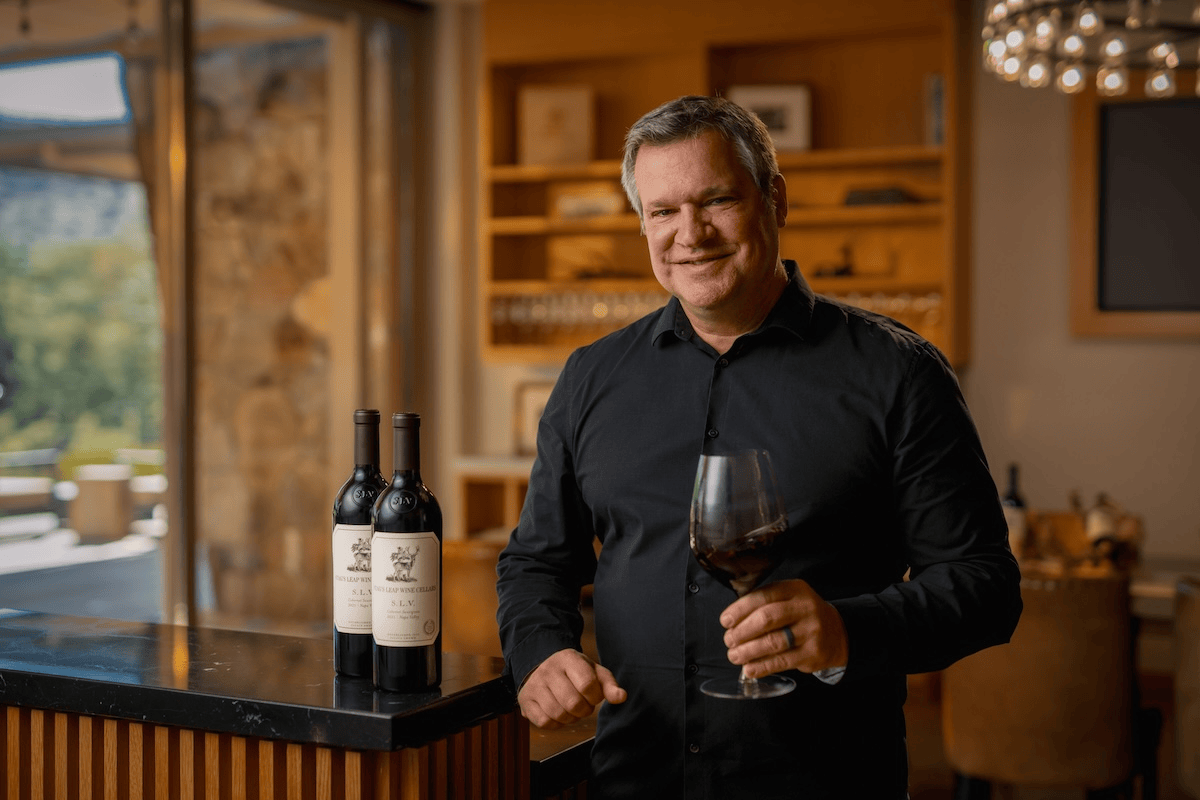
Marcus Notaro, director of winemaking at Stag’s Leap Wine Cellars, has been making red wine since 1995. (Stag’s Leap Wine Cellars)
Marcus Notaro is the director of winemaking at Stag’s Leap Wine Cellars, where he has plied his trade and craft since 2013. Early on, he worked as a tour guide at Chateau Ste. Michelle, a job he said sparked his interest in the technical side of wine and put him on his career path. He entered the training program at the Washington State-based winery, then took a job at Columbia Crest, followed by a stint making wine at Col Solare, which at the time was owned by Chateau Ste. Michelle and Marchesi Antinori in a joint venture (the latter became sole owner of Col Solare in 2024). Notaro has been making red wine (primarily cabernet sauvignon) since 1995.
Marcus Notaro helped make the 2005 Columbia Crest Reserve Cabernet Sauvignon, which Wine Spectator named its top wine in the world for 2009. (Stag’s Leap Wine Cellars)
The future winemaker grew up in an Italian American household whose patriarch made wine at home; I can imagine his parents pairing that wine with the meals served at the family table and the impression those rituals had on the son. Notaro was born in New York and then lived in Connecticut and Los Angeles before his family moved to Seattle when he was 10. He began working at Chateau Ste. Michelle while completing a degree in engineering at the University of Washington. In 1994, Notaro took a job at Columbia Crest and was on the winemaking team there when the winery’s 2005 Reserve Cabernet Sauvignon was named the top wine in the world for 2009 by Wine Spectator. The wine retailed for around $25 upon release.
Notaro moved to Col Solare in 2006, and continued his mastery of red wine, which most recently saw him celebrating the 50th anniversary of The Judgement of Paris by releasing the 2023 Stag’s Leap S.L.V. Cabernet Sauvignon, the wine whose 1973 vintage made history in Paris on that fateful day in 1976. From tour guide and tasting room pourer to maker of red wines worthy of serious consideration and long-term cellaring, Notaro’s path has been one of serendipity combined with intent, education, and practice. His work at Stag’s Leap Wine Cellars, now owned solely by Marchesi Antinori, continues his journey.
Let’s see what he has to say in Wine Talk.
James Brock: Tell us about three wines you think are drinking well at the moment. What makes them worthwhile?
Marcus Notaro: We recently celebrated the 50th anniversary of The Judgment of Paris, the blind tasting that helped to put Napa Valley on the map, when wines from the region shocked the world and bested top French wines. I was at Auction Napa Valley in June, where we partnered with Chateau Montelena on a lot that included one of our last remaining bottles of our winning 1973 S.L.V. Cabernet Sauvignon, alongside a bottle of 1973 Chateau Montelena Chardonnay. During the event, as a nod to the anniversary, I had the opportunity to pour both our new 2023 S.L.V. Cabernet Sauvignon and the 2023 Chateau Montelena Chardonnay, which I know the guests really enjoyed, so these wines are on my mind at the moment. What makes the 2023 S.L.V. particularly worthwhile is that it beautifully reflects the character of the historic S.L.V. vineyard that continues to define Napa, 50 years later. The wine is both powerful and precise, with layered dark fruit, cassis, cocoa, and cedar notes framed by the gravelly mineral character and firm structure that have long been hallmarks of this site. I enjoyed what was left of those wines with grilled skirt steak and morel mushrooms to pair with the S.L.V., along with a scallop risotto for the chardonnay.
This wine made history. (Stag’s Leap Wine Cellars)
JB: If cost was no consideration, tell us the one bottle you would add to your personal collection, and why.
MN: When I was in college in the early ’90s, I worked as a waiter at a small Italian restaurant outside Seattle. The owner was incredibly passionate about wine and would open good bottles off the list to celebrate a successful night, so we could learn about the wines. I’ll never forget trying a Barolo from Bruno Giacosa, likely a late-1980s vintage. It completely blew my mind and was the bottle that first sparked my fascination with wine. That experience set me on the path to learning more about wine and, ultimately, pursuing a career in winemaking. I wish there was a case of that sitting in my cellar to enjoy.
Fay Vineyard was planted in 1961 by Nathan Fay; Stag’s Leap founder Warren Winiarski purchased the vineyard in 1986. The fruit for Artemis is sourced primarily from Atlas Peak and Coombsville. (Brockhaus Images)
JB: What is your favorite grape, and why? If you don’t have a single favorite, tell me about one that you are especially passionate about.
MN: Cabernet sauvignon runs through my veins. Even before I started down the winemaking path, my beverage of choice while studying in college was black currant tea, which happens to be one of cabernet’s classic flavor descriptors. What I love most about cabernet is its complexity. The different personalities it expresses depending on where it’s grown, its potential for aging, and its potential to be made into wines full of flavor and rich in texture, but with a sense of elegance as well.
JB: How about one bottle that our readers should buy now to cellar for 10 years, to celebrate a birth, anniversary, or other red-letter day?
MN: These are perfect occasions to open one of our “Estate” wines. After about 10 years, they’ve reached what I like to call their “well-behaved teenage years,” where some of the youthful edges have integrated into the wine, but they’re still full of primary fruit character and have plenty of life ahead of them. If I were choosing a bottle to cellar today for a future celebration, I’d select the 2023 S.L.V. Cabernet Sauvignon. As the 50th anniversary vintage of S.L.V., it has a special story behind it, and I expect it will reward patience beautifully over the coming decade and beyond.
Stag’s Leap Wine Cellars occupies a storied place in the wine world. (Stag’s Leap Wine Cellars)
JB: Where is your go-to place when you want to have a glass or bottle (outside your home and workplace)?
MN: My backyard is one of my favorite spots, particularly during harvest. I love to go outside with a nice glass of wine, enjoy the cool evening breezes, and think about what’s on the horizon, what still needs to be picked, how each fermenting tank is progressing, and what I should do next. Another favorite spot of mine is the Sonoma Coast. On Sunday afternoons, I love to head out there with my wife and youngest daughter to pick up a few things for a picnic lunch, open a nice bottle of wine, and watch the waves and the sunset.
JB: If there was one thing you wish everyone would keep in mind when buying and drinking wine, what is it?
MN: Keep an open mind and try something or somewhere new. It’s such a special time to be a wine consumer, as new great wines are being produced around the world. I suggest taking the opportunity when you can to go to a tasting experience where there’s lots of different wines to try, have fun and find some new bottles that you like.
JB: We’ve all read the countless articles and papers devoted to the dire state of the wine world and industry, the stories of surplus fruit, ripped-out vines, younger drinkers abandoning wine, climate worries, and the role of alcohol in human health. What do you think needs to be done to improve the current state of wine? Better education? Marketing? How concerned are you about the future of the industry?
MN: There’s a lot happening these days, and I try not to get too caught up in the headlines competing for clicks. Wine is in the business of agriculture, so there will always be ups and downs. Mother Nature ultimately sets the course, and our responsibility is to respond to the challenges and opportunities each season brings, crafting the best possible wine while remaining true to the distinct personality of our vineyards. As I’ve traveled around the country this spring, attending wine festivals, sold-out vintner dinners, and other events, I’ve seen plenty of enthusiasm for wine from both younger and more experienced consumers.
When it comes to engaging younger wine drinkers, a few experiences with my own children have given me valuable perspective on what our industry can do to better connect with the next generation. My daughter, who turned 21 in May, texted me to ask for my recommendations on a wine that was “cheap and not gross or sweet.” Her assumption that affordable wine is either sweet or not very good suggests to me that winemakers need to do a better job making quality wine approachable and accessible for younger consumers. Then there’s my son, who graduated from college this year. During spring break this year he brought several friends home, and while none of them knew much about wine, we spent a few days exploring Napa Valley, tasting different wines and learning the basics of grape growing and winemaking … they were completely hooked. At his graduation ball, each table was served a bottle of wine. Throughout the evening, several of his friends stopped by to say they weren’t particularly enjoying it and joked that a bottle of Stag’s Leap would have been a welcome upgrade. What those experiences taught me is that younger consumers are interested in wine. Sometimes all it takes is a little education, an affordable tasting experience, and a connection to the place where the wine is grown.
Bruno Giacosa, who passed away in 2018, made wines of legendary status. (Paolo Tenti)
JB: What is your wine eureka moment, the incident/taste/encounter that put you and wine on an intimate plane forever?
MN: The Bruno Giacosa Barolo I mentioned earlier was a pivotal wine for me. Its complexity, story, history and taste completely captured my attention and set me on the path toward winemaking.
Marcus Notaro began his wine career at Chateau Ste. Michelle. (Stag’s Leap Wine Cellars)
JB: What has been the strangest moment or incident involving wine that you have experienced in your career?
MN: It has to be during the 2017 fires. We had just harvested some merlot and crushed it into a fermentation tank at a sister winery on the night of the Atlas Fire. Shortly after, we lost power and access to the facility, including the tank, for over a week. When we were finally able to return, it was only for a brief window of a few hours, just enough time to drain the free-run juice from the tank before we had to leave again. Several days later, once we regained full access, we were able to shovel out the pomace and see what had developed. What emerged were essentially two very different wines: a delicate, light, fruit-driven free-run, and a press fraction with remarkable structure and power. We ultimately blended the two together, and the result was the best merlot we have produced in my 13 vintages here. It remains something of a mystery wine because so many variables were out of our control. No one truly knows what happened inside that tank, from temperature to fermentation dynamics to the yeast that carried it through.
JB: If you could journey to one destination (or region) tomorrow to explore its wines, where would you go?
MN: Piedmonte, Italy, where the food is meant for the wine, and the wine is meant for the food.
JB: Your favorite wine reference in a work of literature (fiction, film, poem)?
MN: As the current winemaker for Stag’s Leap Wine Cellars, it has to be George Taber’s book “Judgement of Paris,”right?
This book is a must-read if you like wine and history. (Scribner)
Not so long ago, I found myself in a conversation with a certain type of individual who, when I paused to open a bottle of riesling from New York State and offered them a glass, looked at me and stated, with pride, “I don’t drink white wine.” I poured myself a glass and pondered that statement.
What they did drink were expensive bottles of red. Bottles that they let everyone (or at least those on their social media feeds) know they had purchased. I pitied this person then, and I reckon I do still. One of my tenets is that drinking wine does not make you sophisticated, no matter the price you paid for it. The bottle, so to speak, does not the man (or woman) make. I’m not sure if this individual has changed their mind about white wine, but I am certain that their need for that type of self-aggrandizement is alive and well.
I thought of this person and their personality when I sampled a few bottles of wine this week, an albariño from Spain and a picpoul de pinet from France. Inexpensive wines, enjoyable and delicious. I smiled, briefly, then forgot my misguided acquaintance entirely when I tasted the wines.
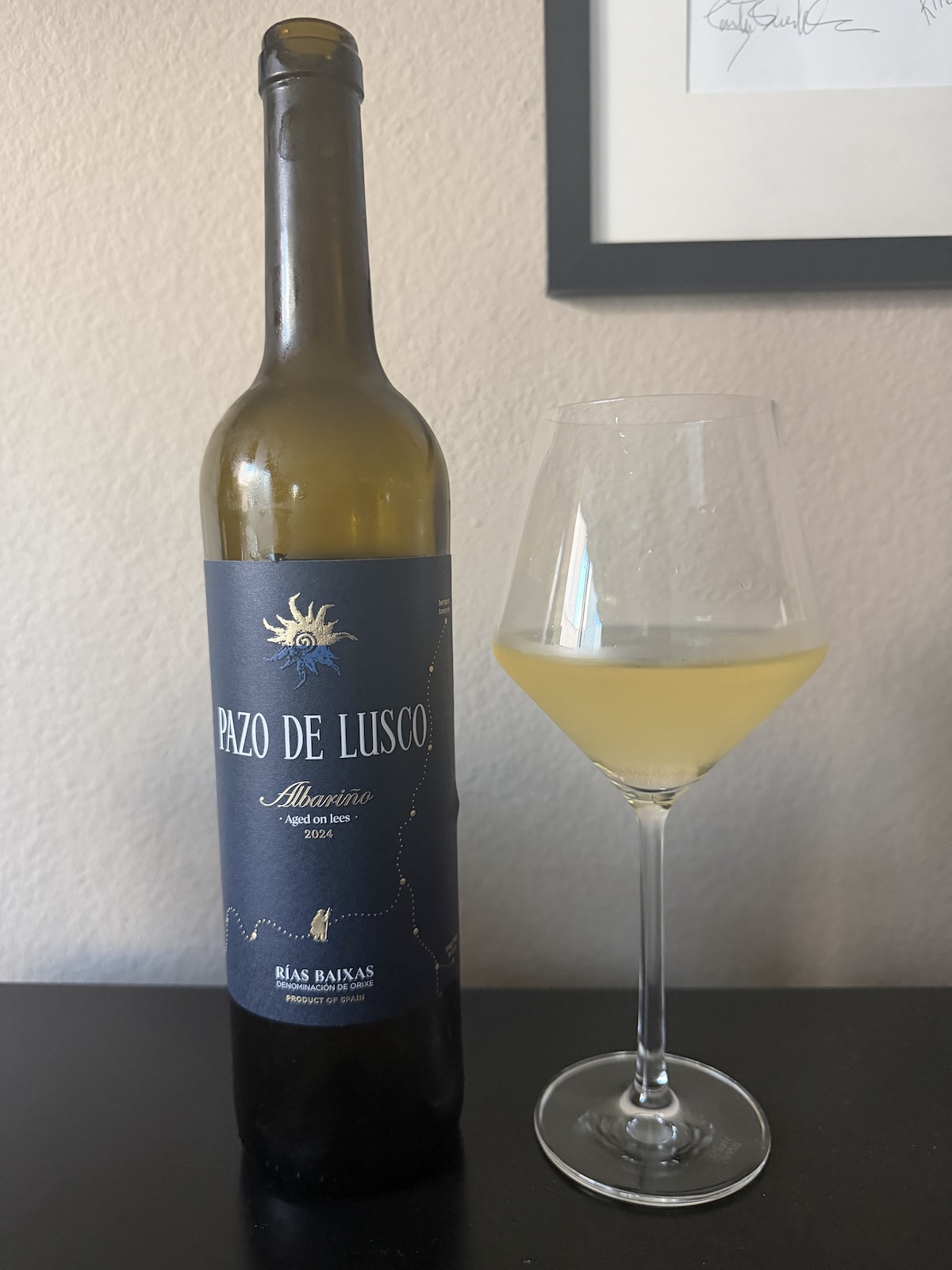
An albariño that calls out for oysters. (Brockhaus Images)
The albariño, from Adega Pazos de Lusco — “lusco” is Galician for “twilight,” and one can imagine opening a bottle of this on a terrace overlooking the sea as the sun is beginning to set, platter of freshly shucked oysters at hand — is dry, was aged on its lees, and fermented with native yeasts.
Notes of toasted pear and brûléed lemon mark the pour’s aroma, along with an intriquingly evanescent note of briny green melon. My first taste of this wine brought the word “green” to mind, and the flinty profile here satisfies well.
Adega Pazos de Lusco is located in Galicia, close to Spain’s border with Portugal. (Familia González Byass)
Adega Pazos de Lusco is located in Galicia, about 2 kilometers from the Portuguese border, in Condado do Tea (County of Tea), a subzone of the Rías Baixas appellation. It has been part of Familia González Byass since 2016.
The winemakers gave this an 8-hour cold soak at 8 degrees Celsius, followed by 25 days of fermentation in stainless steel tanks. It’s filtered and fined. Alcohol is 13 percent. Pair with small and cold oysters, butter-poached shrimp or lobster, or baked mullet. Suggested retail price is $31, but it is often found at lower prices. Search here.
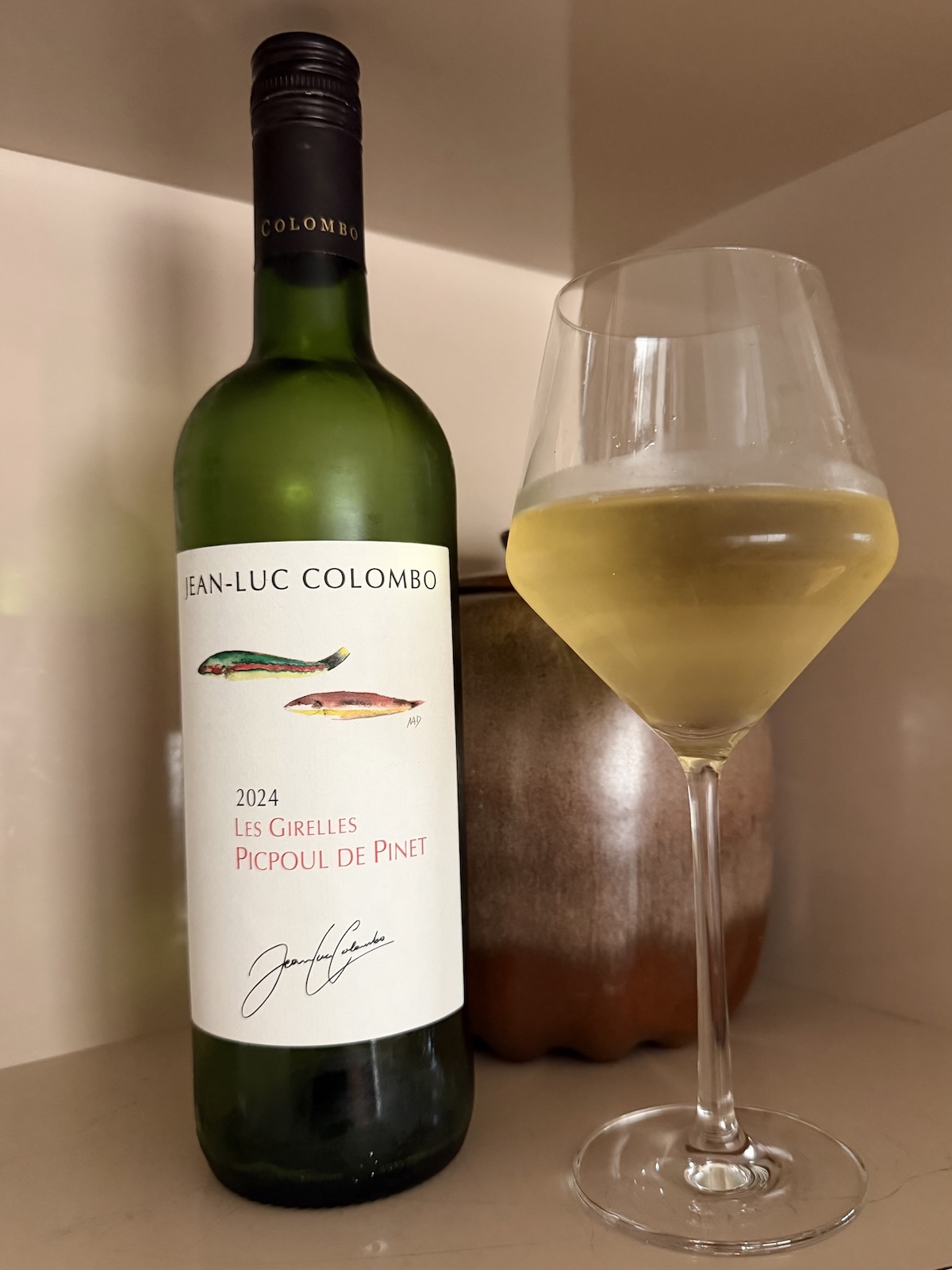
Try pairing this wine, from Jean-Luc Colombo, with a lobster salad. (Brockhaus Images)
In 2024 my partner and I, along with another couple, visited Jean-Luc Colombo’s beautiful vineyards near Cornas during a birthday trip to Burgundy and the Northern Rhône. Colombo’s sites there overlook the Rhône River, and produce some great wines. I like the man’s fierce dedication to his winemaking and lands, and was happy to have recently sampled a wine of his made in another region of France, namely, Languedoc-Roussillon.
A girelle is a fish, known in English as a wrasse, and this bottle from Colombo displays a pair of rainbow wrasses on its label. The males are resplendent, and display bands of yellow and green and blue and orange, which often appear to shimmer and change hue. They are also lively fish, darting energtically to and fro in the waters of the Mediterranean.
Jean-Luc Colombo is a man of strong and outspoken passion and pride. (Vins Jean-Luc Colombo)
While Colombo’s picpoul de pinet is not as colorful as the male wrasse, it is a lively and aromatic wine full of freshness and structure. It’s 100 percent piquepoul blanc, a grape naturally high in acidity, a “lip-stinging” pour that is meant to be served chilled (54 degrees Fahreheit is ideal). I paired it with a cold lobster salad, and would also happily drink it while dining on raw oysters, Dungeness crab, or a seafood platter. Beautiful citrus on the nose and palate — lemon and grapefruit — as well as some acacia and brininess throughout. I’ve not had a more enjoyable wine at its suggested $18 retail price. Look for it here.
If I should happen to find myself at a table alongside the individual mentioned above, the one who disdained my riesling, I’ll likely offer them a pour from my bottle, because it’s the polite thing to do, no? It might be an albariño or a simple muscadet, or perhaps it will be a Grand Cru Chablis or a magnum of Krug. You see, I have nothing against expensive wines; in fact, I have liked or loved nearly every single one of them I have drunk. I do, however, detest drinking in the company of snobs. That turns spending time with even the best of wines into a loathsome experience.
Charles Clark has been a mainstay of the Houston culinary scene for decades. His approach to food and wine is bold and dynamic; time spent in Spain early in his career had a profound effect on the way he hosts and feeds his guests.
Charles Clark pours for guests at his Brasserie 19. (Andrew Hemingway)
I always enjoy spending time at Brasserie 19, Clark’s popular and lively place on West Gray Street. Seated at the bar is best, and the people-watching opportunities are legion. The wine list is large and full of value, the food commendable.
Clark is the subject of the latest Wine Talk, and he has a lot to say. It was published in PaperCity Magazine, and you can read it here.
Summer is nearly run out, though here in Southern California a week of high heat is upon us. It’s going to be 94 Fahrenheit on Wednesday, and it appears that similar highs will persist through the end of the week. So it goes …
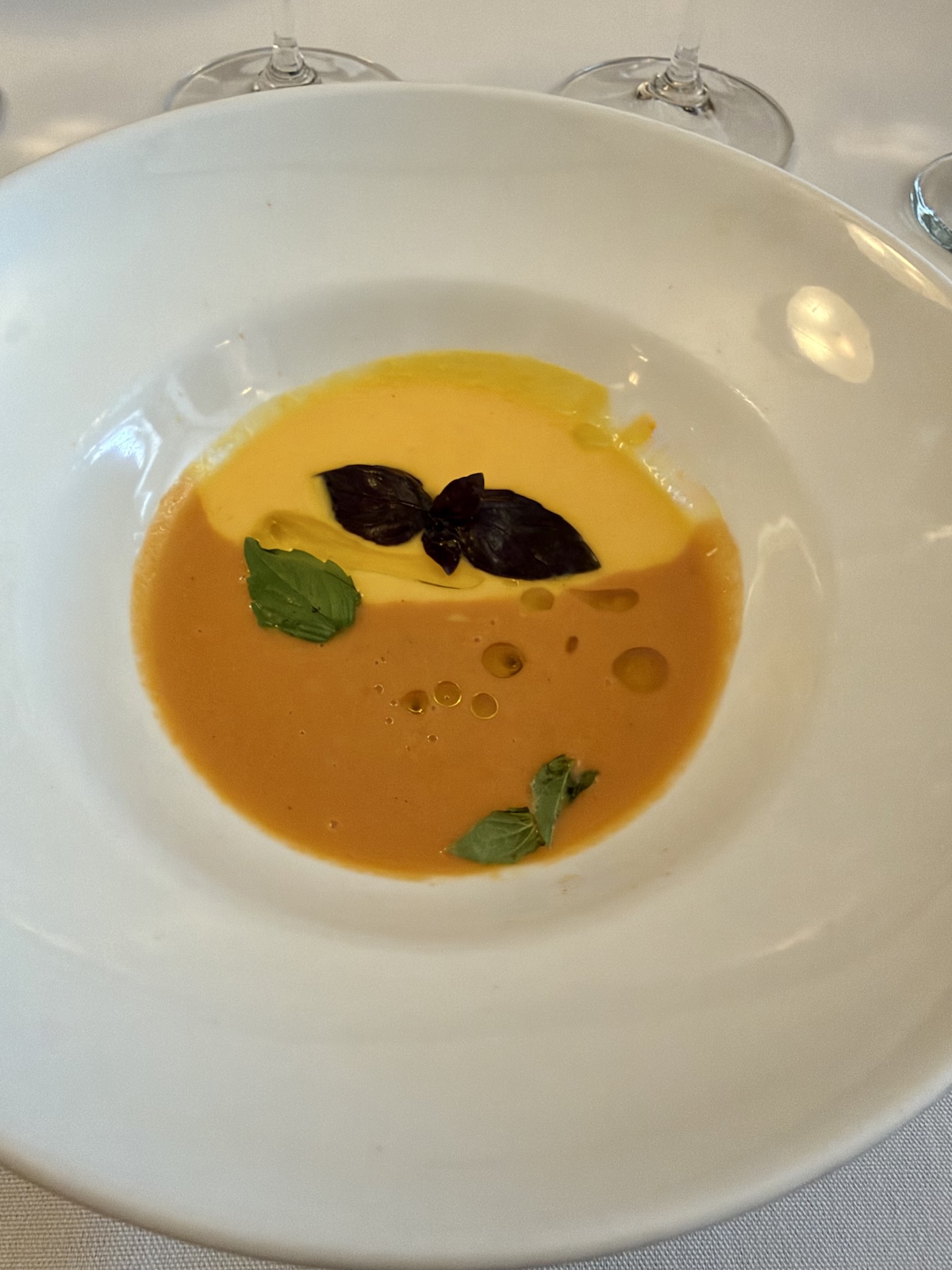
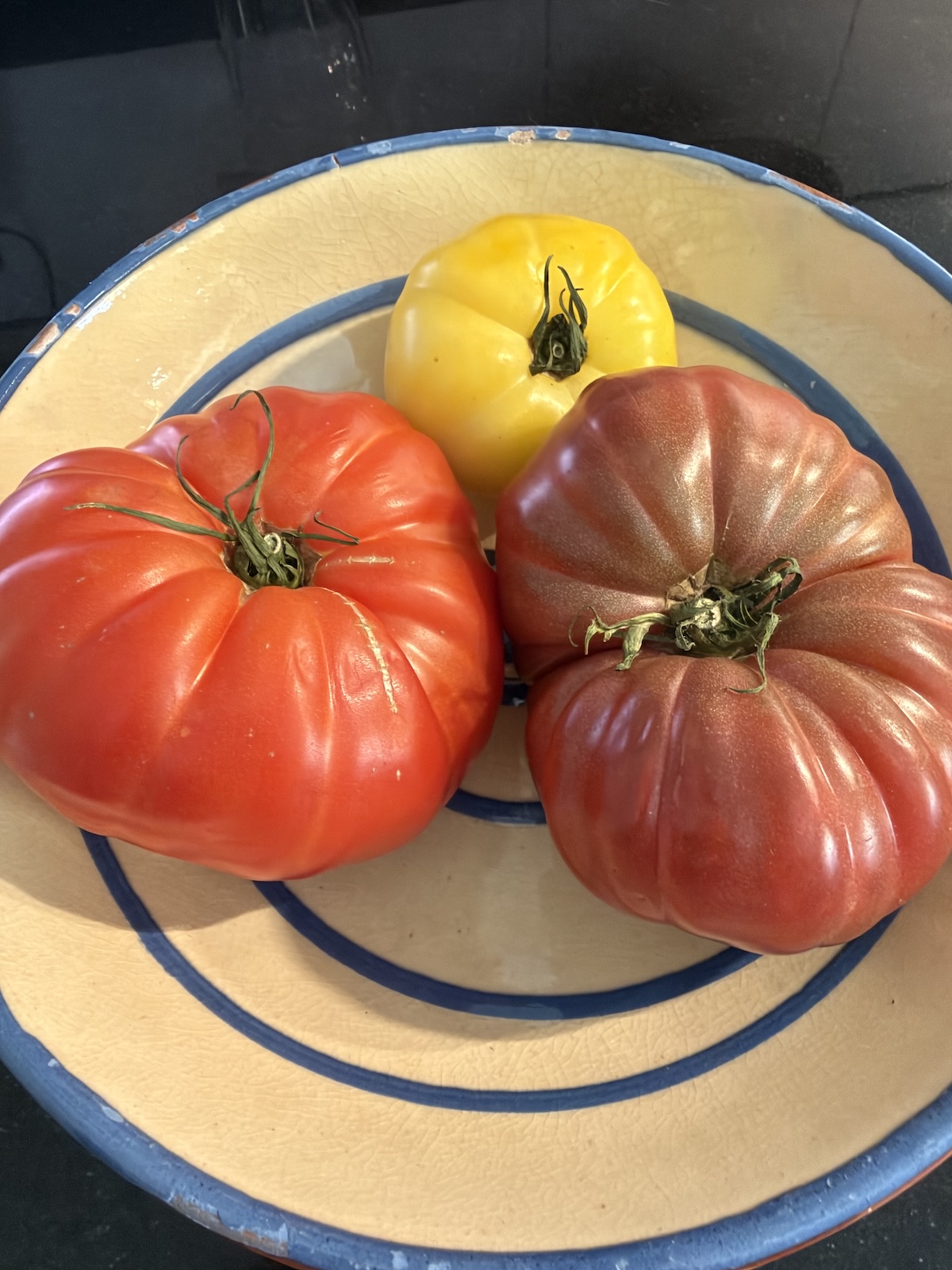
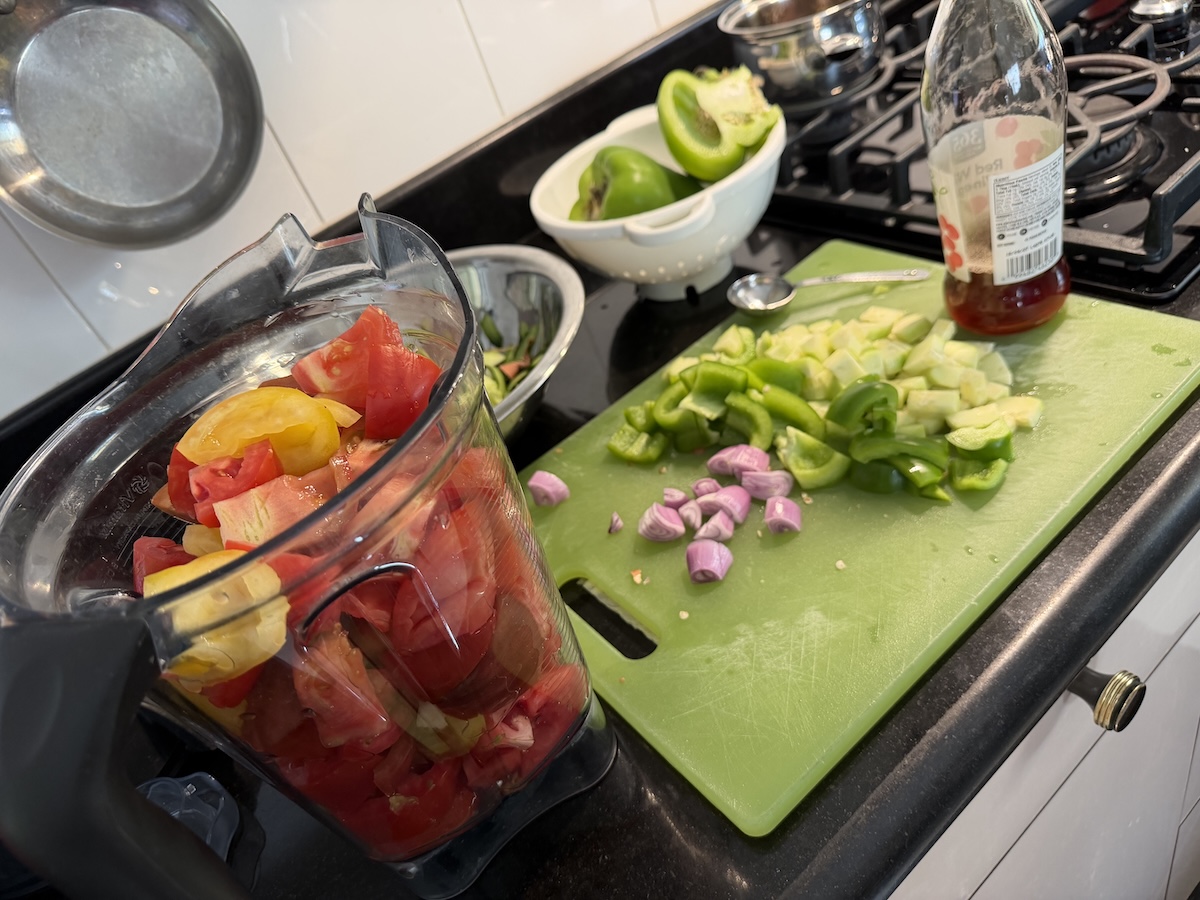
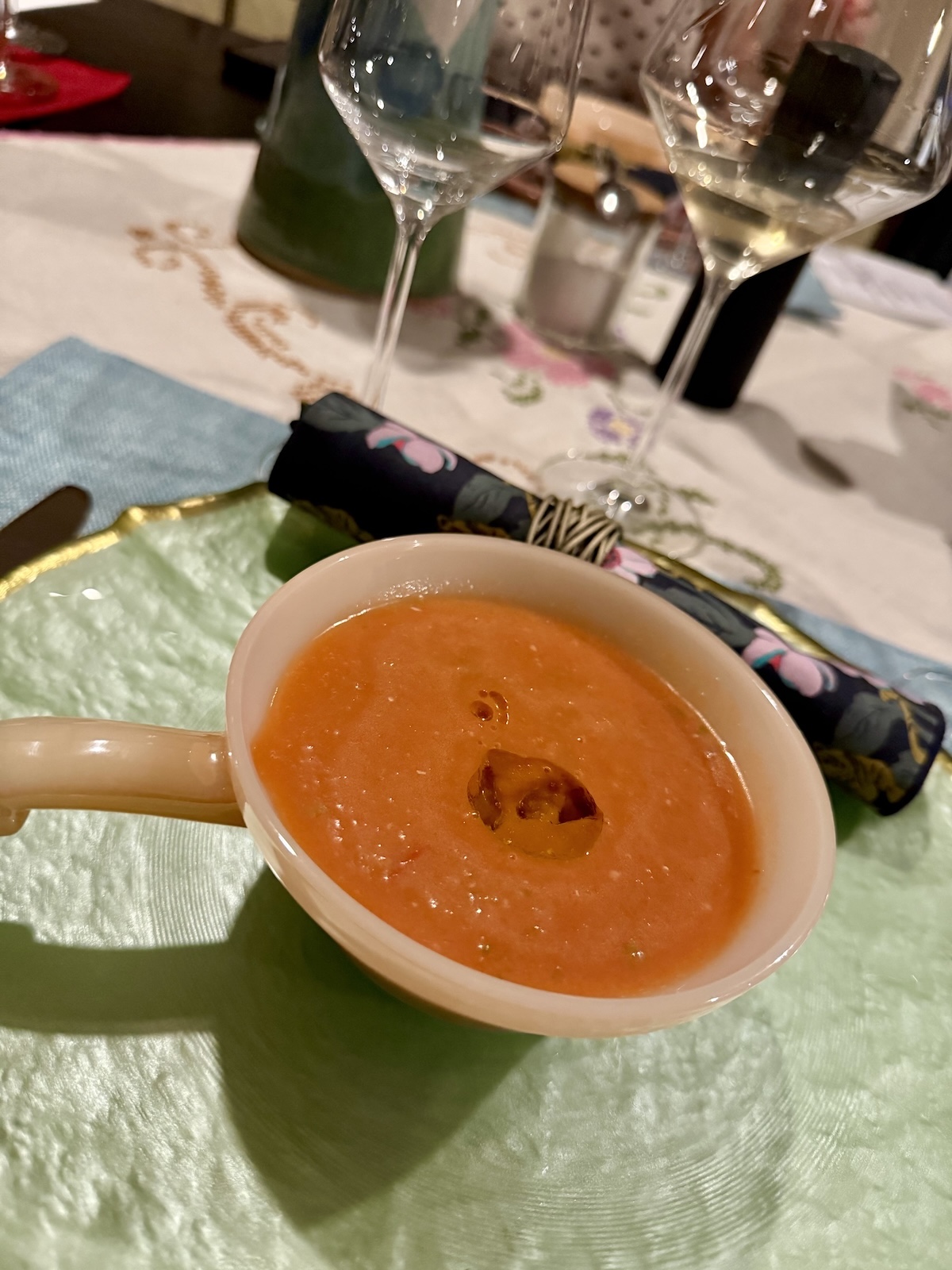
My Labor Day weekend was highlighted by a dinner party we hosted on Saturday, for which I began prepping on Friday by making gazpacho and ice cream. I was at lunch a week or so ago at Marino Restaurant and Sal Marino gave me his recipe for gazpacho, which I used. Here is an image of his version of this dish:
Sal Marino’s gazpacho is a tomato bomb. (Brockhaus Images)
A few of the tomatoes I used for my gazpacho. (Brockhaus Images)
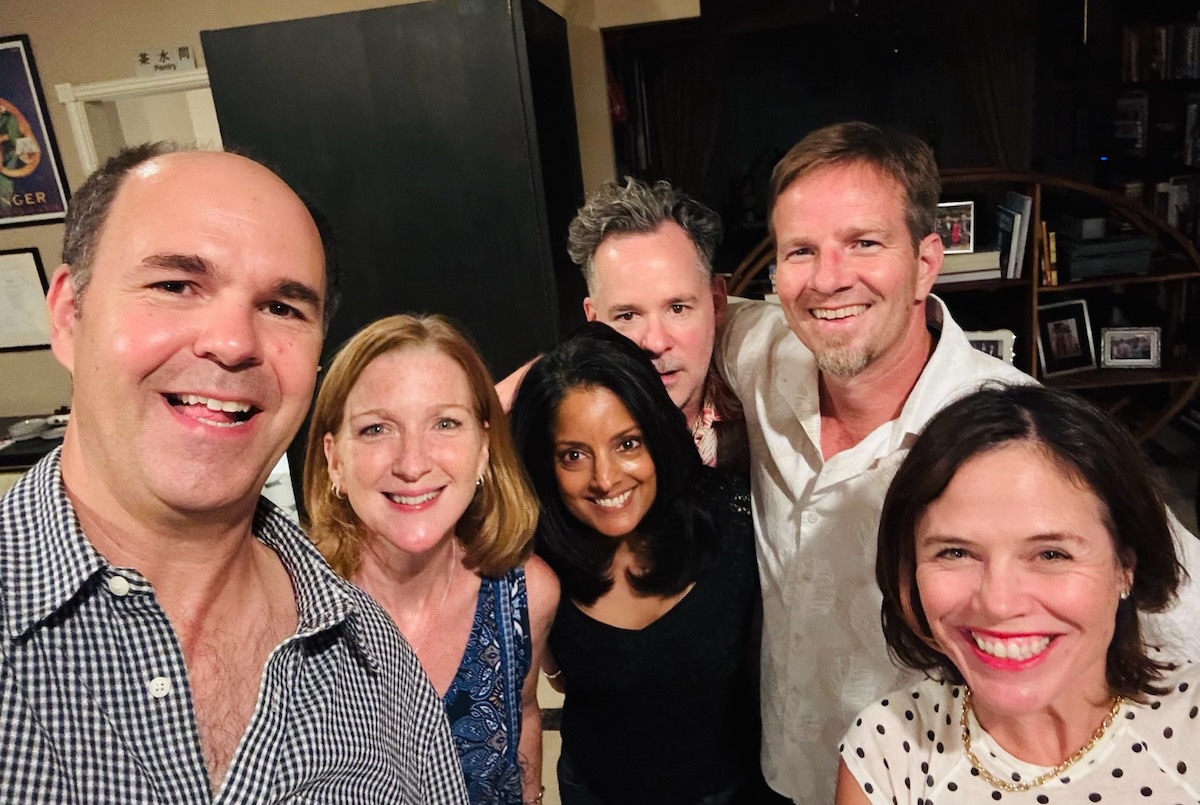
The guests numbered four, two regular dinner and cooking companions, two whom we have been attempting to get to our table for a few years now; something or other always interfered. But that is now a thing of the past.
This is a dish that everyone should master. Simple, yet full of complex flavor. (Brockhaus Images)
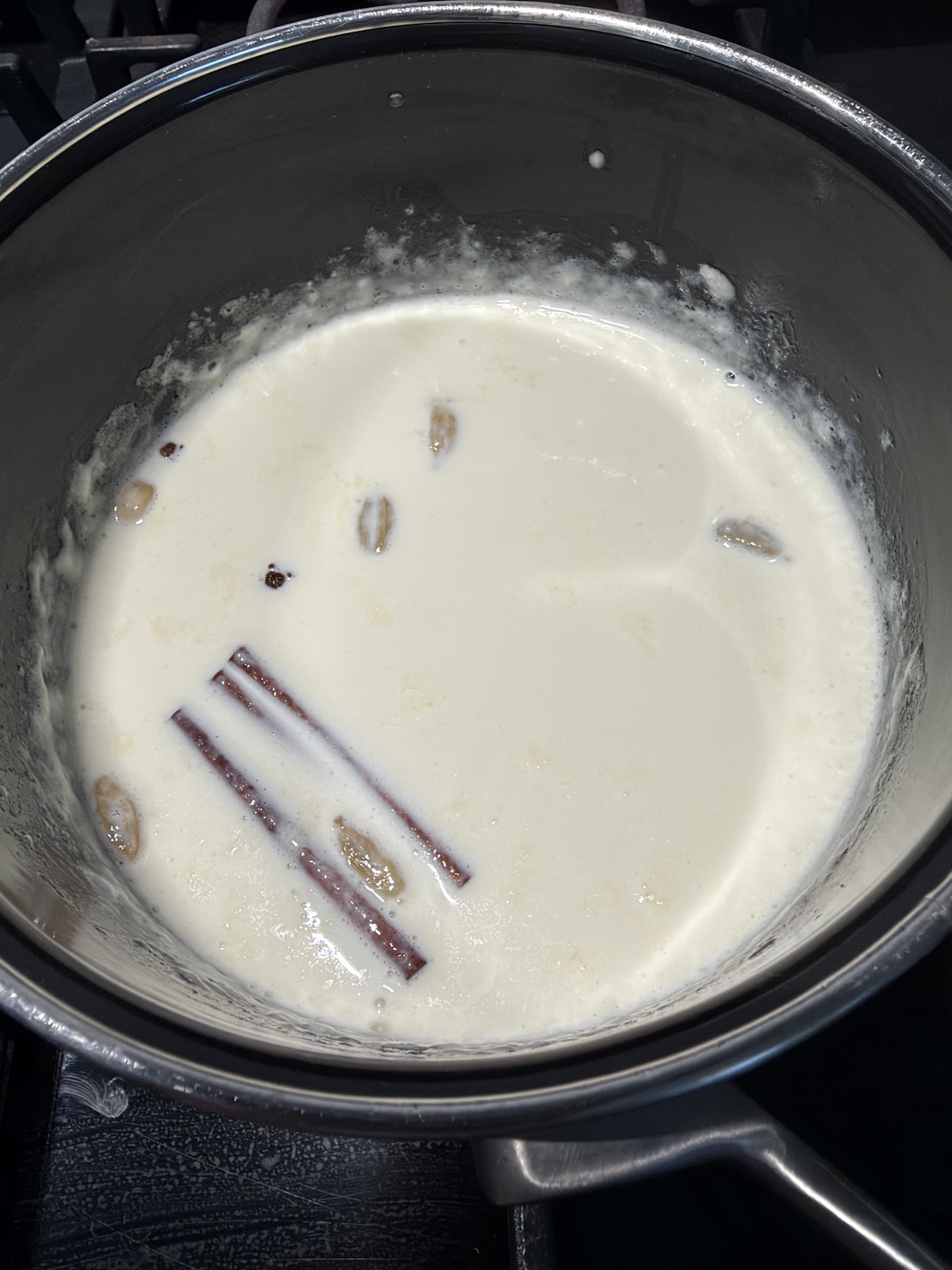
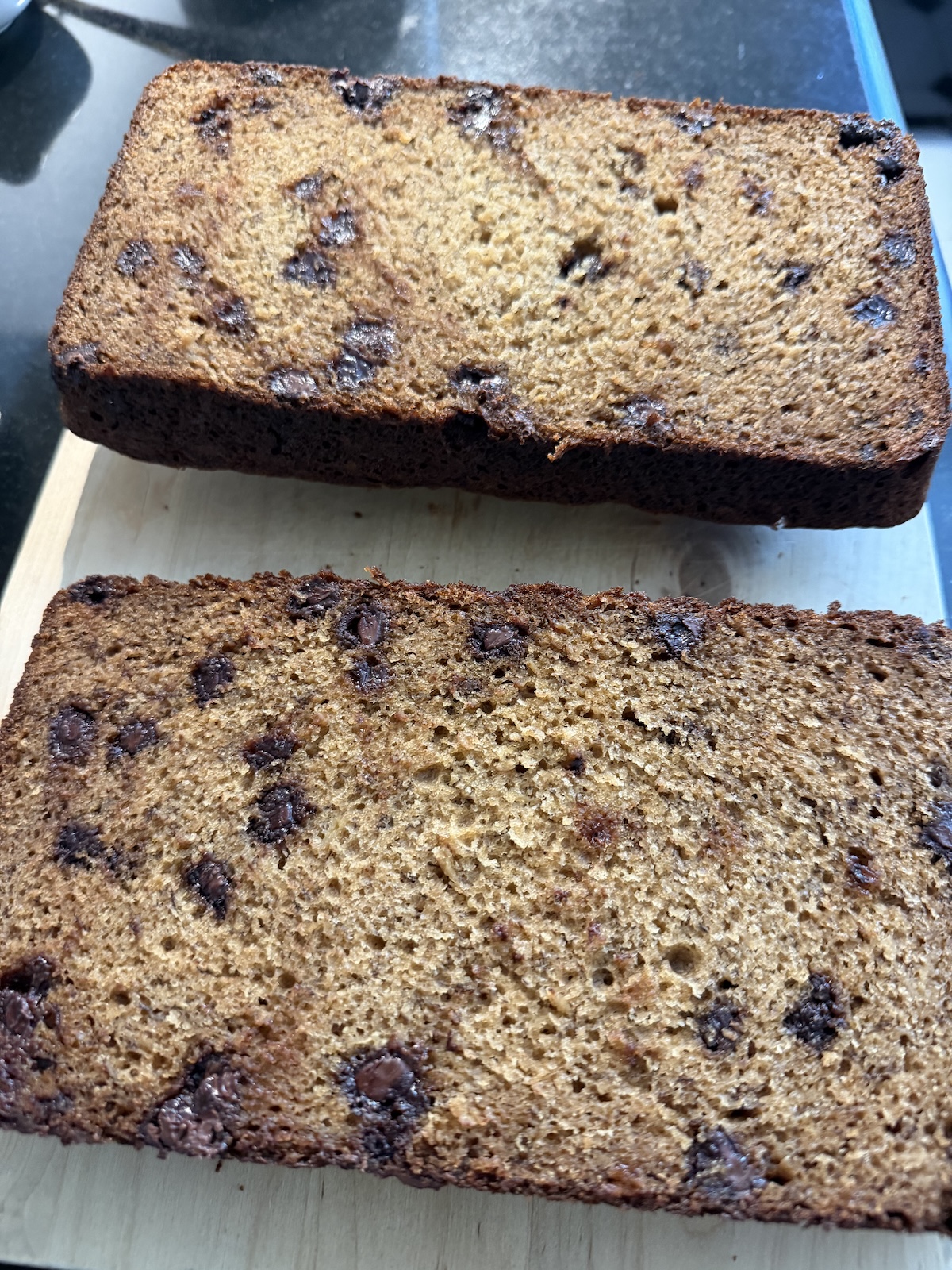
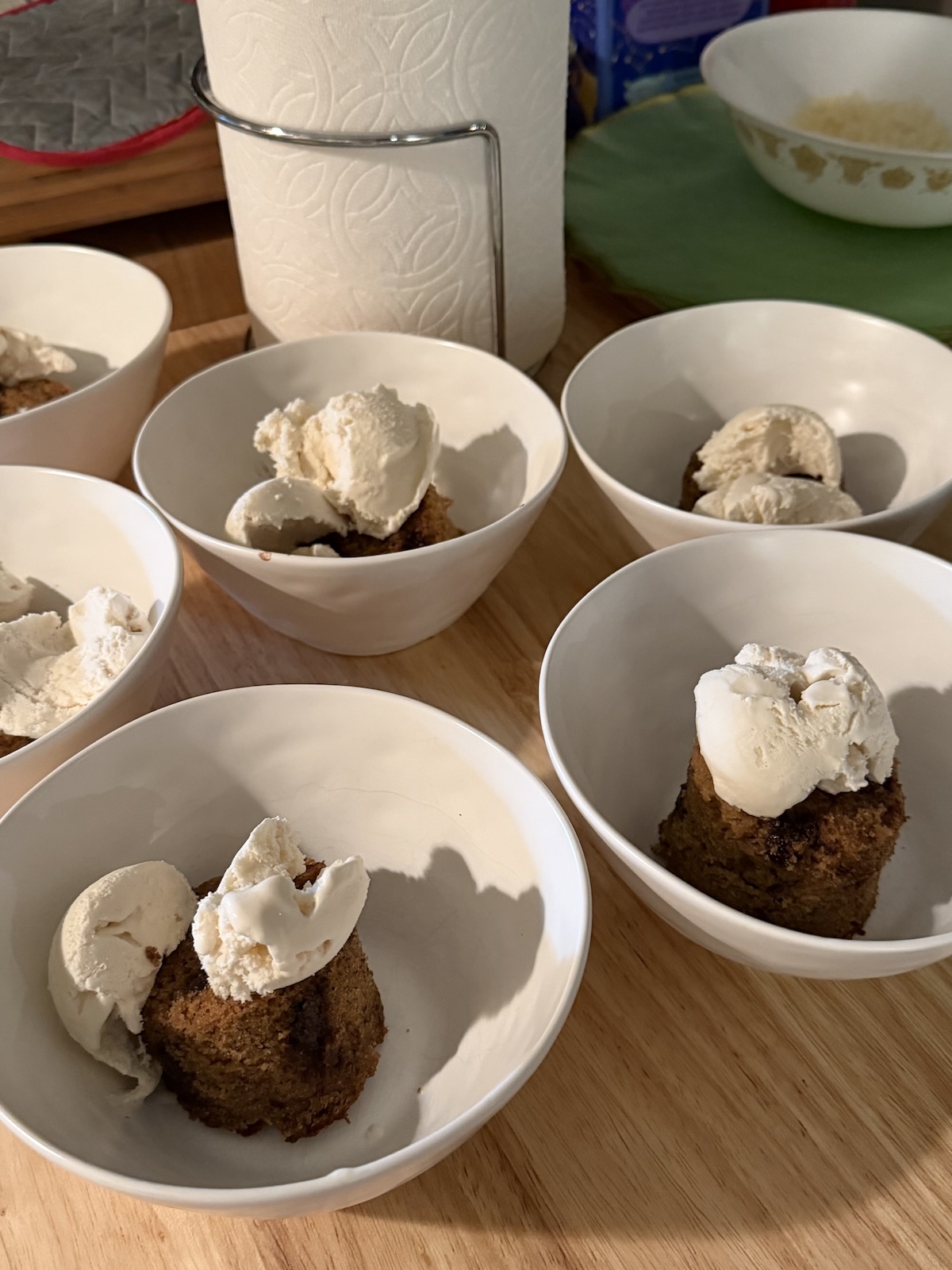
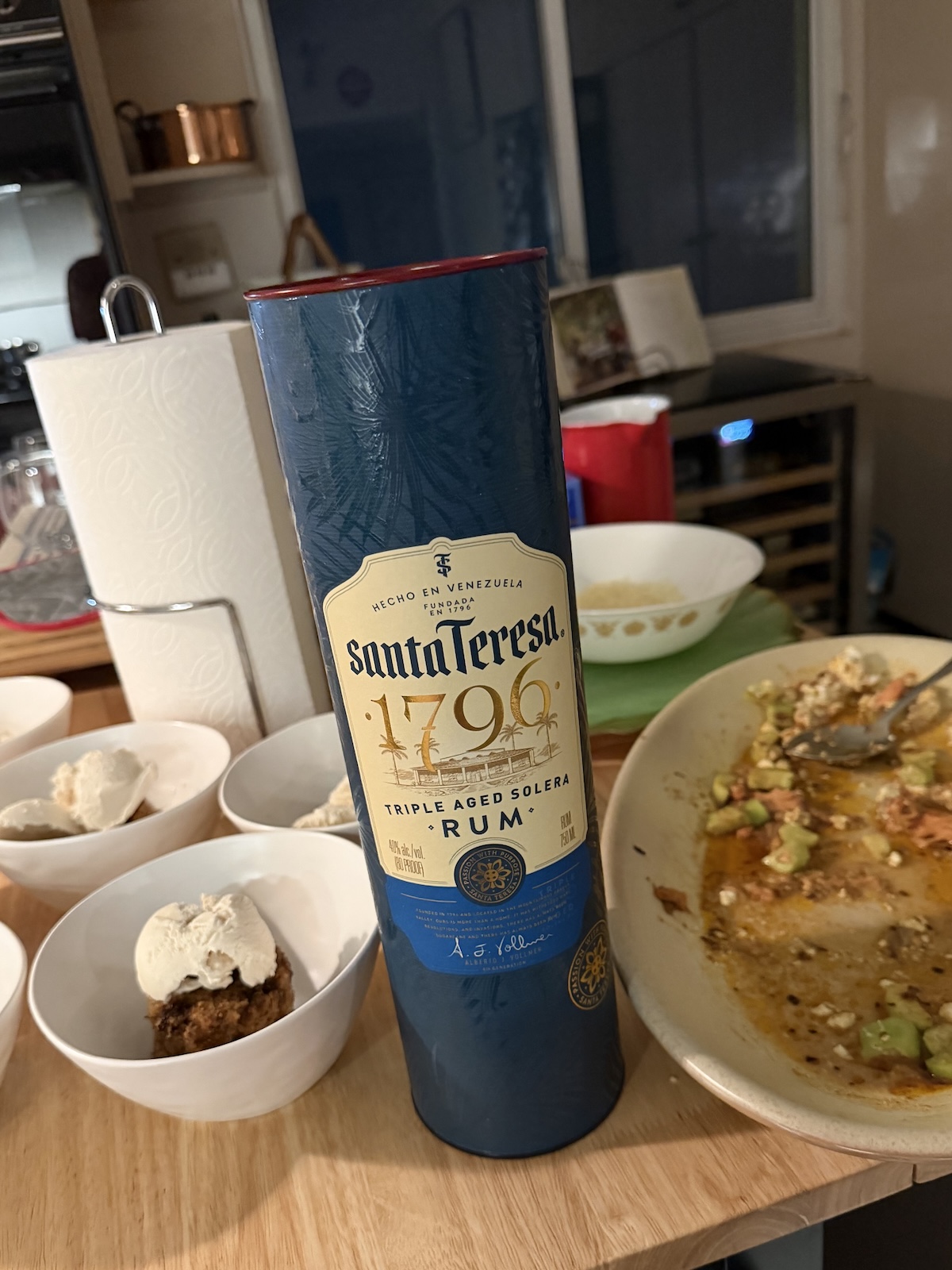
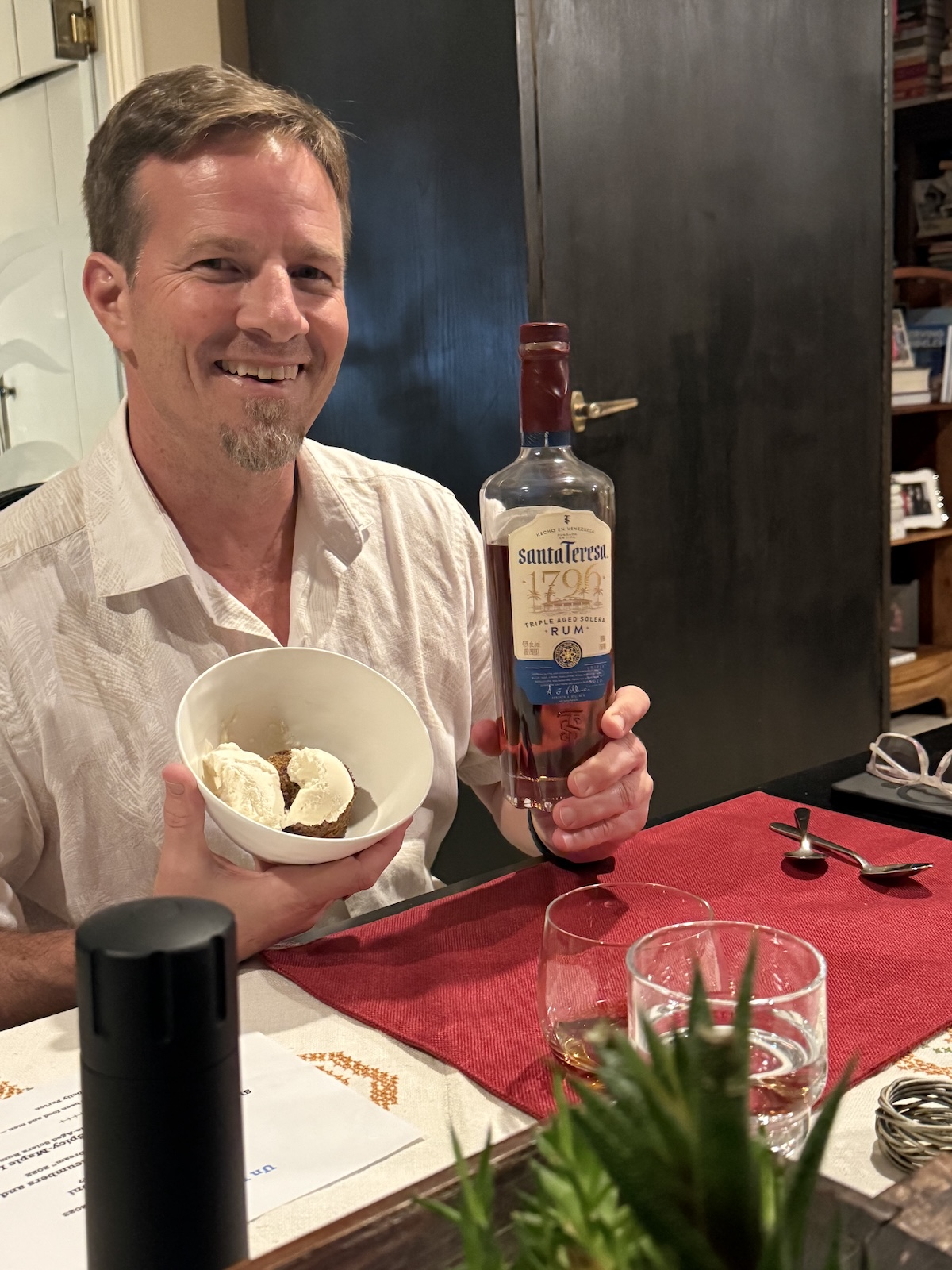
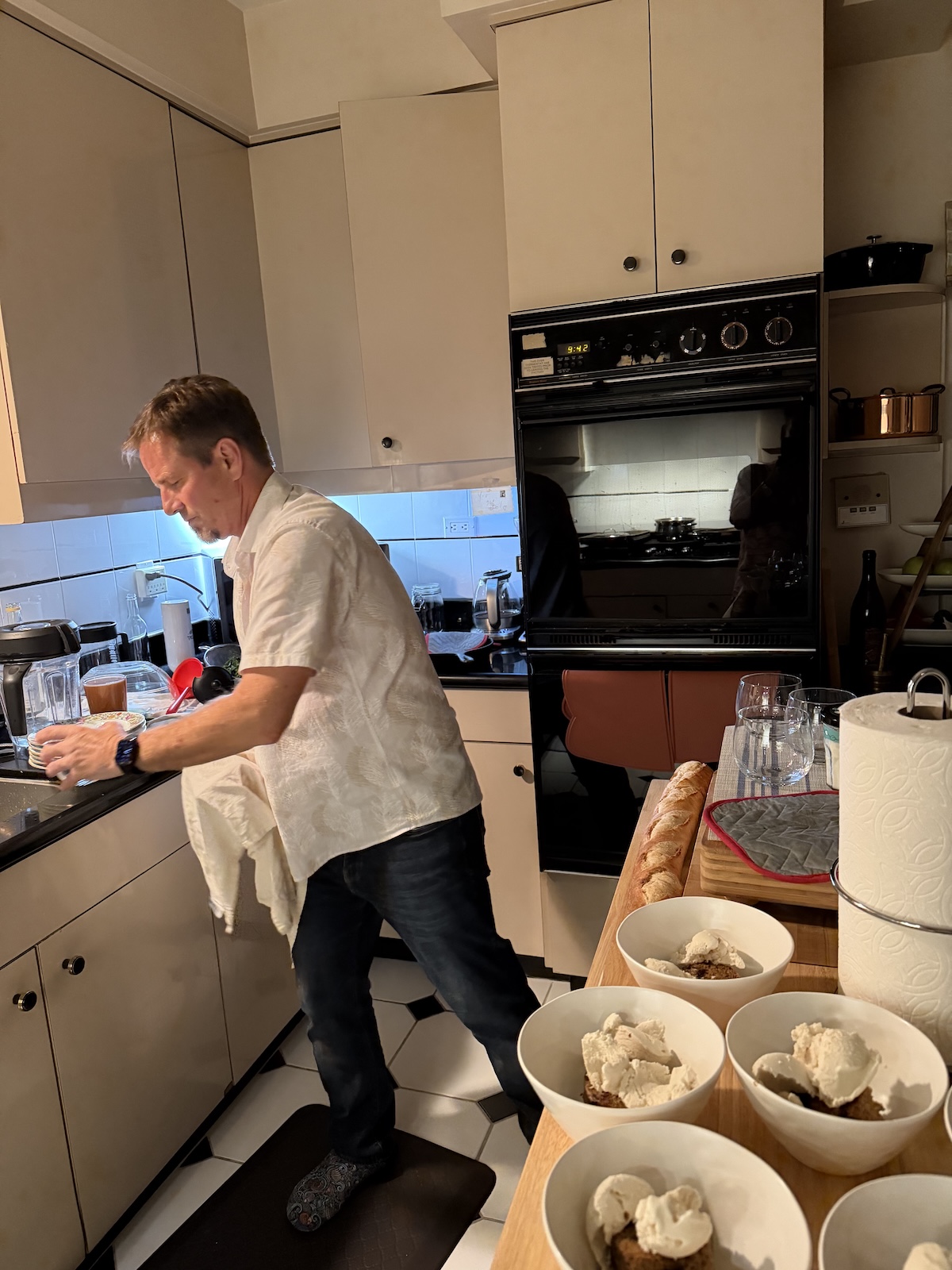
The ice cream I made without eggs, a Philadelphia-style spicy-maple concoction. I used heavy cream and simmered in it cardamom pods, cinnamon sticks, and some salt. About a cup of maple syrup I reduced, then added to the cream and milk mixture, and it all chilled overnight in the refrigerator. I made a chocolate-banana bread on Saturday morning and served the ice cream with it for dessert.
Spices and cream (Brockhaus Images)
A bread made with bananas, yogurt, and chocolate, plus browned butter. (Brockhaus Images)
The closing dish. (Brockhaus Images)
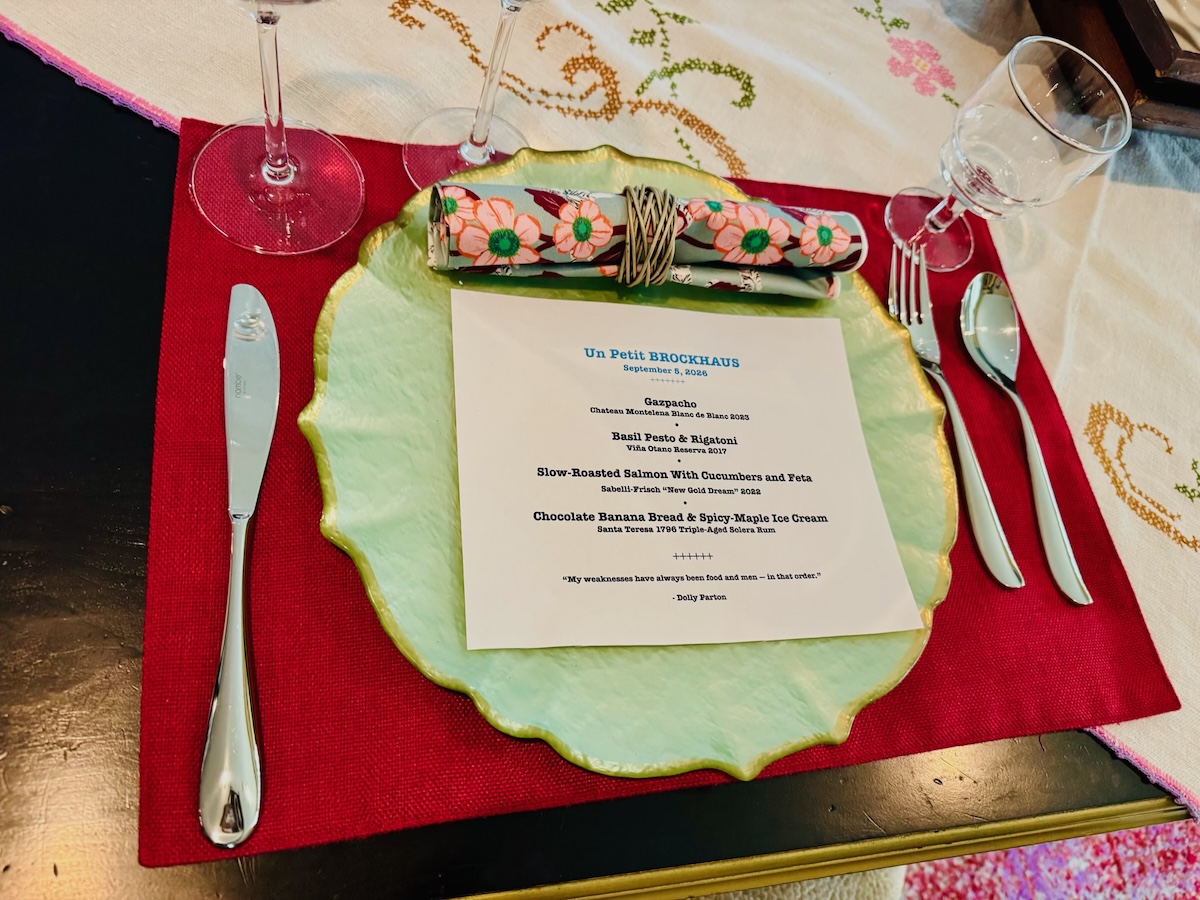
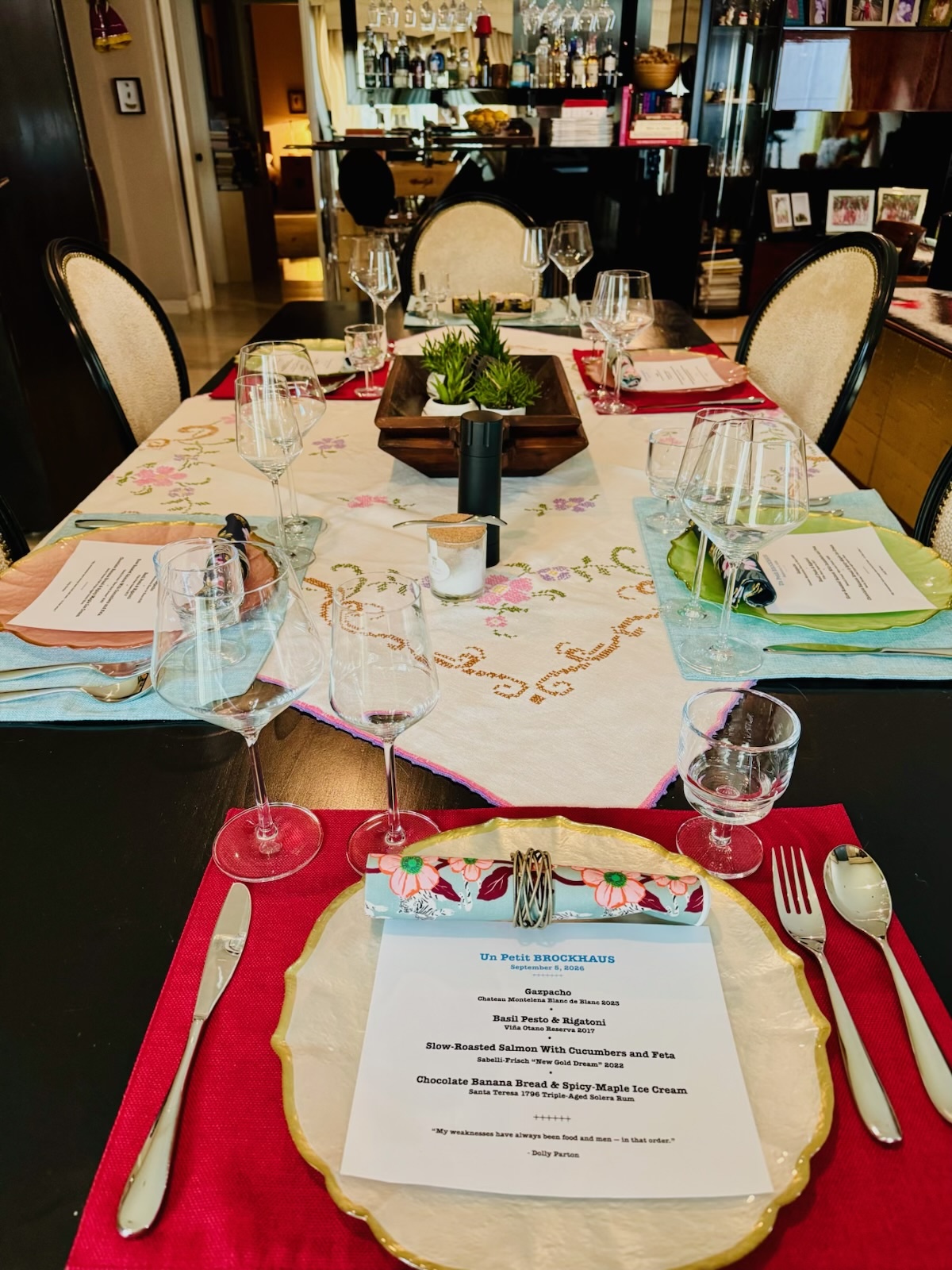
The table was set Saturday afternoon.
A seat for the evening. (Brockhaus Images)
The table is ready. (Brockhaus Images)
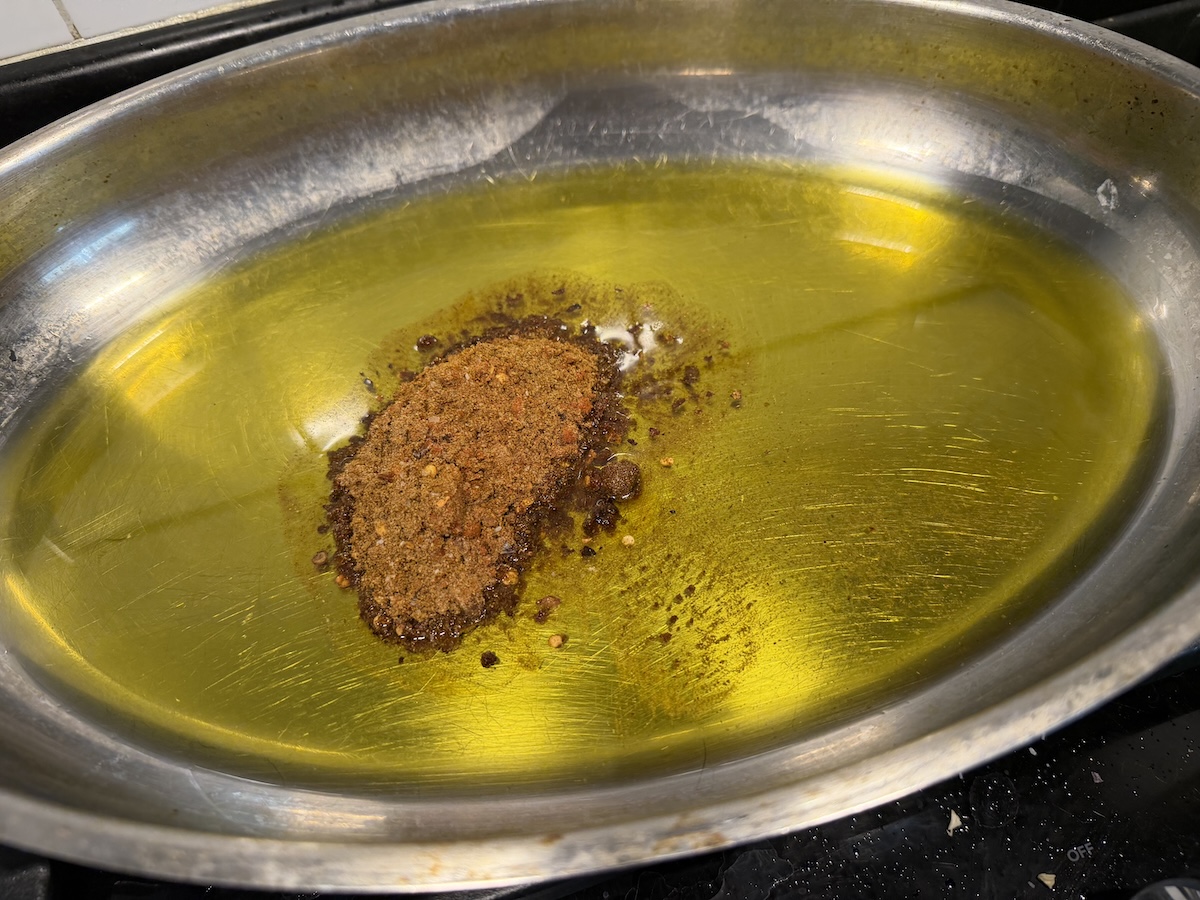
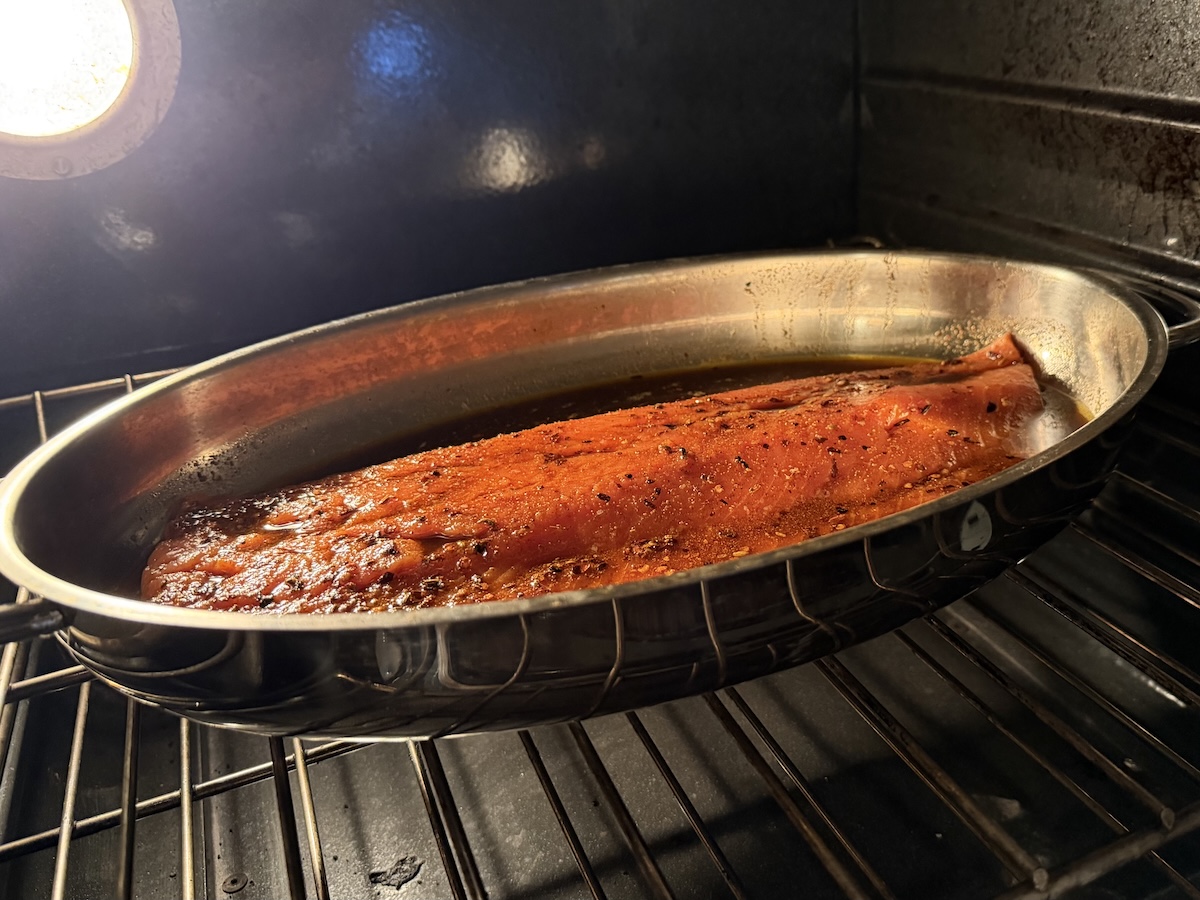
The rest of the menu came together on Saturday. For the main course, spices including red pepper flakes, smoked paprika, toasted and ground coriander, and fennel seeds were simmered in olive oil for 30 minutes; that mixture melded for four hours, then I slow-cooked a coho salmon at 300 Fahrenheit for 20 minutes in the oil.
Olive oil and spices mingled for four hours. (Brockhaus Images)
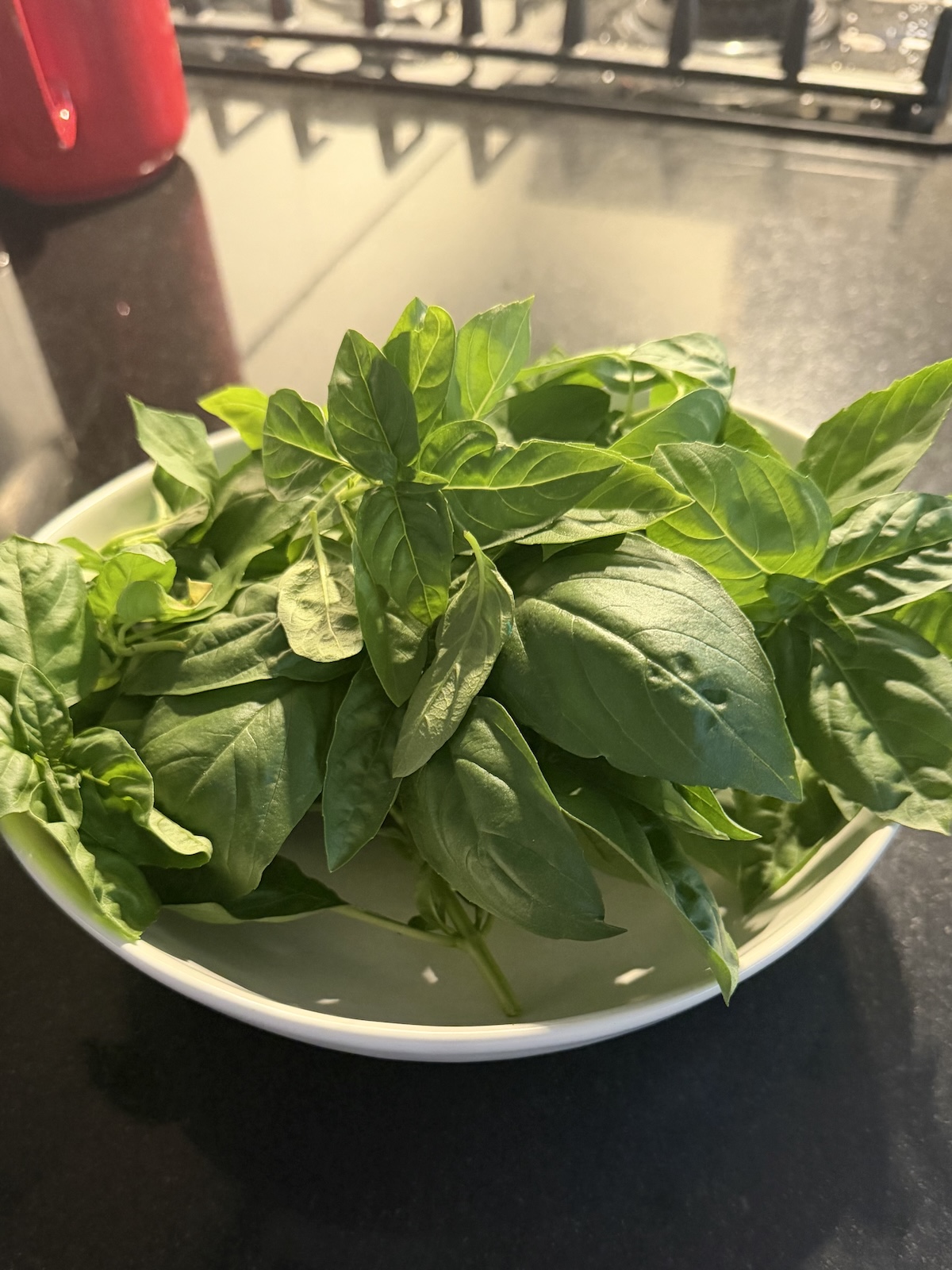
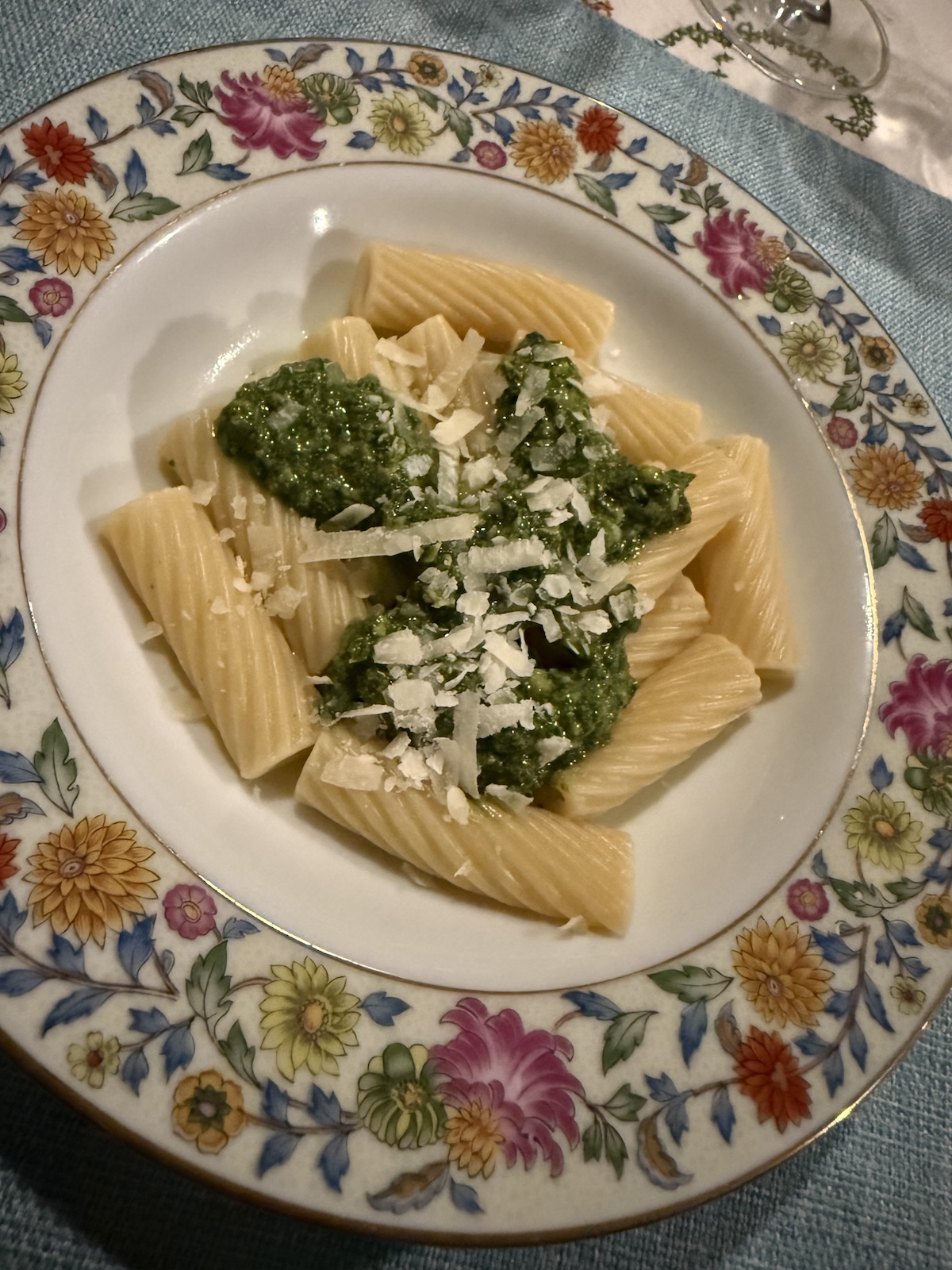
We opened with the gazpacho, then I served rigatoni with basil pesto; the leaves had been harvested that afternoon from our balcony garden.
This basil could be no fresher. (Brockhaus Images)
Pasta and basil pesto: I could eat this on a daily basis. (Bethany Burke)
Gazpacho opened the meal. (Bethany Burke)
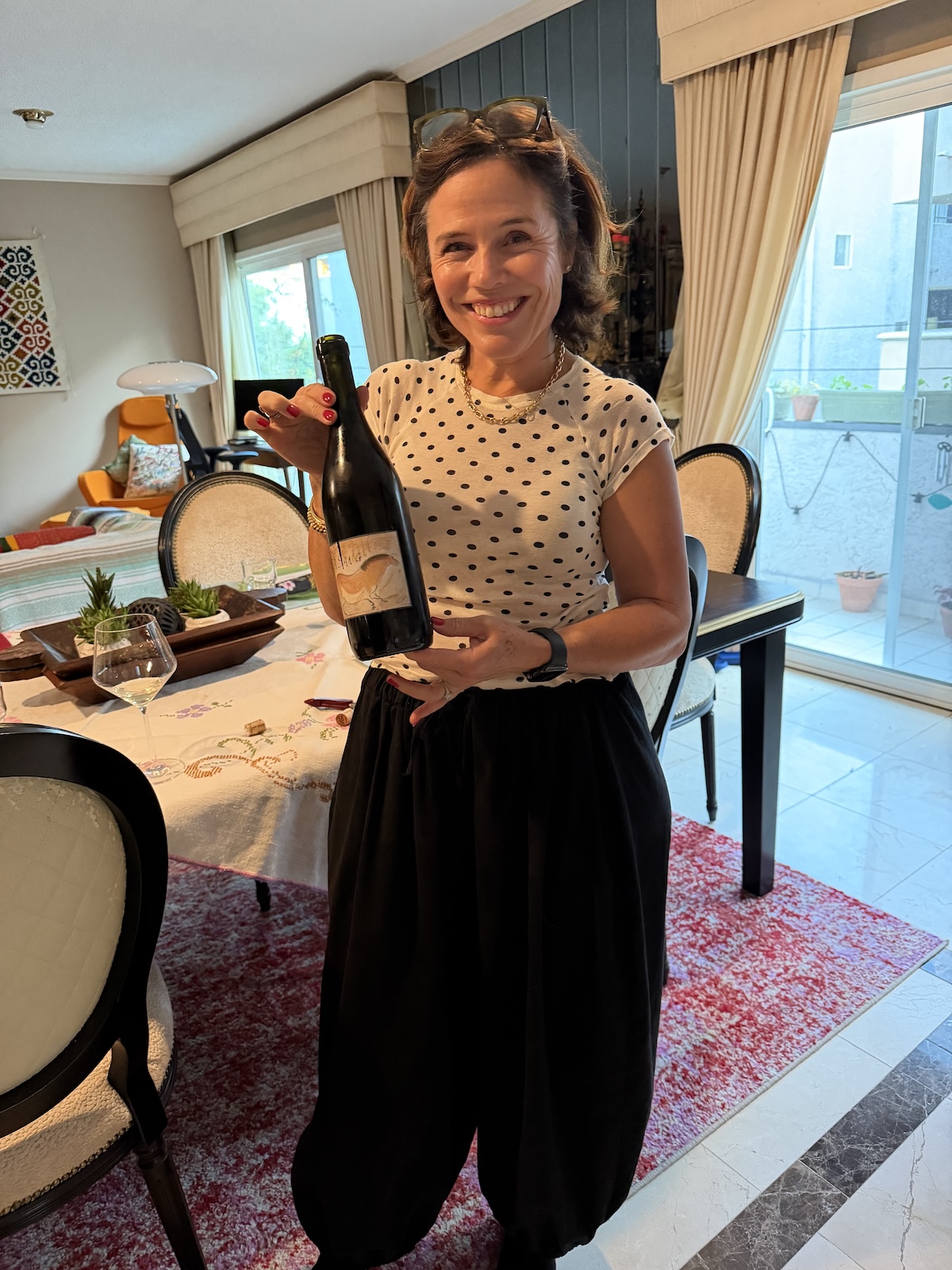
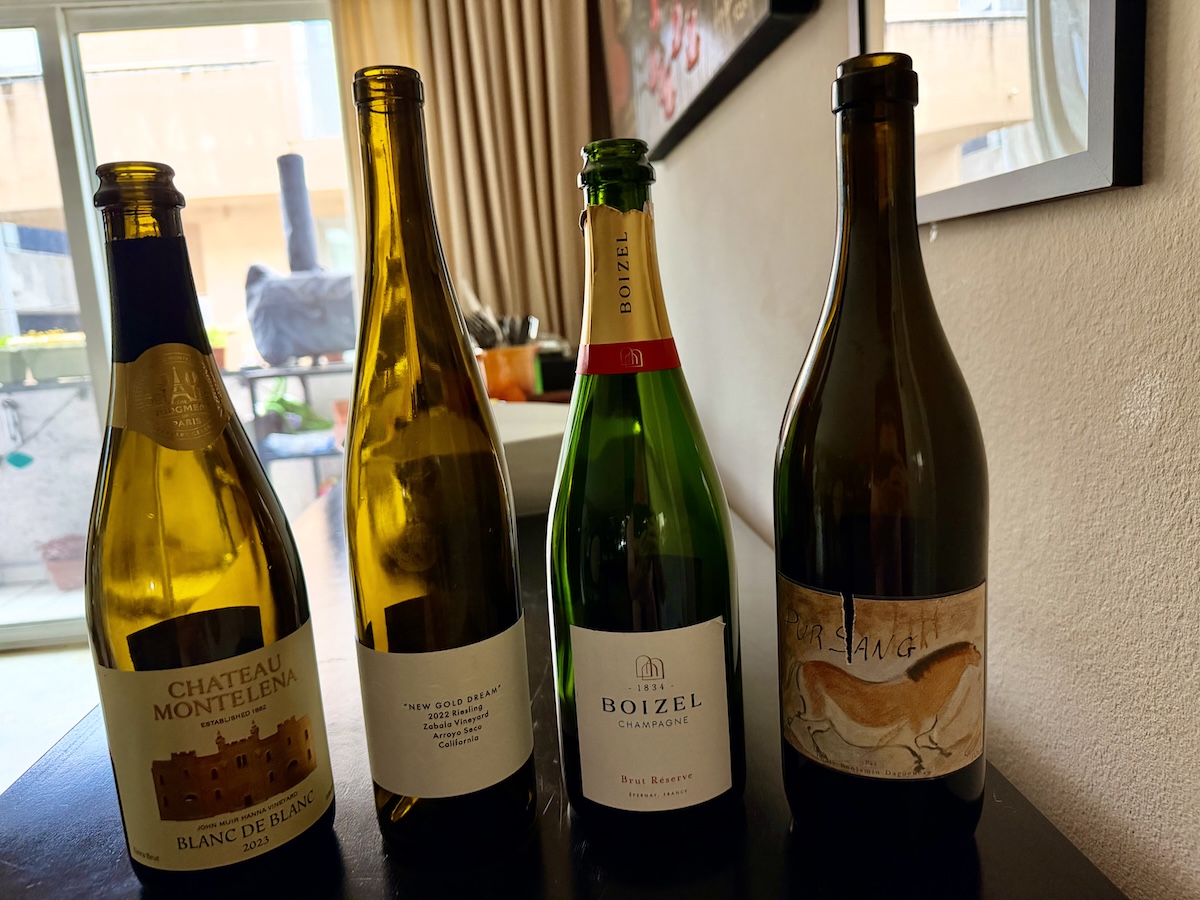
Katherine Jarvis brought a 2014 Pur Sang from Domaine Dagueneau. (Brockhaus Images)
I cooked the salmon at 300 Fahrenheit for about 20 minutes. (Brockhaus Images) Shannon Windham, a great cook, is never an unwanted guest. (Bethany Burke)
Shannon at work. (Brockhaus Images)
A few of the bottles we shared. (Brockhaus Images)
They gathered around a table … (Brockhaus Images)
There are few things in life I love and appreciate more than cooking and sharing my food with others, especially friends and family. It is love’s labor, a work and passion for which I live. I hope on this holiday that whatever you cook is delicious, and that you are able to share it with people you love.
Last Sunday I attended a party devoted to rosé, an annual gathering organized and hosted by several individuals in the wine industry. It takes place in the backyard of a home in Santa Monica graced by a beautiful coast redwood tree, and serves as a reunion for may of the attendees, as well as an occasion for many to meet people new to them. Not everyone at the party is in the wine business, but many are, and the wines assembled by attendees are myriad and diverse, though all are rosés.
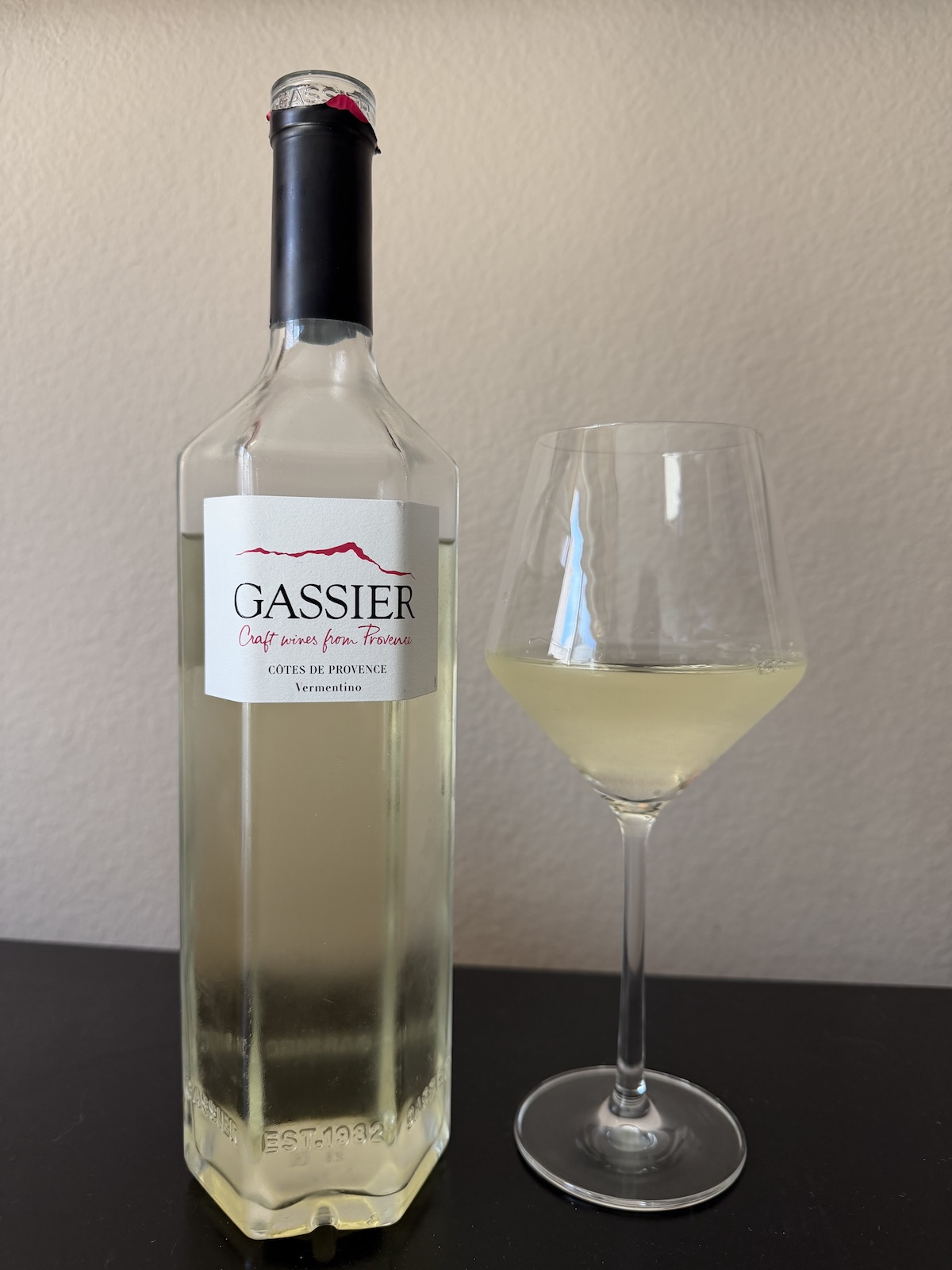
Coincidentally, I sampled a wine this week from a legendary land of rosés that I liked immensely. But it’s not a rosé. It’s the 2025 Château Gassier Côtes de Provence Blanc, 100 percent vermentino, made by Léa Rouyet, a Basque Country-born winemaker who’s been at Gassier since 2015.
A wine from a beautiful, sun-drenched region of France. (Brockhaus Images)
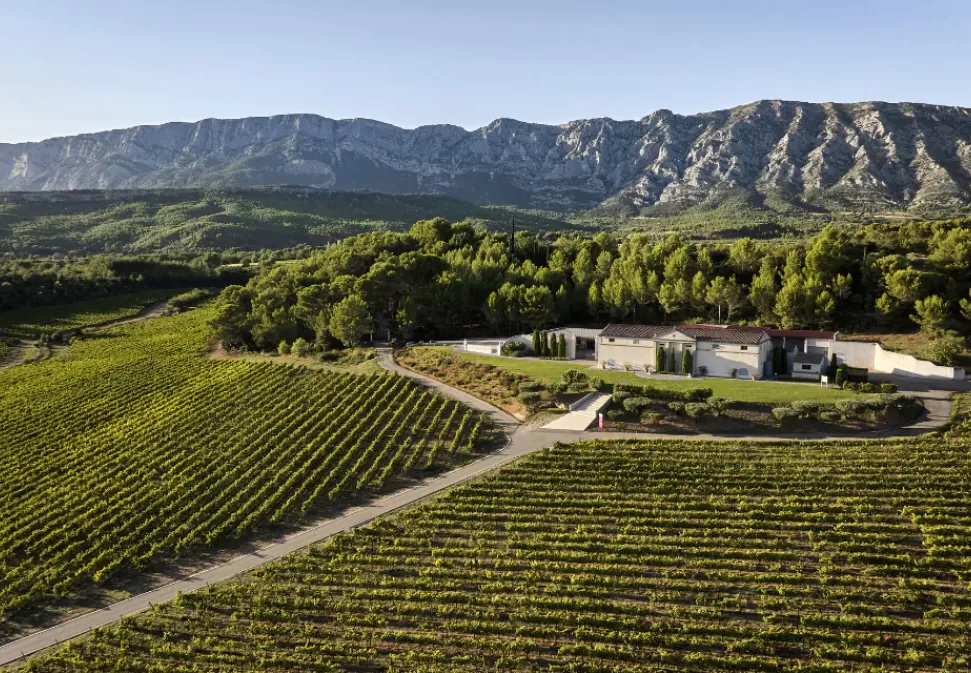
This wine hails from Sainte-Victoire, a storied area replete with vineyards that produce elegant rosés and stellar, if underappreciated by many, whites. Gassier harvests the wine’s fruit at night, which helps reduce oxidation. Direct and slow pressing, with minimal contact between skins and juice, gives a freshness and seductive color to the finished project. Poor soils of clay and limestone have created a wine with a rich body and energetic, stellar acidity.
The Gassier winery, in Puyloubier, France, sits at the foot of Mont Sainte-Victoire. (Château Gassier)
In the glass this wine is very light in color, and appears almost irridescent in certain light. Aromas of white stone fruit and lemon blossom dominate, followed by soft melon and minerality on the palate. This is a thoroughly refreshing wine, one that I paired with a honeydew melon and prosciutto. It would also pair well with oysters or a tuna ceviche.
Léa Rouyet is the winemaker at Château Gassier. (Château Gassier.)
This wine sells for around $20, and is a good one to have around for when that impromptu guest stops by. I have a bottle in my refrigerator now, and look forward to opening it soon. Find it here.
Seyval blanc. Heard of it? If not, you are not to feel badly. While it is a grape that has been around for a while, and has proven its place in the wine world, it is not widely planted in North America — estimates hover between 700 and 900 acres in the United States and Canada. For comparison, upwards of 75,000 acres of pinot noir, and more than 115,000 of cabernet sauvignon, are planted in the two countries.
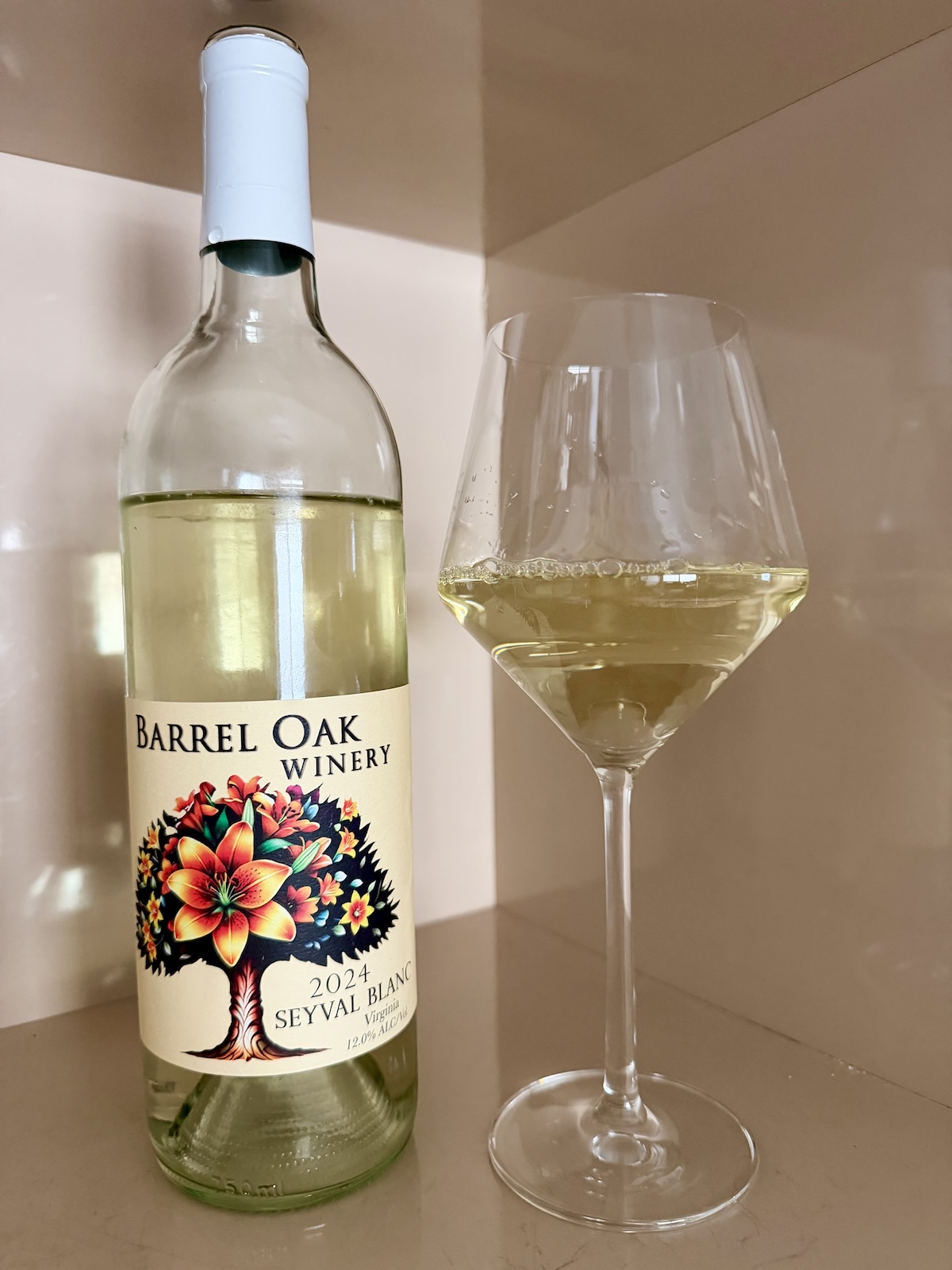
This is 100 percent seyval blanc from Virginia’s Barrel Oak Winery & Brewery. (Brockhaus Images)
Seyval blanc is a hybrid, and was developed by Bertille Seyve and his father-in-law, Victor Villard, in the 1920s in their nursery in France. For those who appreciate such information, it is a cross of 50 percent Vitis vinifera, 37 percent Vitis rupestris, and 13 percent Vitis licencumii. It is a high-acid grape, and it tends to ripen early, which makes it particulary suited to cooler climates.
And cooler regions is where it shines, including England, where makers of sparkling wine are using it to great effect; the Finger Lakes region; Canada; and the Lake Erie AVA.
Virginia is also a player here, a state in which recent statistics indicate that about 40 acres of seyval blanc are planted. It is produced by myriad wineries, including Barrel Oak Winery & Brewery, a 78-acre estate responsible for my wine of the day.
Barrel Oak Winery & Brewery encompasses 78 acres in Virginia’s Piedmont region. (Barrel Oak Winery)
The 2024 Barrel Oak Seyval Blanc is a cork-closure wine whose fruit is grown in the estate’s B-Block plot, which is situated between 500 and 700 feet above sea level in the Middleburg AVA. Soils are marked by clay with deposits of gneiss and granite, a composition that gives this wine an appealing minerality on the palate. Alcohol is 11.25 percent, 353 cases were produced, and it did not go through malolactic conversion. This is an all-stainless steel creation, crisp, bright, and lively.
Jeremy Ligon, Barrel Oak winemaker, joined the estate in 2021. (Barrel Oak Winery & Brewery)
In the glass, the wine is a pale, soft yellow, and body is light to light-plus. Harvest brix of 22.0 should leave us with ample acidity, and a first taste of the wine makes that evident. Orange flower is definitely in the aroma and on the palate, along with bright apple, perhaps Granny Smith. I served this bottle with sautéed crayfish and angel hair pasta, and the winemaker team, led by Jeremy Ligon, suggests seared trout with lemon and capers, which I’ll try next time I drink this wine. It carries a suggested retail price of $30 (purchase from the producer or search here.
I’m working on a profile of Barrel Oak that will include a discussion with Ligon, and I’ll soon be sampling the estate’s 2022 Chocolate Lab, a port-style product, and the 2023 Vidal Blanc. Keep your eye on Virginia, a state with more than 300 wineries within its borders.
This story was originally published in PaperCity on Sept. 1, 2026. Read the original version here.
The restaurant’s signage caught my eye nearly every time I drove past it, which had been at least 500 times. It’s named Nanbankan, and its entrance is nondescript and unadorned, and that is what attracted me. I love Japanese cuisine, and this restaurant, with its narrow storefront and plain sign, seemed almost a speakeasy. I wanted to know what unfolded inside the door. For whatever reason, I had never taken the time to stop by and see what it was all about. Until a few nights ago.
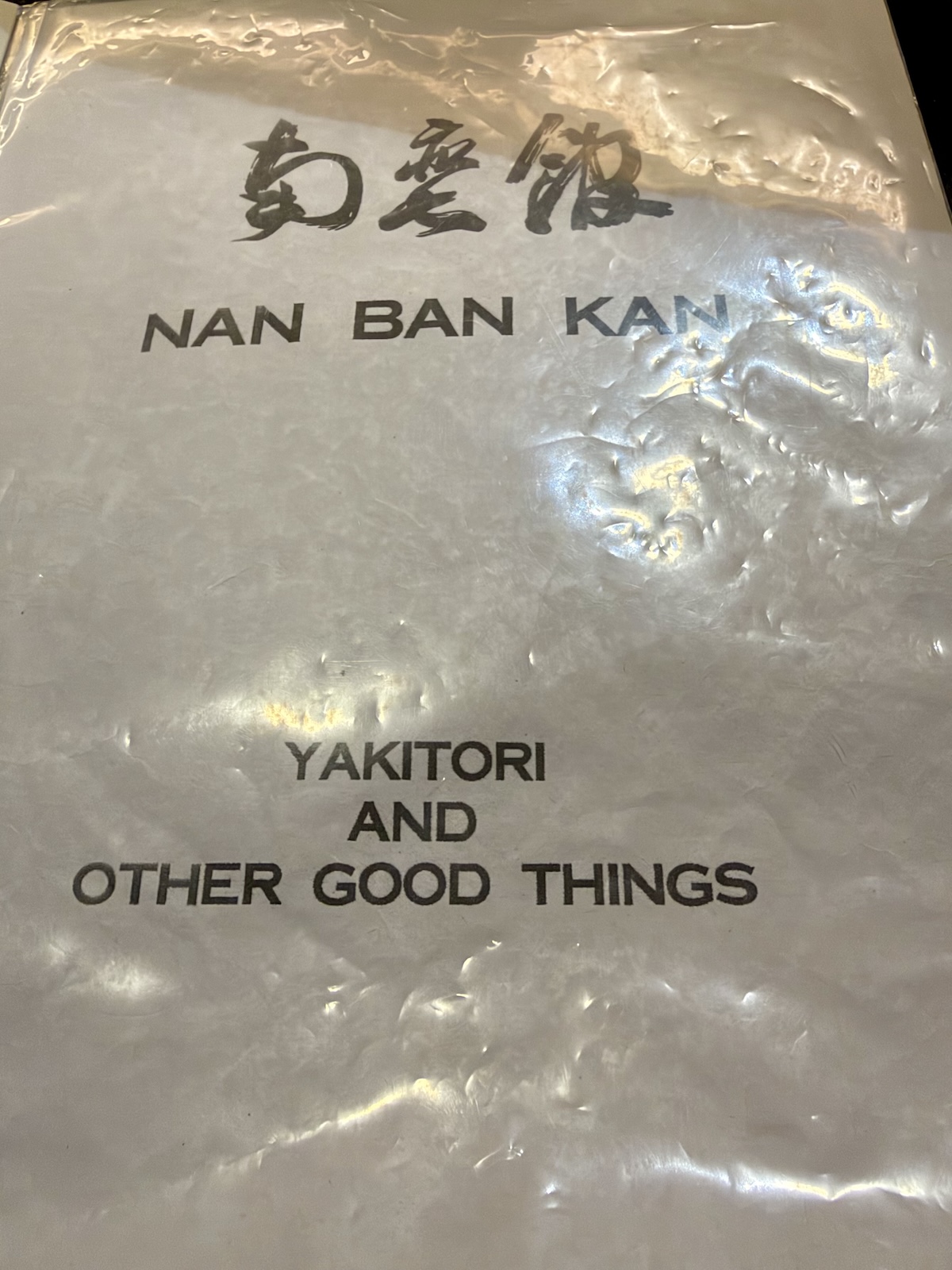
I had made plans earlier in the week to meet my friend Allison for dinner, and, as we both live equidistant from Nanbankan, I suggested we meet there. It serves Yakitori, and, as its menu stated, “other good things.” Turns out, false advertising it was not.
A promising cover. (Brockhaus Images)
“Yaki” means “grilled,” while “tori” is translated as “bird, or chicken.” Grilled chicken. Nanbankan serves that, and Allison and I shared a fine example of negima, rich thigh meat and green onions on a bamboo skewer grilled perfectly, moist and full of smoke and glazed with tare (soy and mirin). It was the opening dish among many that we shared.
Need one anything else with which to begin a meal? Chicken thigh and green onions.
What followed, in no particular order, were lamb chops, yellowtail collar, eggplant, slightly — to my taste —overcooked ebi (shrimp), onigiri, one of which was stuffed with salmon, the other “house style” with scallions and assorted other ingredients, New York strip steak, mushrooms, and chicken breast wrapped in shisho leaf.
Shrimp grilled simply and perhaps 8 seconds too long.
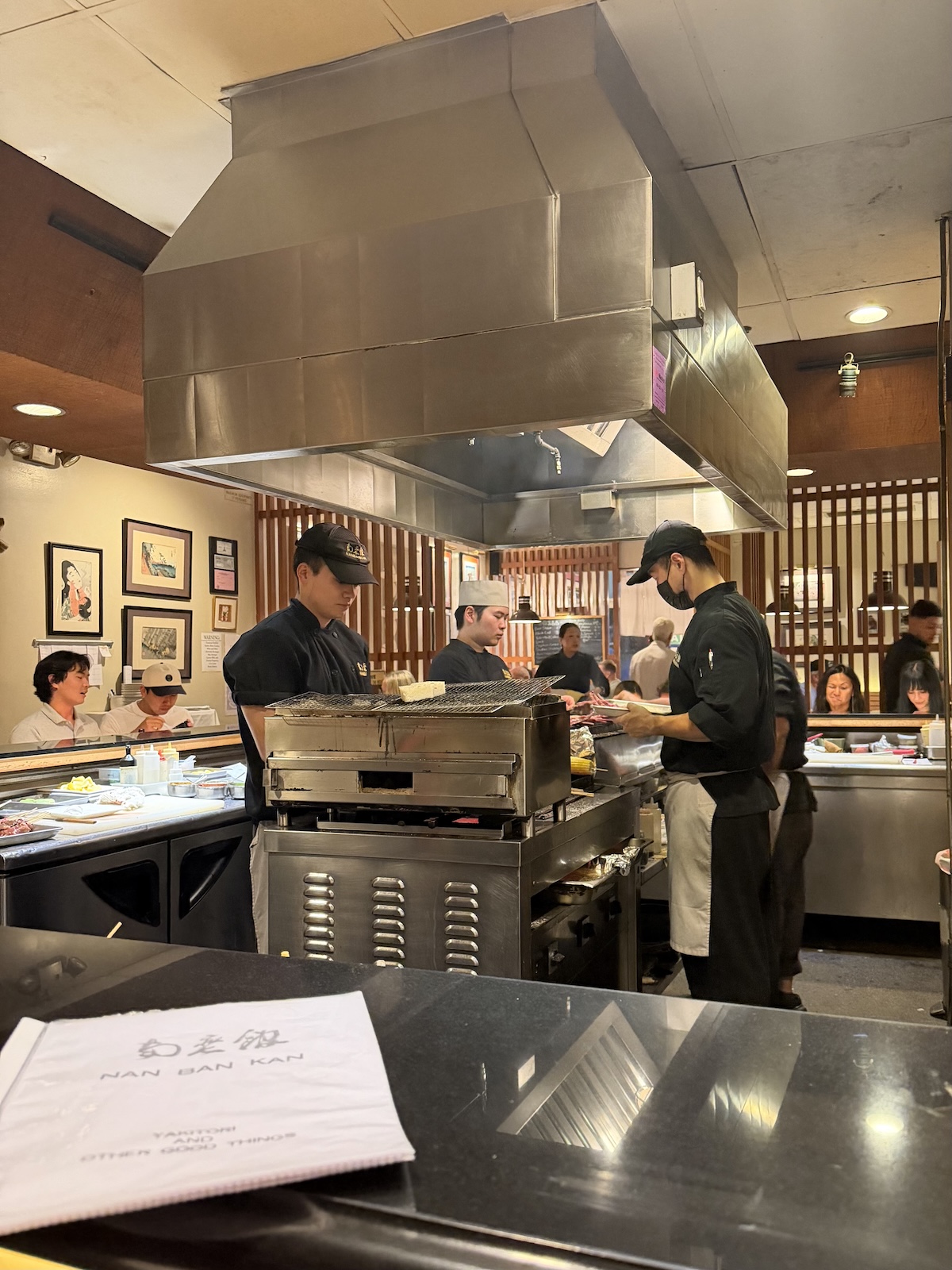
We were seated at the far end — the last two seats next to a wall — of the bar, which wraps around the grilling area. The best seats, I would say, as we had a view of the entire busy yet orderly room. Older couples were there, as were diners in their thirties and twenties. I could tell that some of them were regulars, because their familiarity with the staff was evident. The Band played through the speakers, a good sign.
Every dish, excepting, as noted, the shrimp, was much more than good: the rice cakes with crisp exterior and warm and moist interior, the mushrooms slightly chewy and earthy, the yellowtail collar cooked with aplomb — flesh flaky and briny. I especially liked the two chicken dishes, and the egplant was perhaps the best thing of all.
I love meaty and earthy mushrooms, and these were that exactly.
Tender, moist breast meat wrapped in shisho leaf.
The 2025 ‘Wild Series’ skin-contact white from Pali Wine Co.
Allison brought a bottle of ski-contact white from Pali Wine Co. — Nanbankan has a $20 corkage fee — and it paired well with most everything we ordered, though the steak skewer might have been better off with a red. The Pali wine is a blend of gewürztraminer and pinot noir, fruit of the former from Danny’s Vineyard in Monterey County. The pinot is Pali estate.
Nanbankan is a place to which I can walk, and that makes it even better. Plus, upon entering I was greeted by a gracious and attractive man with silver hair wearing a tailored seersucker suit. What could be better?
I shall return, soon, to Nanbankan, this time with Angela. And I will order pork.
I take wine and food very seriously, but not so seriously that their true meanings and place in life become obscured by human vanity. I began drinking and learning about wine while in high school, in the Rheinland-Pfalz. It was everywhere, a part of daily life, consumed by most everyone in one form or another, held in high esteem but not made into a personal badge of “sophistication” and “discernment.” It was and is a beverage made possible by the humble yet vital work of farming.
That said, I think about wine constantly, and have been learning about it — a never-ending journey — since that first sip of Basserman-Jordan. I love wine, I respect wine and the people and lands that birth it, and I am glad it is part of human existence.
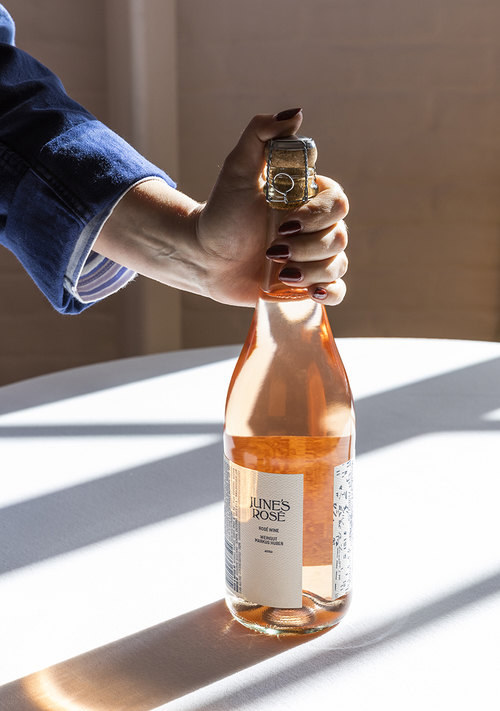
June Rodil also respects wine, and thinks about it daily while keeping it in proper and sane perspective. “You don’t need to know the producer’s elevation, soil composition or preferred method of canopy management before you’re allowed to enjoy the bottle. You don’t have to pretend to recognize an aroma. You’re also allowed to dislike an expensive wine and love an inexpensive one,” Rodil says. I respect that take, and agree.
Rodil, a master sommelier and lover of chicken fingers, is featured in the latest edition of Wine Talk, which you can read here.
June Rodil’s brut rosé is perfect for any occasion. (June’s Rosé Instagram)
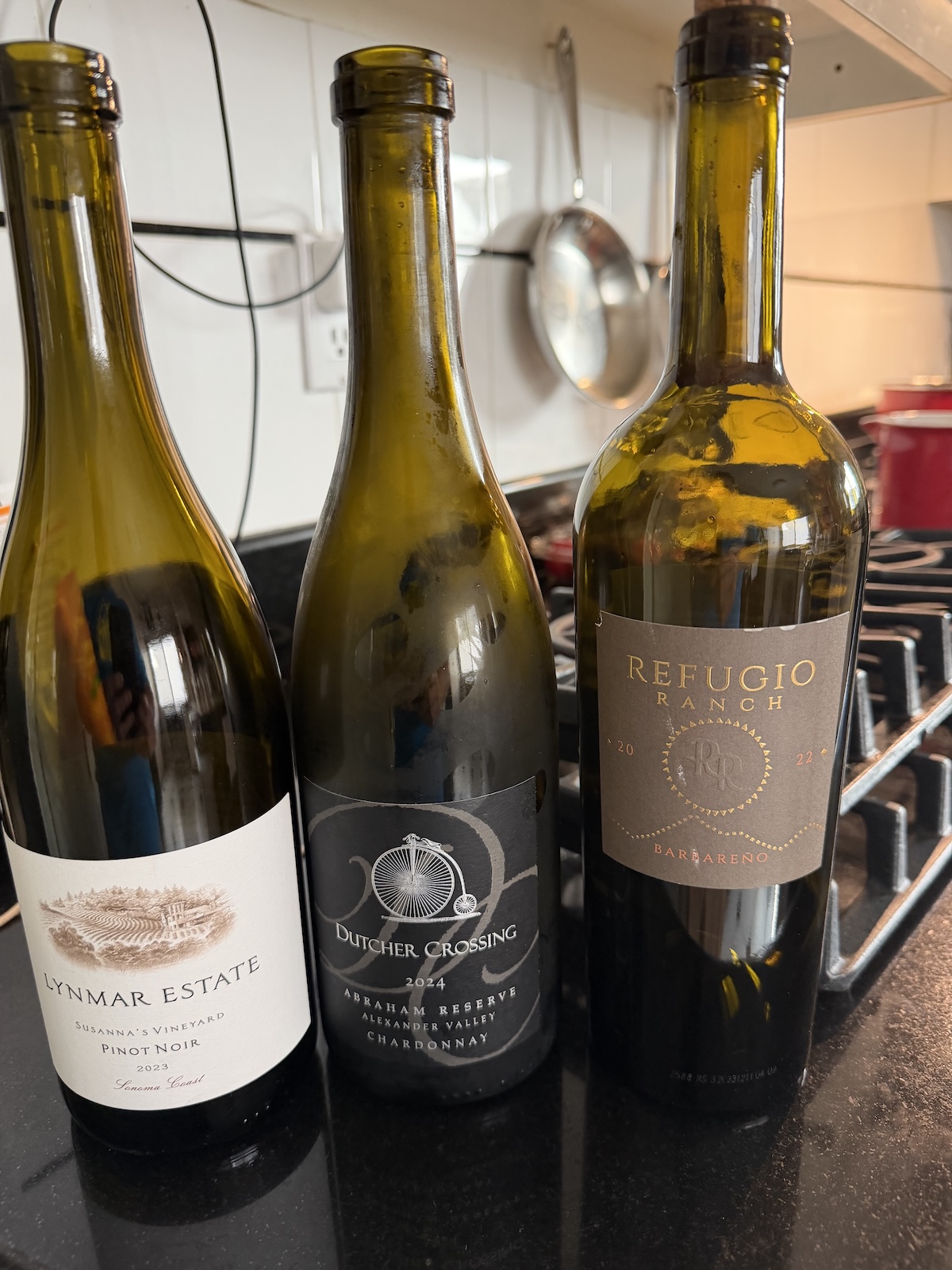
Debra Mathy is the owner of Dutcher Crossing Winery, a Dry Creek Valley estate that she purchased in 2007. A trip to France during high school, one that involved visits to a number of wineries, put an idea in her head: I want to one day make wine, and own a winery, she remembers telling her parents.
After a career in education, she made her dream come true. She purchased Dutcher Crossing and has been at the helm of the estate ever since. One of her wines is in this week’s Tasting Notes, which you can read here. You’ll also find bottles from Lynmar Estate and Refugio Ranch.


























Recent Comments