Wine, Food, and Other Vital Things

Category: cooking (Page 6 of 8)

The food is Hot and Hot in Birmingham

Whenever I am in Birmingham, Alabama, Highlands Bar and Grill is on my agenda. And my most recent visit to “The Magic City” was no exception. In fact, I dined at Highlands twice in May, and, as always, loved it.

Setting the stage (Photo courtesy of Hot and Hot Fish Club)

Setting the stage (Photo courtesy of Hot and Hot Fish Club)

But this time I added another restaurant to the schedule, a place I have had on my list for years but for whatever reason – and the main reason is Highlands Bar and Grill – never entered: Hot and Hot Fish Club. (Chris Hastings, the restaurant’s chef and co-owner, was named best chef in the South in 2012 by the James Beard Foundation, and I’ve long admired his support of Alabama agriculture.)

My decision to visit Hot and Hot was made at the last minute, and it was a Saturday, and I was arriving around 8:30, but I was dining solo and scored a seat at the end of the bar, near the kitchen door. Which was fine with me, because I like to see how people move in a restaurant, how the food flows. The bartender set my place and I looked at the cocktail list and the wine board, settling on a glass of Riesling.

The restaurant was buzzing, full, loud. People were waiting near the front door for a table, and the tables on the patio were full. After a first taste of my wine I walked through the main dining room, where one is treated to a view of an open kitchen. Men and women and a few teen-agers were talking and drinking and eating at their tables, and all of the places at the chef’s counter were occupied. A warm room, inviting.

Ravioli and cheese and chicken ... and corn

Ravioli and cheese and chicken … and corn

Back at the bar, I enjoyed my wine and the bartender handed me the menu. I quickly homed in on the ravioli as my first course. Good choice. The pasta was filled with farmer’s cheese and chicken, and the plate was completed with summer squash (including a blossom), English peas, and spring onions. And, in what would be a welcome and delicious leitmotif that evening, the ravioli was bathed in a sweet corn broth. (Corn is what I am talking about when I write “leitmotif”. Early corn, sweet, amazingly flavorful. It featured in every plate.) This first course was perfect. Vegetables cooked to point, or the point I like: right below crisp, giving a sublime mouthfeel. The ravioli was as thin as paper. The cheese, firm and mild, crossed the membrane in a delicate manner. Ideal opening.

Duck, two ways. And, more corn.

Duck, two ways. And, more corn.

Next: Pan-seared Duck Breast and Crispy Confit. (I love duck; in fact, one of my favorite breakfasts in memory is the morning I cooked two breasts for breakfast. Duck, with Champagne. It was a Sunday, and the day began well.)

The duck at Hot and Hot was as it should be: the breast pink, the confit crisp and dense. The plate contained, continuing the theme, corn, Anson Mills grits, Alabama strawberries, pecans and arugula. (I don’t know where Chris Hastings got that corn, because I failed to ask, but I hope many more people have the chance to eat it. It is the best corn I have had in about five years.) Plates such as this one sing, all of the flavors and textures communicating, harmonizing, and for a little while on that stool at the bar I was completely happy.

I often decline to order dessert. I consider wine to be my dessert. Or I have cheese. But this time I was intrigued by something on the menu: Sweet Corn and Lemon Bread Pudding with Benne Seed Brittle, Corn Cream, and Lemon Ice Cream. Put simply, it was the highlight of the evening. And that’s saying a lot.

A bread pudding for the ages.

A bread pudding for the ages.

Think moist and dense bread pudding. And, once again, think corn. Sweet corn. The corn cream I slathered on the bread pudding, and I made sure to slide a few of the kernels on each spoonful of bread pudding, because that corn was amazing. And the bread pudding … I once had a superb bread pudding in Portland that featured pigeon. I remember thinking during that meal that this was “the” bread pudding. But at Hot and Hot Fish Club I had another great one. Warm, not too sweet, slightly crisp exterior. Eating two portions would not have been out of the question. I could have done without the ice cream and the brittle; to my palate they were too sweet. But I think I am being too harsh. I imagine most people would not have a problem with the sweetness.

Jason's Corn 'n Oil

Jason’s Corn ‘n Oil

Speaking of the bar, the man working behind it and bringing me my food and drink that night is an exemplar of his profession. His name is William Hamrick, and he mixes and pours with grace and care. He answered my questions forthrightly, and when I ordered the bread pudding for dessert he made me the best libation I have had in a long while, saying they would pair perfectly. He called it Jason’s Corn n’ Oil, and it was made with John D. Taylor Velvet Falernum. You take 2 ounces of the Falernum, ¾ ounces of Gosling’s Black Seal Rum, and ¾ ounces of fresh lemon juice. Shake. Serve over crushed ice and garnish with a lemon peel. It was delicious. It seemed to me that the dessert and drink were created together one night in a divine session of inspiration. Mr. Hamrick wrote the recipe down for me. You can see it below. And you should make this drink tonight.

One for the books

One for the books, courtesy of William Hamrick

After a bit of conversation with a couple from Atlanta sitting next to me, and a few more words with Mr. Hamrick, I left Hot and Hot Fish Club and headed up the road. I shall return, though, and if a table isn’t available I’ll be more than happy at that bar.

Perfect pig, perfect weekend

A brining pig

A brining pig

What do you cook at a lake in North Carolina on a summer day in May during a reunion with friends from high school, one of whom you haven’t seen in 13 years? A weekend during which Angela will meet some of your closest friends, people with whom you went to high school in Germany?

My first thought was a suckling pig, a pig that I hoped could be sourced from a North Carolina farmer. Beth, our hostess for the weekend, got to work and contacted Joseph Cataldo, a restaurateur in Salisbury, who found us the perfect pig. (He also loaned me a pan big enough to brine in.) Beth and her husband, Glenn, and their four children live in Salisbury, and they made us feel at home as well.

Glenn and Beth, consummate and caring hosts

Glenn and Beth, consummate hosts

Brined and rinsed

Brined and rinsed

A friendship more than 30 years in the making

A friendship more than 30 years in the making: Mark, Tina, Beth and James

Tina and Angela conspire

Tina and Angela conspire

Respect your product

Respect your product

We had some fine food during that weekend, including a Low Country Boil on Friday made by Beth and Glenn and a great dinner out on Saturday cooked by a Brazilian chef.

Low Country Love

Low Country Love

We saved the suckling pig for Sunday, our final day at the lake.

A fine pig

A fine pig

Skin-deep goodness

Skin-deep goodness

Prepping the skin

Prepping the skin

Mark and I rub

Mark and I rub

What's inside: garlic, fennel, basil leaves, orange zest

What’s inside: garlic, fennel, basil leaves, orange zest

Adding some salt

Adding some salt

Ingredients from the inside out

Ingredients from the inside out

We brined the pig on Saturday night, with lots of elephant garlic and some bay leaves and black peppercorns. On Sunday we transported the pig to the lake house and prepped. Angela took care of the garlic and the rub: orange zest, fennel fronds, salt, pepper and olive oil. I scored the pig’s skin, and Mark and I stuffed it with lots of garlic and the rub, plus some fresh basil leaves, and then massaged the skin with the remaining rub. A little more salt and pepper all over the skin, and the pig was ready for the oven.

I cooked it at 250 Fahrenheit for about 3.5 hours, and then for the last 30 minutes raised the temperature to 475 Fahrenheit, which gave us a perfect skin, crunchy and crisp; it melted in the mouth. We tented the pig with foil and let it rest for 15 minutes, and then began carving. The meat, dark and white, was moist, and the fennel and orange mingled in every tendril.

Out of the oven

Out of the oven

Perfect skin, perfect meat

Perfect skin, perfect meat

Mark gets some skin

Mark gets some skin

Crisp and hot

Crisp and hot

Glenn takes the knife

Glenn takes the knife

Glenn carves

Glenn carves

Glenn carves

Manual labor

Carving and talking

Carving and talking

The skin is key

The skin is key

Glenn carved, with expertise and aplomb, using his fingers like an extra knife, and we feasted, down to the tongue and ears. We ended the day on the dock, watching the sun set over the water. Perfect weekend, perfect pig.

On the lake, after the feast

On the lake, after the feast

(Angela Shah photography)

Little Serow

Travel for food. Eating one’s way through the world. It’s a fine way to live. We were in Washington, D.C., last week for a few days and heard some great things about Little Serow, a Thai place on L Street. The chef, Johnny Monis, had just been named best chef for the mid-Atlantic region by the James Beard Foundation, and when we arrived at the restaurant around 4:15 in the afternoon there were about 10 people waiting on line (Little Serow does not take reservations). We had cabbed it over from downtown and the driver gave us an umbrella, because the skies had suddenly darkened and the wind-driven rain would have drenched us without one. Angela had a meeting scheduled at 6:00 with some important people, so she jumped in another cab and left me in line as the sun drove away the clouds and rain. I secured two spots at the late seating, which turned out to be early, 8:15.

Food at Little Serow: In a word, excellent. Atmosphere and design: low-ceilinged basement, blue-painted brick walls, long communal bar, a few tables against one wall, kitchen in the rear, partially in view.

Service, blue

Service, blue

To begin

To begin

crispy rice, sour pork

crispy rice, sour pork

Menu is fixed,  five or six courses, changes often. A value at $45. Below is what we had:

nam prik num
finger chilies / shallot / bla rah

tom kha gapi
shrimp / ramps / galangal

soop naw mai
bamboo shoots / snakehead fish / rice powder

gai laap chiang mai
chicken liver / sawtooth / long pepper

naem khao tod
crispy rice / sour pork / peanuts

gai lan bla kem
greens / salted fish / egg

si krong muu
pork ribs / mekhong whiskey / dill

Will you be in D.C. anytime soon? If so, take yourself to L Street and stand in line. And make sure to ask for some Imbue bittersweet vermouth. And have the ribs. And linger and look at each plate and talk to the staff. They are good. The ribs will move you. And Angela loved the chicken liver.

A little bit of my New York in Hong Kong

I’ve been away from New York for a while, and I miss it, a lot, but our planet is a big one, and there’s a lot to see out here, and I’ve been lucky enough to see a lot of it lately. Still, every time I return to the city for a visit one of the places I always make sure to get to is Babbo, that magical restaurant on Waverly Place that has never failed to make me happy, never.

Whether I dine at a table upstairs – the quieter room – or downstairs, which is louder and busier, or at the bar, my favorite place at Babbo, from the moment I enter the former coach house’s door I become part of what I consider one of the best restaurants in New York, if not the world. (I’ve eaten in a lot of great dining rooms in many parts of the world, and my experiences at Babbo have always been right up at the top of the list.)

But this is not about Babbo, not really. And it’s not about New York. (On the other hand, it’s about both of those places, in a roundabout way.) It’s about Hong Kong, and Lupa, another restaurant created by the Bastianich and Batali empire. (There is, of course, a New York Lupa, another fine place to eat owned by Bastianich and Batali, which gives its name to the Hong Kong outpost.)

But it’s mainly about getting my Babbo fix. (And this is for another time, but I could also use some time at Casa Mono and Otto and, to a lesser degree, Esca and Del Posto. I shall return.)

Lupa opened in Hong Kong last year, and I was hoping that the kinks had been ironed out of service and the kitchen, because I know how difficult it is to take a concept and style and duplicate it in a country that shares nothing in common with the original location’s environment, and by environment I mean ingredients, customs, diner expectations and other, often ineffable, things.

I called for a table at the last minute, and had no trouble getting one. I was dining alone, something I love to do. (I can better take in a place that way; I don’t have to engage in conversation, and I don’t have to worry about my dining companion(s) liking – or not liking – the food.) Keep in mind that I was not under the illusion that Lupa Hong Kong would be an exact replica of the Lupa in Manhattan, or that the vibe and feel of Babbo would have been magically transported thousands of miles from Waverly Place to the Central neighborhood of Hong Kong. I was there for the food, food that I hoped would, for a few hours, allow me to taste Babbo again.

Judging by the food, I was not disappointed. In fact, I was very pleased, with the entire evening. The service was excellent, if a little too punctual. (It always annoys me when staff in a restaurant want to rush away one’s plate or bowl the second it seems to be almost empty; I like to have time to sop up the remaining sauce, or merely savor the dish fully. Swooping down on a table and whisking away the porcelain disrupts, to my mind, what should be a calming and rejuvenating experience for all of the senses.) The waiters seemed to know the wine list, though they acted a bit confused when I ordered a Negroni instead of immediately placing my food order.

A menu that takes me back to Babbo

A menu that takes me back to Babbo

As I sipped my apéritif, I looked at the menu, and my eye went immediately to the Pasta Tasting Menu, because I reckoned that would be a good representation of the kitchen’s work. I have enjoyed Babbo’s pasta tasting menu on many occasions, so that’s what I ordered.

A treat from the chef came first, two orecchietta filled with marrow. They were an excellent start to the meal: warm, perfectly al dente, and filled with rich, smooth marrow.

Marvelous marrow

Marvelous marrow

Next came a cold pasta, Tonarelli Freddi. A small piece of sea urchin graced the top of a mound of square spaghetti, loosely mixed into which was an abundant amount of tender – read “not overcooked” – crabmeat. Bringing all of the ingredients together was a jalapeño pesto, and its effect in the cold dish was stupendous – it was a bit spicy, a bit hot on the front of the tongue, but then heat evolved into warmth and deepness. Splendid. It made the crab better than it should have been.

Urchin, black spaghetti, and jalapeño pesto: what more could one desire?

Urchin, black spaghetti, and jalapeño pesto: what more could one desire?

I had ordered a quartino of one of Bastianich’s whites with the early part of the menu, and it was a good one: dry, but lively.

Postage stamps that one wants to lick over and over again

Postage stamps that one wants to lick over and over again

Next came Francobolli, or, as described on the menu, Caciocavallo-filled “Postage Stamps” with White Asparagus and Fava Beans. First, I love fresh favas, everything about them. I love preparing them, shelling them, removing the thin membrane … everything. Their bright green color (if they are blanched properly) are a treat for the eye, and their taste … their taste is often ethereal, a rich accompaniment to meats and pastas and nearly everything. The asparagus was crisp, the pasta was thin and allowed the sheep’s cheese to creep out in my mouth, and the sauce, which seemed to be butter and olive oil and cheese, added the right amount of richness to a successful dish. Mint supplied another flavor component, a proper one.

We were moving on from the seafood-pasta portion now, so I ordered a quartino of red, a nice and unassuming Montepulciano d’Abruzzo. And then came my favorite dish of the evening. It included pork sausage. And fennel pollen. And broccoli rabe. And it was excellent. House-made little ears, as the menu described it (and I hope all of the pastas at Lupa Hong Kong are made in the house). Mild sausage, sprinked with fennel pollen, in a dish studded with crisp rabe. I’d have it again, any time.

Ears that talk to my mouth

Ears that talk to my mouth

Now, unfortunately, came my least favorite plate of the night. And it’s a shame, because pigeon is one of my favorite things to eat. At Spring and Amador, two places I spent some time at last year, pigeon is done well, very well. As it should be. The pigeon I had at Lupa was, as I described to myself upon chewing the first piece, mealy. And I am hoping it was an anomaly, because I will try it again at Lupa in Hong Kong, because, as I said, I love pigeon. The plate was basically pappardelle, wide ribbon pasta, “in salmi,” and the sauce and the pasta were very good. But that pigeon.

Pappardelle and pigeon, which I am thinking will be better next time I try it

Pappardelle and pigeon, which I am thinking will be better next time I try it

I was then presented with a soft, runny, brie-like cheese, accompanied with truffled honey and thin brioche wafers, and the dessert wine I ordered, a Moscato d’Asti (Bricco Quaglia” La Spinetta 2011), made the plate sing. Rich cheese, rich honey, and truffles. Nothing better. Almost nothing better.

Dessert was rhubarb panna cotta, about which I had no qualms. I recall that it had a bit too much citrus taste for my palate, but I am not big on citrus desserts, and I bet that 99 out of 100 diners would find it wonderful.

The kitchen is run by Zach Allen, who has a long history with Batali and Bastianich, and Jeff Newman, the latter of whom I had a wide-ranging conversation with during dinner. We discussed Cantonese eating habits, culinary school, New York and the rigors of sourcing ingredients, among other topics. They seem to have the kitchen in tip-top shape, and in my opinion have done an excellent job in a fairly short period of time. Juan Gimenez, Lupa’s manager, has assembled perfect order in the dining room, and has put together a great service.

If you are in Hong Kong, go to Lupa. I am going again soon. And if you are in New York, keep my place at Babbo’s bar warm. I will be back there soon, ready for some Mint Love Letters, a sweetbread or two, and that sublime goose liver ravioli.

Forget the casinos; go to Macau for some fine suckling pig

Macau lies about an hour from Hong Kong, if you go by a fast boat. To be precise, they are fast ferries, and I was aboard one on Monday morning, headed, with Dean and Julie, to the three islands known as Macau.

“Gambling casinos” are the two words most associated with Macau, and we had plans for a brief visit to The Venetian, but the first destination, after dropping off our bags at the hotel, was Restaurante Fernando, a sprawling Portuguese restaurant near the beach, on the island of Coloane. Robin, a colleague of Dean’s, recommended that we eat there, and guidebooks called it a “don’t-miss.”

Since 1986

Since 1986

We left the hotel and headed toward Hac Sa Bay, where Fernando is located, taking a winding road that runs parallel to the water. The island is very green, full of diverse vegetation, and a variety of birds – and stray dogs – add noise and color. After about 20 minutes we neared a beach and walked along the shoreline.

Asleep on the job

Asleep on the job

Consulting our map, Dean steered us along a sandy path, past a sleeping guard and a camping site. As we neared the end of a trail we saw nothing but a picnic area, so decided we had walked too far. We turned and retraced our steps, back past the snoring guard. To our right was a cluster of buildings, and the first one we came to was Fernando.

Enter here for great pork

Enter here for great pork

The restaurant’s front entrance is rather plain, but, as I later discovered, the entire complex – which includes a round pagoda-like bar out back and a large patio with tables for diners – has the comfortable feel of a lodge, or a fishing camp, which is appropriate, since the sea is so near.

We were told by Dean’s friend to make sure we ate in the back dining room, and walked through several rooms, past the doors leading to the kitchen, and down a long hallway covered in paper currency.

A world of diners

A world of diners

At our table, next to open windows and surrounded by other diners – it was lunchtime – we took a look at the menus and decided to order a few items to share. A waitress who seemed to be in charge – we later learned that her name is Liliana, and that she is Macanese – asked us what we wanted to drink; Dean and I chose Portuguese stouts, brewed under the brand name Double Bock, and Julie ordered a quartino of vinho verde.

A stout from Portugal

A stout from Portugal

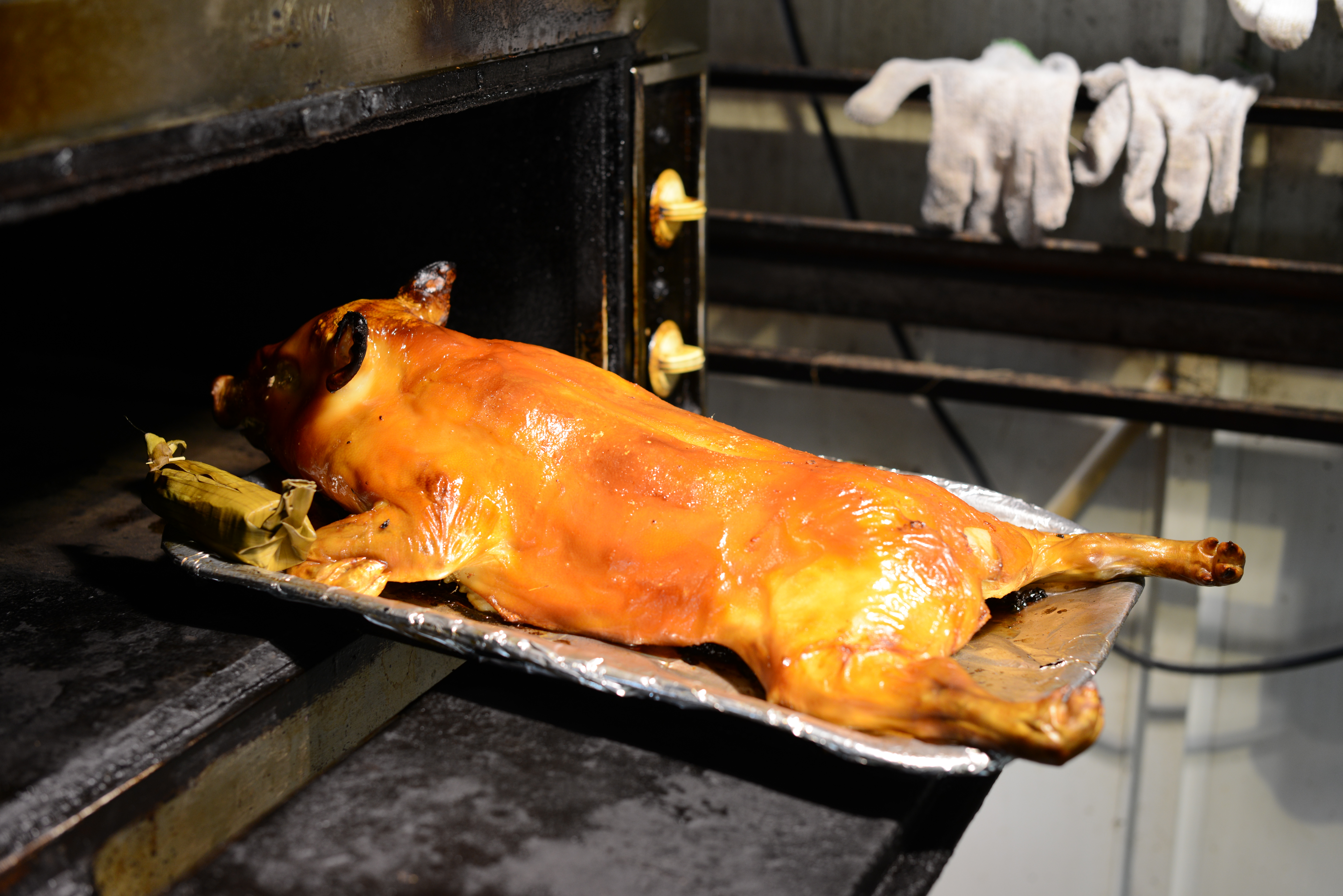
To the food: shrimp in a chili sauce, “drunken steak,” (a take on Steak Diane), and roast suckling pig, which, in my opinion, is the best pig I have had thus far in this part of the world. The skin was crispy and just salty enough; it was not so chewy that it stuck to my teeth, but it provided a perfect snap and flavor. And the meat. The meat was all one wants from suckling pig: tender, earthy and wholesome. I closed my eyes and let a piece (almost) melt in my mouth.

That's some pig.

That’s some pig.

I don’t mean to ignore the other dishes, because they, too, were good. The shrimp were fresh, not overcooked – one of my pet peeves is chewy, dry seafood – and the steak was a perfect medium rare, accompanied by a sauce tasting of pepper and brandy. There was nothing left on the plates when we finished, and we used our bread to make sure we left no sauce behind. It really was that good.

Dean pours the Sangria.

Dean pours the Sangria.

After-lunch drinks at the Pagoda

After-lunch drinks at the Pagoda

Near the end of the meal we ordered a pitcher of Sangria, and, after pushing our plates aside, went outside to sit at the bar. There, Lili, as she ordered us to call her, told us a bit about the restaurant and gave us a recommendation for dinner in Macau. A perfect dining experience require mores than food, and Lili helped make Fernando perfect.

I got up to take a tour of the huge kitchen, which is comprised of several connected rooms, and I talked with a few of the cooks. The chef was an imposing woman who, by the looks of it, had the kitchen fully under control, as it should be. But there were lots of smiles, as it also should be.

An ample kitchen

An ample kitchen

A cook from Nigeria

A cook from Nigeria

Busy lunch

Busy lunch

Not Staub, but plenty good

Not Staub, but plenty good

The pork gets its own oven

The pork gets its own oven

When I returned to the pagoda bar I saw that Dean had been recruited for a match of Foosball; I soon found myself playing alongside him, against two of the waitresses. Suffice to say that they kicked our asses, with style, laughing all the while. (One of the women played with the grace of Platini, no wasted movements, always finding the corners of the goal.) Dean and I lost the final match 5-0.

Foosball fools

Foosball fools

Dean plays defense

Dean plays defense

Platini, in foreground, celebrates another fine goal

Platini, in foreground, celebrates another fine goal

Lunch over, Foosball pride a little deflated, Sangria making us warm, we said goodbye to Lili and the others and boarded a bus bound for another island.

Sometimes one hears of a restaurant and is told that it is wonderful, that one must go, only to be disappointed. On other occasions the experience is all one wants from a meal: gracious and comfortable service, honest food that tastes the way it is meant to, engaging conversation, all of which enjoyed while surrounded by an ineffable spirit of goodness. Fernando is all that. You should go. And order the pork.

A horse tale (and Max produces some fine pasta)

I enjoy teaching others to cook, and showing them that learning a few things culinary is well worth the time it takes to do so.

I’ve been cooking a lot in Gudrun’s kitchen this month, and it’s been fun showing Max the ropes, especially making pasta.

Last week we went to the Saturday market and I bought a nice foal steak and some horse sausage, and they became a wonderful ragù. It was cooked low and slow, for seven or eight hours. I started it on Saturday evening, and on Sunday Max and I got together and made pasta. I put him in charge, and he did a fine job … it was his second batch, and I do believe he could produce some good pasta in any kitchen.

We made vanilla panna cotta for dessert, Holger opened a Syrah, and Sunday evening in Kaiserslautern was delicious.

This slideshow requires JavaScript.

Duck and cheese, for a brisk day in Paris

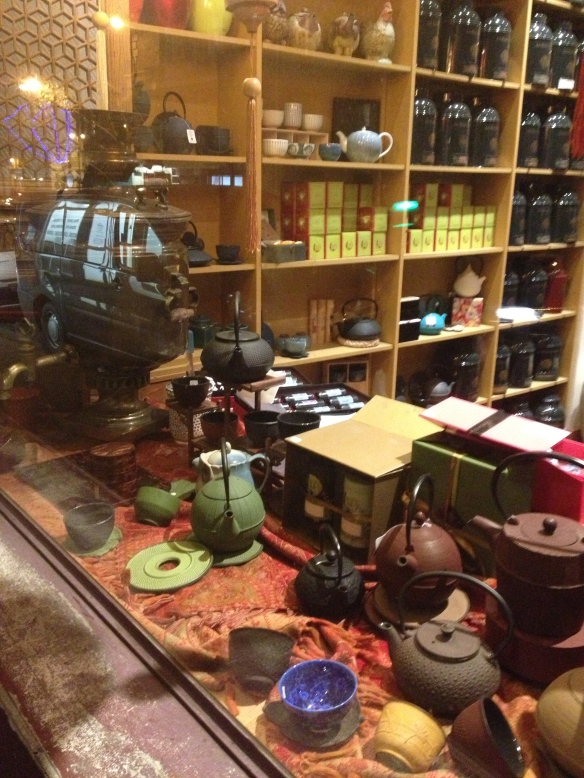
Paris is … well, Paris is a great place for food, which is one of the reasons I love this city. Every day I wander into another little shop, looking for cheese, meats, vegetables, wines, coffees, or teas. Or conversation with people who love food and love to cook.

Teas of the world, in the 5th.

Teas of the world, in the 5th.

Today was brisk and sunny, I was out early, enjoying the holiday feeling, the lights and smiling people, the frowning people. Christmas trees are selling now, and the man who sits on the corner near my apartment depending on the kindness of strangers for his income added a new puppy to his entourage. He now has three.

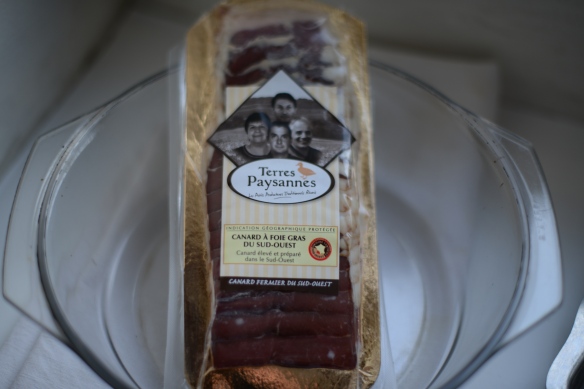
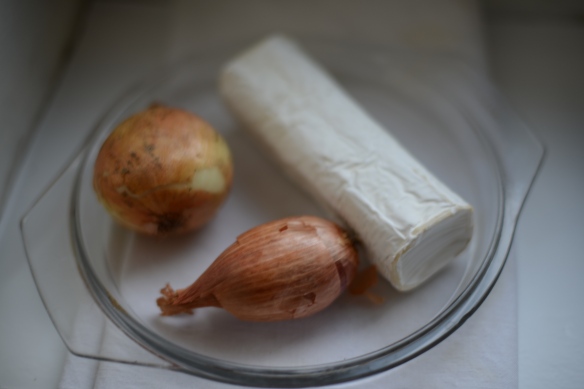
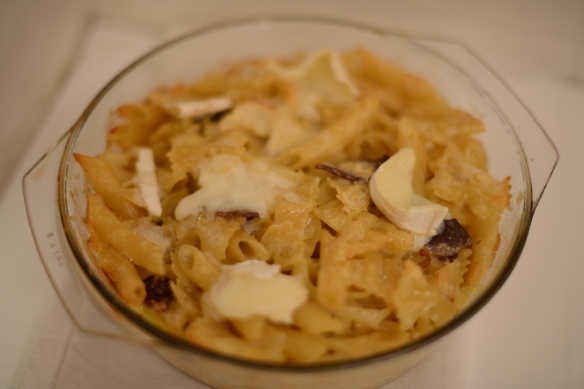
I have been cooking a lot lately, saving my dining-out money for when Angela arrives. The kitchen in my apartment is small, two burners and a toaster oven. That limits my choices, but so far I’ve not had any problems satisfying my palate. This afternoon I picked up some sliced duck and a few shallots, and when I returned home I surveyed the kitchen and noticed some pasta and chèvre, and macaroni and cheese came to mind.

I love duck.

I love duck.

From a goat and a garden

From a goat and a garden

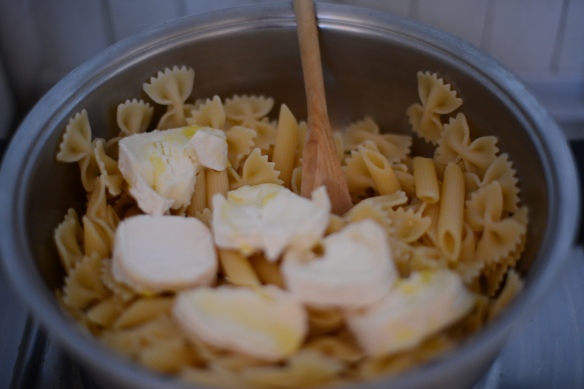
I cooked the pasta until it was just under al dente, then rinsed it in cold water and drained. I returned it to the pan and cooked it for a minute longer, to chase away any excess moisture. I then sliced the chèvre into it, added some salt and butter and mixed that well.

Cheese, pasta and butter

Cheese, pasta and butter; stir well.

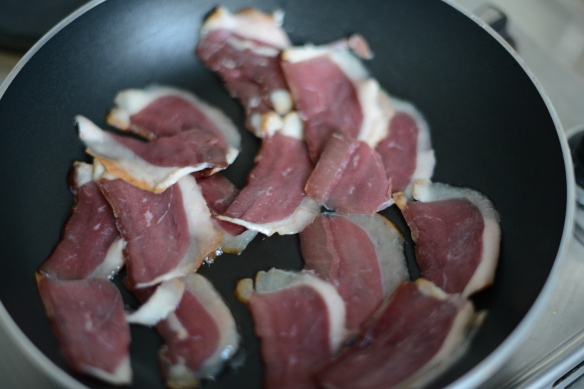
duck bacon?

Duck bacon? Yes.

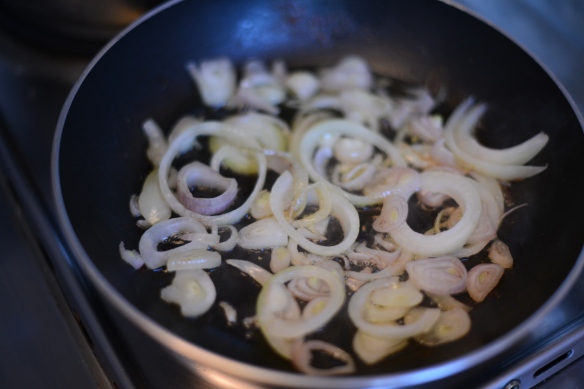
Duck fat and vegetables

Duck fat and vegetables

The duck I heated gently, then removed it from the pan and sautéed an onion and a shallot in the duck fat, which imparts a great taste to the vegetables. The duck I tore into smaller pieces, then added it, along with the onion and shallot, to the pasta and cheese mixture. Stirred it well and seasoned with more salt and pepper, then added a bit of cream.

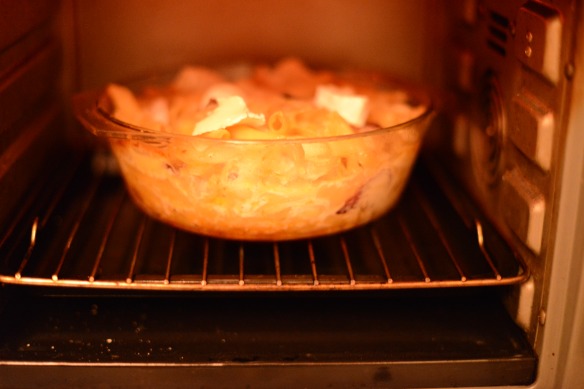
The oven was hot, so I buttered a baking dish and put the pasta mixture into it. Into the oven went the dish, and I cooked it for an hour or so.

One can do a lot, or a little, with a toaster over

One can do a lot, or a little, with a toaster oven.

About five or 10 minutes before the dish was done I put a few more pieces of chèvre on top of the pasta and broiled it until the cheese melted.

It was excellent, with a baguette and a pinot noir. If you can’t find duck I have also tasted this dish with pork bacon, or lardons, or salmon. I prefer duck.

Everyone loved macaroni and cheese, no?

Everyone loves macaroni and cheese, no?

A healthy obsession with Escoffier

Jeremiah Tower's work on Escoffier is the perfect introduction to the work and life of the famous chef.

Jeremiah Tower’s work on Escoffier is the perfect introduction to the work and life of the famous chef.

Escoffier. Anyone who loves food, who loves to dine in good restaurants, should know his name. And most definitely, anyone who cooks in a restaurant has a responsibility to be fully aware of his name, and, more importantly, of his profound presence that is all around you as you cook and serve guests. He is one of the luminaries in the chef pantheon.

Now comes an eBook on Escoffier by another famous chef, Jeremiah Tower. Its title is “A Dash of Genius,” and it is a welcome addition to the Escoffier library, especially for readers who don’t know much about the French demigod (whose full name is Georges Auguste Escoffier).

One of the most enjoyable aspects of “A Dash of Genius” is the way Tower tells the reader how Escoffier entered his life, and how the Frenchman’s legacy and lessons have affected his creativity and career. (In addition, Tower’s use of recipes is marvelous, and will make you want to cook.) He begins:

“I have been obsessed with Auguste Escoffier since I was sixteen at King’s College School in London. My drama teacher gave me ‘Ma Cuisine’ for having played Algernon Moncrieff in Oscar Wilde’s ‘The Importance of Being Earnest.’ I thought it was a curious choice, but I read it every night under the bed covers with a flashlight after lights out. And was entranced. Later, in Harvard College and cooking for friends, I graduated from ‘Ma Cuisine’ to ‘Le Guide Culinaire.’ I worked through it enough so that when I moved to a little house in Cambridge in my senior year, the first dinner I gave was pure Escoffier.”

Tower goes on to list the menu for that dinner, which took place in 1965, but, as someone who never tires of reading menus, I’ll not spoil your enjoyment. Get this book.

Escoffier, a man of sublime taste and great vision. (Photo courtesy of Ecole Ritz Escoffier)

Escoffier, a man of sublime taste and great vision. (Photo courtesy of Ecole Ritz Escoffier)

“A Dash of Genius” begins at the beginning, and tells the story of Escoffier’s birth (1846, near Nice) and early development, establishing the fact that the young man from the south of France had an “iron will” even at an early age. He was working for his uncle, and, according to Tower, this is where Escoffier’s ideas on reforming professional kitchens and, indeed, all aspects of running a restaurant, were born. The formation of kitchen brigades, bringing all the functions of cooking into one unified space (as opposed to cooks working in separate, unconnected rooms), and the improvement of hygienic conditions in kitchens: we owe Escoffier much gratitude for these and many other innovations.

Tower spends a lot of time on Escoffier’s charitable work and other benevolent activities, which were many. For example, Tower recounts the story of two nuns who would daily visit the Savoy, at which Escoffier was chef, on a horse-drawn wagon. The women would go through the restaurant’s garbage looking for used coffee ground, tea leaves, and other items, which they used to feed residents of a rest home. When Escoffier noticed their activities he ordered that all the food thrown away by the restaurant be clean and in good condition, including, writes Tower, quail carcasses, legs and thighs still intact – the restaurant generally used only the breasts of the small birds.

Tower continues: “The day came when there was no horse. No nuns. Escoffier leapt into action and visited the rest home to see the Reverend Mother. All she needed for the horse was five pounds. Escoffier supplied the money and the next day the same two nuns with a new horse pulled up to the Savoy.”

Escoffier continued to help the nuns for more than 20 years. In addition, he was the recipient of, among many other awards and honors, the Chevalier of the Légion d’Honneur and the Officier de la Légion d’Honneur. He raised 75,000 francs for the benefit of women and children during World War One, and took on the task of rehiring every cook of his who had gone to war, eventually “implanting over 2,000 French chefs around the world.”

Escoffier founded a magazine, “Le Carnet d’Epicure,” in 1911, and wrote books, the most famous being “Le Guide Culinaire,” which is found in restaurants and home libraries around the world. If you do not own it, please get a copy. It alone would have lit Escoffier’s star in the firmament forever, and its more than 5,000 recipes, not to mention its practical and groundbreaking approach to cooking and producing food for a modern clientele, will be with us until the final pot of stock grows cold.

Jeremiah Tower, whose study of Escoffier is food for the mind and senses. (Photo courtesy of Jeremiah Tower)

Jeremiah Tower, whose study of Escoffier is food for the mind and senses. (Photo courtesy of Jeremiah Tower)

Another interesting encounter with Escoffier that Tower tells readers about deals with Chez Panisse, the pioneering restaurant in Berkeley, California, founded by Alice Waters, at which Tower was an instrumental presence. In 1976, Tower was creating menus for a “Week of Escoffier” festival at Chez Panisse, and on this particular night 60 guests were waiting in the dining room for their dinner. Foie gras was on the menu, there because Tower wanted to serve Tournedos Rossini, which he said was a childhood favorite of his. From beyond the grave, Escoffier guided Tower to transform his approach to food and the serving of it to paying guests:

“It was the foie gras that made me rethink what I was doing. In the United States in the early 1970’s it came in cans … After one taste of canned goose liver, I knew I was eating more pig wurst than goose liver, and the canned truffles might as well have been old turnips. Facing a demand to do one more night of Escoffier, I thought, why not his famous Caneton Rouennais en Dodine au Chambertin? Of course, this was as long as I could get the Chambertin. I looked to the local ducks. Reichhardt Duck Farm Sonoma pekins were fine, but trying to convince myself that they could substitute for French canards de Rouen that arrive in the kitchen undressed and still full of blood for the pressed sauces with which they are served was a losing battle. In those days, international ingredients weren’t flown in every day, and frozen foods were a personal anathema. I was faced with using whatever had been produced in the region – and that realization was my “eureka” moment. I looked up from France and saw California.”

Tower goes on to describe how he took Escoffier’s dishes and made them “local,” and anyone who has dined at Chez Panisse (or, by now, most other good restaurants whose chefs and cooks focus as much as possible on seasonal and local ingredients), has benefitted from that “eureka” moment. I recall one lunch at Chez Panisse during which my three dining companions and I were invited into the kitchen upon arrival and given a tour; I was put to work shelling peas, and loved being around the fresh produce grown on farms around the region. (I’ll leave it to others to discuss Tower’s working relationship with Alice Waters.)

Escoffier survived captivity as a prisoner of war in a German camp, opened excellent hotels and restaurants, traveled to the United States on four occasions, and was instrumental in the development and success of countless cooks and chefs. His work pleased royals and commoners alike, and many of his dishes and their offspring are served around the world daily, to the delight of millions. He died in 1935, two weeks after the death of his wife, in Monte Carlo. His guidance, however, is fully with us. Tower’s study deserves a place on shelves devoted to Escoffier, and will, I think, introduce more readers to the work and legacy of the great man.

Mon Oncle, or, a Wine Bar Opens in Girona

I left Barcelona with wine on my mind and in the trunk of the car. I was headed to Girona, a city Angela and I had visited in 2011 (we had a reservation at El Celler de Can Roca). This time I was going to visit friends who lived there. They were opening a wine bar, and I thought it would be fun to observe their work and give them some help. I had taken a train from San Sebastien down to Barcelona, and, after a few meals and a night at Camp Nou seeing Messi & Co. work their magic, I rented a car and headed toward the ocean. (I did make one stop, for lunch, at Can Fabes, more on which later.) (Update: Here is the story of my afternoon at Can Fabes.)

Girona is a beautiful city, with a small river running through it. It is not far from the French border, and its people are fiercely independent. I had my trusty GPS unit, and had programmed into it the village in which my friend and her husband lived, about 20 minutes outside of Girona. They own an amazingly beautiful bed and breakfast in which I stayed one night during my visit, and I recommend it highly.

They were not home when I arrived, so I called and arranged to meet them in Girnona, near Mon Oncle, the name of the soon-to-open wine bar. It is in a building in a large open square, in the old district; in other words, a perfect location. Plenty of space for outdoor dining, for sitting and enjoying wine with friends.

When I reached the square, after a stroll along the river, Mon Oncle was abuzz with activity; Axel, one of the owners, was helping affix a sign to the building’s exterior, and his sister, Marie, and her husband were inside unloading supplies and going over inventory. I had not seen Axel since 2005, and the last time I saw Marie was in New York in 2002. We greeted and I told them I was available for work. We toasted with beers and I started helping ready chairs and tables for the square. Mon Oncle’s opening night was two days away, and cases of wine and water and beer were stacked inside the restaurant, ready for the open-house crowd that would gather to celebrate.

What occurred two days later was magical, and perfect. Hundreds of people showed up (even a group of drummers), and they drank and dined and danced and, in short, created the perfect atmosphere for the premiere of Girona’s newest wine bar.

Searching For a Ghost in Switzerland

I neared Vevey, and the sunshine reflecting off of Lake Geneva was bright and warm. That morning I had left Provence, and because I was looking for M.F.K. Fisher had not booked a place to spend the night in Switzerland. To be exact, I was hoping to make my way to the spot on which Fisher’s house in the hills above Vevey stood. She lived there during one of her sojourns in Europe, and I have been trying to spend some time in each place she lived, including Dijon and Strasbourg, and Provence. I planned to find a room in the hills.

From a hill high above Lake Geneva

From a hill high above Lake Geneva

Vevey, at first glance, once I arrived in the city proper, underwhelmed me. I scanned the steep hills above and wondered which road I should take to get nearer to where Fisher cooked and wrote, and grew discouraged, because they all seemed to end in neighborhoods of orderly lawns and quiet houses. In my head I had imagined an alpine pasture, wildflowers, a few cows … not BMWs and S500s and crosswalks.

Growing frustrated, and resigned to spending the night in a drab room back in Vevey – I had driven through Montreux, directly adjoining Vevey, glamorous, bright, alluring, but on this trip am sleeping inexpensively (though not devoid of grace and comfort) – I noticed a woman on horseback, riding a brown beauty up what looked to be not much more than a trail. I slowly nosed the car toward the trail, and saw that it was wide enough for one car to proceed along it. In addition, a sign told me it was open to traffic, so slowly up I went.

About 10 minutes later I saw a restaurant on my left, and pulled into the small parking lot next to it. It was 5 o’clock in the afternoon, the restaurant closed and empty. Across the narrow street a woman was walking a dog, and I asked her if she knew of any chambre d’hôtes in the immediate area. She pointed toward a fork in the road, about 100 feet in front of us, and told me there were two, one up the left fork and one down the right fork. I thanked her, went back to the car, and took the right fork. 

About two minutes later I saw a wooden house on my left …

A house at the end of the road

A house at the end of the road

It was beautiful, and welcoming. I parked the car and approached the front door, and my knock was answered by a smiling woman. She told me the room was occupied, but invited me in. The house, warm, redolent of wood smoke, immediately made me feel at home. I asked her about the area, and told her why I stopped near Vevey, about M.F.K. Fisher and my wanting to find her home there. The woman, Monika, told me she had not heard of Fisher, but then her daughter, Danielle, entered the room and, hearing our conversation, said she would ask her brother about Fisher, as her brother knew a lot about the history of the area. I gave them my email address and said I was going to check on the other bed and breakfast nearby. I wanted to continue the conversation, but was concerned that nightfall would find me homeless.

I drove back to the fork and headed higher, looking for a railroad crossing, where, I was told, I would find a salmon-colored house. It was easy to locate, and I parked my car across the street from the building. Walking up to the front door, I noticed a few people in the house’s side yard working on what looked to be a large shed. I greeted the first person I saw, a woman whose black sweater was covered in sawdust; when I told her I was looking for a room for the evening she put down what she was holding and took me inside the house, to a room on the first floor. It was perfect: neat, clean, functioning WiFi. I told her I would take it, and she invited me back outside for a coffee. She also ordered me to bring in any clothing I had that was in need of laundering …

Angela and sons, preparing lunch

Angela and sons, preparing lunch

The structure they were working on was something I would like to have: a room with a table that seats 12 people or so, adjoining a fully equipped kitchen. It was so much more than a shed. They used it for family meals, and their guests enjoyed breakfast at the big table, overlooking an outdoor Jacuzzi tub, a sauna, and, at the rear of the garden, a chicken house. (I learned that of eight hens, one remained, the other seven victims of a fox. The lone hen’s only companion was a goose, a plucky specimen that strutted on the grass looking like a miniature emperor.)

The Emperor of Chamby

The Emperor of Chamby

I had dinner that night at the restaurant down the road, where I had first parked and learned about my two bed possibilities, and after settling in at my table and ordering a glass of wine, I turned my thoughts again to M.F.K. Fisher, the person I was in search of on this steep hill overlooking Lake Geneva. I wondered how far away the site of her house was, if she had ever dined on venison from the area (my main course that evening). And I thought about the idea that she on many evenings, from a perch most probably above where I was sitting, looked down on the lights of Vevey and Montreux, as I was doing.

Loin of venison in the Swiss hills

Loin of venison in the Swiss hills

I had driven for the better part of that day, so after my meal I headed back to my room, looking forward to getting in bed early, or at least earlier than was usual for me. But, as I opened the house’s front door and started toward my room, Angela and her husband met me in the foyer and invited me to go out with them for a drink, which I did. We drove down the steep hill and met some of their friends in a small club whose DJ loved ’80s music, and, to my relief, Marley and Nina Simone. We lasted until 1:30 or so in the morning, and after discussing local politics and my next destination and restaurants in the area we headed back up the hill to sleep.

The next morning I was awake at 8:30 or so but stayed in bed reading. I knew that I did not have a long trip ahead of me to get to Bavaria, so decided to take it easy. My hosts were already preparing lunch, and when I went outside I saw a pot filled with octopus and tomato sauce. As I was drinking my coffee, Angela asked me to stay for lunch, and how could I say no? They were all working on the room again, installing windows. The grandmother was in the kitchen, laying out cheeses and charcuterie. I lingered over a second cup of espresso and took in the sights and sounds, watching three generations of a family work and cook and live, and felt warm and at ease.

This, among other things, forced me to stay for lunch

This, among other things, forced me to stay for lunch

From the heart and hands of an artisan

From the heart and hands of an artisan

The table was set for our meal, and I went to my car and brought back a bottle of wine, a red from Provence. More family members arrived, and a plate of house-cured salumi was brought in. We ate the octopus and artichokes and bread and drank our wine. The fog, which earlier had shrouded the horizon and blocked our view of the lake far below, was lifting, and I took that as a cue that I should be on my way. I reluctantly stood and shook hands and received and gave hugs, and left my hosts at the table.

I neglected to mention that two ghosts are in this story, the other being that of Hemingway. About 250 feet or so from my room, higher up the narrow road, stood a house where the writer lived in 1922 with Hadley Hemingway. The house was then the Pension de la Forêt, and I wondered if Fisher ever stayed there …

A room for a giant

A room for a giant. (Swiss Tourism Archive)

A young couple in Switzerland (JFK Library/Hemingway Collection)

A young couple in Switzerland. (JFK Library/Hemingway Collection)

As I drove back down toward the fork in the road I decided to say bye in person to the woman whose pension I first stopped at; the night before she had sent me an email telling me her apartment would be available the following evening if I had plans to stay in the area longer, and her daughter had put me in touch with a historian in Montreux who might know something about M.F.K. Fisher’s life in Vevey. They were kind to do this, and I wanted to tell them so. The mother opened the door and invited me in; I could smell the pleasant odors of food coming from the kitchen, and again felt instantly welcome. The house was built in the 1630s, and its solidness gave me a sense of well-being. It turned out that the mother’s husband had been an American scientist; he died in 2011. He had done much work restoring and modernizing the house, and was a renowned builder of model ships, as I was to discover on a tour of the house.

The Titanic, big and with exquisite detail

The Titanic, big and with exquisite detail.

I received another lunch invitation, and wanted to stay, both because of the hospitality and the smells emanating from the kitchen. But Germany beckoned, and I planned to arrive at my next destination before sunset, so I once again said goodbye and started down the hill, toward Bavaria.

Chasing a ghost is challenging, and I never found M.F.K. Fisher’s house (or what remains of it, if anything does) or the land upon which it stood. But I did find good people, and spent a few hours with them and their food and kindness. And I know that would have made Fisher happy, indeed. I also know that the next time I am near Montreux I will find myself in good company, around warm tables full of fine food and much laughter.

« Older posts Newer posts »

© 2026 Mise en Place

Theme by Anders NorenUp ↑