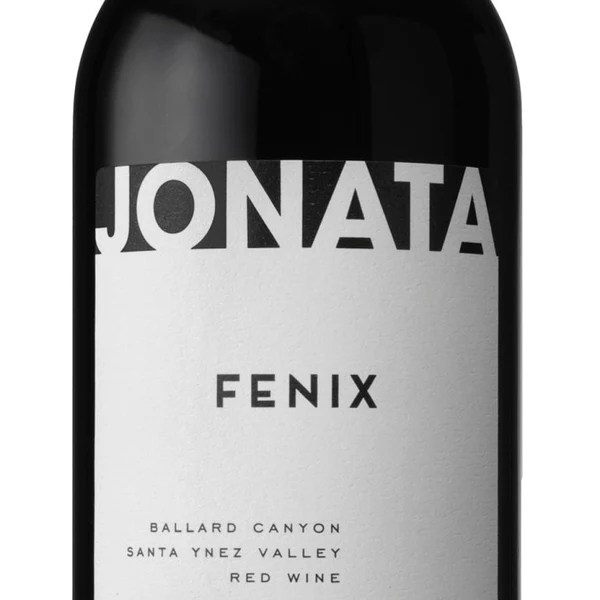
A Bordeaux-stye red blend from the Ballard Canyon AVA is up first in this edition of Tasting Notes, and it’s a selection many of you will want to add to your cellar or wine list. I tasted the 2021 Fenix, from Jonata, on a recent afternoon, along with a few other bottles, and this vintage puts on display the methodical yet agile and intuitive stewardship of winemaker Matt Dees.
The blend is 77 percent Merlot, 14 percent Cabernet Sauvignon, and 9 percent Cabernet Franc, and if you, as I do, love Cabernet Franc, you’ll enjoy the 2021 Fenix even more, because that grape was beautifully evident during my sampling, as it was the next day, when I poured the wine at dinner, pairing it with a duck breast seasoned with salt and star anise.
Where did Jonata get its name? Matt Dees explains. (Jonata)
Dees, who has been overseeing Stan Kroenke’s Jonata since 2004 (and whose purview now includes Kroenke projects The Hilt and The Paring) came to the profession without a degree in oenology, though he did earn a degree in plant and soil science at the University of Vermont, a curriculum relevant to winemaking.
Back to the 2021 Fenix, which was retailed with an average price of $100 (look for it on sites such as Benchmark Wine Group and K&L Wine Merchants, and inquire at your preferred local purveyor). You can also consider becoming a Jonata member for access to current releases and earlier vintages. The 2021 spent 20 months in 50 percent new French oak and 50 percent twice-used French oak barrels (225 liters). Note: One barrique holds 300 750-milliliter bottles of wine. Alcohol clocks in at 14.5 percent, and 1,265 cases of the 2021 were produced.
Dees recently told Levi Dalton in an episode of “I’ll Drink to That” that the Jonata vineyard is the sandiest he’s ever seen, adding that “it’s a beach.” When the Jonata team was surveying the property and assessing it for viability, several winemaking consultants told them that they would be better off growing asparagus or developing a golf course — the sand would be perfect for bunkers. I’m glad Dees didn’t listen to them. The soil there has been producing some stellar wines.
Matt Dees takes soil seriously.
Complex, decadent, focused, architectonic, confident. Those terms came to mind when I sat with the Fenix. Black and dark-blue fruit, buffed leather, and violet notes arouse the olfactory senses, while blackberries, sage, pristine forest floor, plum, and wild mushroom — perhaps chanterelles — meld wonderfully on the palate. Duck breast, as I wrote, pairs well with this wine, as would a rack of lamb. You need some fat to marry the robust (yet remarkably refined) tannins. This is a wine that will please you now, or in 10-plus years if cellared properly.
On to New Zealand
We’ll venture to a wine from New Zealand next, the 2022 Pencarrow Pinot Noir, which I tasted alongside another Pinot from that island country (the latter selection has among its team a very famous name — more on that below).
This Pinot Noir is a steal for $30.
Palliser Estate makes the Pencarrow line, which also includes a Chardonnay, a Pinot Gris, and a Sauvignon Blanc, all made from fruit sourced (100 percent) from Palliser estate’s Marlborough-based vineyards. Guy McMaster is the winemaker, alcohol is 14 percent, and 73 percent of the fruit came from the Pencarrow Vineyard, 24 percent from the Woolshed Vineyard, and 3 percent from the Pinnacles Vineyard. The (mainly) wild-fermented wine is cold-soaked, then pump-overs and plunging take place, followed by 10 months in oak barrels.
As with the Jonata Fenix, I sampled the Pencarrow Pinot Noir on a sunny afternoon immediately after opening the bottle (a screw cap) and finished it later with food. The wine is an attractive light ruby in the glass, an inviting hue. A faint white pepper note marks the aroma, along with wild raspberry, red cherry, and fruity nutmeg. Those profiles continue when one tastes the Pencarrow Pinot Noir, and I picked up some mushroom-centric umami as well. Tannins are powdery, and the finish is sustained. This wine, which retails in the $30-$35 range, is fun to drink, pure fun. Later that day I paired it with a meatloaf made from beef and pork and sun-dried tomatoes and could not have been happier.
A Famous Name
Does the name Sarah Jessica Parker ring a bell? It likely does. She is the famous individual to whom I referred earlier in this piece, and she’s the Invivo X proprietor — her official title with the brand. The 2022 Invivo X SJP Pinot Noir, which Wine Spectator placed at number 82 on its 2024 Top 100 wine list, closes out this edition of Tasting Notes. If you are skeptical of wines linked to celebrities, I understand, but that sector is too large and varied for blanket aversion. This bottle is worthy of your consideration.
From New Zealand comes this wine, which represents a great value.
Marlborough is the region from which the grapes for this wine hails — with a touch of Central Otago fruit added in. It has a suggested retail price of $25, which in my opinion is more than fair. This Pinot Noir is a bit darker in the glass than is the Pencarrow, a hue that is nonetheless fetching. No one I know would mistake this wine for anything other than a Pinot Noir; there is a lively black cherry component, plus allspice and earthy leather, on the nose. The aroma promises something satisfying, and it doesn’t disappoint. A taste reveals cherry and raspberry, with muted oak and smoky spice.
Sarah Jessica Parker and Rob Cameron taste Invivo X SJP samples. (Courtesy Invivo Wines)
The Invivo X SJP has an ABV of 13.5 percent, and fruit was harvested by hand and de-stemmed into open fermenters. Indigenous yeasts began fermentation following a cold-soak of 7 to 10 days. The wine spent 11 months in 35 percent new and 65 percent used French barriques, and malolactic fermentation occurred in barrel.
What did I pair this Pinot Noir with? Salmon. I had a few skin-on, wild-caught coho filets and wanted to see how they’d do with the wine. I seared them (skin-down first; be sure to dry the skin fully before cooking) after seasoning with salt and pepper, and finished by adding a tablespoon of butter to the pan and basting the filets with it. The wine’s tannins complemented the fish’s richness and my guest was ecstatic.
The wines in this Tasting Notes demonstrate terroir well, and the winemaking quality is evident. If you try one (or all of them) let me know what you think. The next edition of Tasting Notes will include a Texas sparkling wine, a California Pinot Noir, and a Tuscan red that loves being chilled.
Nick Goldschmidt, who hails from New Zealand, has made wines in myriad regions around the globe. He and his family have called Healdsburg home since 1990. (Courtesy Goldschmidt Vineyards)
Ilike to talk about wine with people who share my passion for it. We open bottles, we trade stories about travel and soil types, terroir and residual sugar, and we talk of taste and food and restaurants. We recommend wines to one another, we drink, and we learn a lot.
In Wine Talk, I introduce you to friends, acquaintances, and people I meet as I make my way around the world, individuals who love wine as much as I do, who live to taste, who farm and make wine. You’ll appreciate their insight, and I hope you’ll learn something from them as well.
Nick Goldschmidt has a way with wine, and with words. The native New Zealander is gregarious and he’s passionate about his craft. The man is a walking, breathing repository of viticultural knowledge, lore and history.
Goldschmidt’s career officially began in 1982, when he took a research position at New Zealand’s Lincoln University. He graduated from that institution with a degree in horticulture, and did postgraduate work in viticulture and oenology at the Wagga Wagga campus of Charles Stuart University, also in his homeland, and then at Adelaide University, in South Australia, where he was enrolled in the Hickinbotham Roseworthy Wine Science program.
I’ve long known of Goldschmidt, and have enjoyed his wines over the years. When I was contacted recently about Merlot Month and saw that he was one of the participating winemakers this year, I knew I wanted to feature him in Wine Talk. (October is Merlot Month, and PaperCity’s The Pour series will have more about that, so stay tuned, and in the meanwhile, drink more Merlot.)
A family of wine. (Courtesy Goldschmidt Vineyards)
Goldschmidt and his wife and business partner, Yolyn, have called Healdsburg, California home since 1990, and his passion is now a family affair. In fact, one of the wines I tasted in preparation for Merlot Month was the 2019 Chelsea Goldschmidt Guidestone Rise Merlot (Alexander Valley AVSA). There are five Goldschmidt children, and Chelsea is one of them (the names Hilary and Katherine also grace Goldschmidt labels).
Let’s see what the winemaker has to say.
James Brock: How has COVID-19 changed your work and life?
Nick Goldschmidt: I have a theory that the average white guy lives to 85 and I am 59, so I have 25 years left to live. Twenty five by 365 days is 9,125 bottles of wine to drink. If I drink one bad bottle of wine, that is like throwing a good one against the wall.
I had a dream COVID, as four of our five children moved home. What other time in my life would I have adult children living with me? It was truly an amazing experience.
As a result of the additional people in the house, my wine cellar has been severely depleted and I’ll be closer to 10,000 bottles by the time I pass. The second thing I learned was that my children were asking, “OK, if we are drinking five bottles of wine tonight, which ones are they? We need to start drinking them in reverse order.” This also made sense, so we drank the best wines first. Great idea to finish the evening with a white. Fresh and with good acidity like we now do at wine judgings.
From a professional aspect, I was actually in Chile when COVID hit so I saw the implications of trying to harvest and make wine with all these severe restrictions in place. This meant I knew how hard it would be when I was scheduled to do this in California six months later. I’ve also seen today countries on a slower route to recovery and some that are much faster in terms of vaccinations. This means each country has its own set of rules, not only in terms of getting in, but how it is to work.
For instance, without foreign workers it has been very hard to pick grapes in New Zealand, which I think has been the hardest hit. Getting around Chile takes many special passes each day, which requires getting online before I head off each morning. Then Argentina has been impossible to get into. Canada has also been difficult, but is opening up now. So yes, consulting has been a challenge.
We have also seen difficulty with shipping and trucking. Of course, containers from New Zealand are taking months just to book. But also getting rebar for a planting job I am doing on the Staircase Vineyard has been ridiculous. We ordered in November and finally got it in June.
The Staircase Vineyard: A study of soil.
As a result I think in some strange way that COVID has been good for me in terms of both my personal and professional life. I am much closer to all clients I’ve been in touch with during this time.
JB: Tell us about three wines you think are drinking well at the moment. What makes them worthwhile? How about a food pairing for each one?
NG: I have started drinking what I preach. By that I mean I often talk about wines holding up over time primarily focusing on color and no “crusty deposit on the shoulder of the bottle”. As wines age, they move from purple to red to brown to orange, and I’ve always explained how I get my wines to only go purple and eventually to red. I learned many years ago how to slow the ageing beyond that.
This wine has a special place in the heart of Nick Goldschmidt.
So I started drinking older wines. For example, Goldschmidt Yoeman, which is the first wine that we made, in 1999. I have been drinking the 2001, marking 20 years for this particular wine. Remarkably, it has remained in a purple color with great liveliness, and it still has a fine freshness. No crust. Tannins are of course integrated and possess far more silky complexity than when released.
The second one I’ve been drinking a lot of is Singing Tree Chardonnay. We have been making this wine for a while now. It is from a field selection (no clone) and has a more lively mouthfeel on release and so really helps with its ageing. I have been drinking the 2014 and 2016, which really stayed alive. Both good vintages, of course. I think we have achieved what we set out to do, which is to make a wine with tension and liveliness without the high alcohol.
The reason for tasting is as I look back I wondered if I should add more weight to this wine like we did at Simi. I am carefully analyzing people around me and what their perception of the wine is. Do I make a change, or do I stay the course? So far, stay the course, but I do like analyzing over time. Thinking to how we farmed then and now and how our palates also change.
I don’t often drink wines from wineries for whom I consult, but as of late, based on amazing reviews, I’ve been trying Chadwick Cabernet in the Maipo Valley Chile. This wine has had two 100-point scores and I’ve really focused on those and the vintages around them. To me, it is not about the wine itself but a memory of the vintage. With the memory of the vintage comes my memory of the people who lead the winery and make the wine. I spend three months per year in Chile and have done so for almost 30 years now, so I know the area and the vineyard well. Chadwick 2017 is so far my favorite.
The Chadwick Cabernet Sauvignon was the first Chilean wine to receive 100 points from a wine writer (James Suckling, for the 2014 vintage). Image courtesy jackyblisson.com
JB: If cost was no consideration, tell us the one bottle you would add to your personal collection, and why.
NG: If cost was no consideration and it was something I could do each day, I would probably choose Vega Sicilia Unico, because it was one of the first great wines that, when I drink it, I drink with the memory of whom I was with, where and when. Even better would be that I would drink it in Spain in the DO of Ribera del Duero (Denominación de Origen).
I worked in the area when I was consulting with Tarsus. This was when I was the chief winemaker at Allied Domecq and so have many great memories of the region and the winemakers as well.
Vega Sicilia: When Nick Goldschmidt drinks this wine, the memories come flooding back.
JB: What is your favorite grape variety, and why?
NG: Cabernet, of course. It is so specific to its surroundings. I’m originally from New Zealand, and it is very hard to make there, so having lived in Napa and Sonoma for the past 30 years, I have learned a lot about it. I also see it in Maipo, Mendoza and Okanagan, all places I work. It comes in so many shapes and sizes. The future for me, though, is making these wines under 14 percent alcohol. We are doing it already in some appellations, but will it have respect if it is done in Napa?
It has the power and the weight, but it is a spicy variety, and too often at high alcohol they finish sweet. I really do not like the term “Napa Style,” which is used around the world. We need to get away from that.
JB: How about one bottle that our readers should buy now to cellar for 10 years, to celebrate a birth, anniversary, or other red-letter day?
NG: I always find these questions very difficult to answer. I always wondered why we sell wine by the individual bottle and in 12 packs. Is it because we are supposed to drink one bottle per year, or 12 bottles per year? I’m never quite sure. Let’s say it’s 12 bottles per year. Drink one a month and then you choose the best month of your memory when the wine tasted best.
I think the wine that will taste best is always the one that was drunk in one of the happiest moments. Therefore, choosing a wine for an anniversary or another great celebration in your life has to come with some extra effort. I would choose Goldschmidt Game Ranch Oakville. It is a fairly rare wine of limited release, and a bottle can add to the special occasion and hopefully the happy memories that will go with it.
JB: Where is your go-to place when you want to have a glass or bottle (outside of your home and workplace)?
NG: My children will tell you my happy place is down on the Dry Creek river with a bottle of Boulder Bank Marlborough Sauvignon Blanc. I built a table down there many, many years ago and each Sunday night the family gathers at it. We cook over an open fire away from the Internet but with many bottles of wine and lots of great food. We are very fortunate to live in the Dry Creek Valley, and in particular on the Dry Creek River itself.
JB: If there was one thing you wish everyone would keep in mind when buying and drinking wine, what is it?
NG: I always wish people would keep in mind that wine is a living, breathing, evolving product, and it is of the earth. It is not like making beer or spirits where the goal is to make an amazing product but make it the same every day.
Wine is completely different because the vintage itself tells a story about the weather, the people, the soil and the culture, which is one part. You need to travel to the wine regions, getting to know the places. Doing so gives one great reference for when you are back home and assessing and enjoying the wines.
The second part is where you choose to drink the wine. When I go to a restaurant I always choose something that I cannot pronounce on the menu and the wine generally that I’ve never heard of before. Going out for dinner drinking wine with food is a memory and an experience. Don’t drink badge brands. This is the time to try something different, take a risk.
JB: What is your “wine eureka moment,” the incident/taste/encounter that put you and wine on an intimate plane forever?
NG: For me it was a combination of processes. When I worked in the vineyards at Lincoln College in New Zealand I pruned the vines without actually knowing what wine was about. Then during the summer we picked the grapes and made the wine and then I drank the wine. For me, growing crops is fascinating, but to have it turn into something even cooler is amazing. This particular crop turns into a food product that is unique and different and truly represents where it comes from. There’s absolutely nothing like wine.
JB: What has been the strangest moment or incident involving wine that you have experienced in your career thus far?
NG: I don’t really have any strange moments, but I do have situations in which I suddenly had an “aha” moment.
One of the first ones was when I was making wine in Portugal for LVMH. The company owned Roses, a Port house, at the time. When you’re in Portugal with winemakers you pretty much have three ports — for lunch, breakfast and dinner — so after being there for three days I asked a winemaker if I could have a glass of white wine. He said, we don’t make white wine in Portugal.
Drinking Vinho Verde for the first time was an epiphany for Nick Goldschmidt.
But the young lady in the restaurant said, don’t worry I’ll bring you a glass. She filled the glass up to the rim. It was 120 Fahrenheit outside and we were eating barnacles, of which you need three for a mouthful. The condensation was flowing off the glass of wine and it looked so tasty. I took a deep gulp. But when I drank it my whole mouth puckered. It had so much CO2 and acidity in it, and my immediate reaction was, what the heck was that?
The enamel on my teeth was gone, the roof of my mouth was gone, and I had this whole unctuous acidic taste. I asked what it was and the winemaker said it was a Vinho Verde. Well, I didn’t know what Vinho Verde was. I didn’t even know it was a region. I also thought it was CO2, but actually it was minerality. But I always remember that experience. This wine either making me hungry or thirsty and I couldn’t quite work it out. That is sensation I’ve always remembered.
Try this at home.
JB: Your favorite wine reference in a work of literature?
NG: I have many, but they are all about winemaking, specifically production. This is one of my favorites: “Drinking a bad bottle of wine is like throwing a good one against the wall”.





Recent Comments