Wandering the streets of Macau is a good way to spend an afternoon and evening, and if you grow hungry finding food will present no difficulty. You could opt for grilled pork or chicken, or perhaps a charred fish. Or, you could order an egg custard tart or curried intestines. What I did one day is stop at this stand, the proprietor of which fried me a few quail eggs and mixed them into a bowl of mashed potatoes. It was a fine lunch.
Page 24 of 30
“A little more than two years.” That is how I reply when anyone asks me how long it has been since I have had my hands on some lamb tongue. To many people it will sound odd, but when one works daily with items on a menu you become one with them, and discover their nuances and feelings. These things have identities and personalities, and the more you handle them, smell them, feel them, the more they open up to you, the more they give you. And the more you miss some of them when they are taken off the menu or you no longer work with them.
One of my tasks at Amador was prepping lamb’s tongue. Christian, another cook with whom I worked closely at this Michelin Three Star-restaurant located in Mannheim, Germany, showed me how to slice it thinly and use a round to cut it into the shape required for the dish. Not every piece was usable, because we sought a particular, even coloration. Gray does not look good on a plate, and Chef Juan Amador wanted (and wants) nothing but perfection.
I was in Spain, and had driven from Barcelona to Girona, stopping for an impromptu lunch at Can Fabes along the way. Friends were preparing to open a wine bar/restaurant, Mon Oncle, in that little city with the river winding through it, and I wanted to visit them on my way to Provence. Mon Oncle is in an ancient square in Girona, and if you sit at one of its tables you will eat and drink well. It is run by good people. The boy on the left is the son of two of the owners, and he and his friend were busy with an iPad as the adults around them swept and cooked and composed menus.
I was wandering the streets of Tokyo, having just arrived that morning from New Delhi. I was hungry, and tired, but in love with the sunshine and the crowded sidewalks. I knew I wanted a beer, and I knew I wanted to find a quiet place in which to sit and gather my bearings. I saw in the distance a sign on the second level of a small building. On the sign was a pig. I steered toward the pig and walked up a flight of stairs and into a small restaurant whose walls were covered with advertisements for beverages and films. I took a seat at a table near the wall, and was happy to see the stovetop in the middle of the table. I speak no Japanese. The woman in this photograph speaks no English. That was no obstacle. Not at all.
Spring is, after Autumn, my favorite cooking and eating season. An abundance of vegetables that I love to use daily, including King Corn, are out there, waiting for your hand.
The other day I was in a market and ran across some corn that was advertised as having arrived that day, so I asked the clerk and she told me that, yes, the corn had been delivered from a farm in Texas that morning. I selected a few ears and immediately had a dish in mind. (And my mind wandered to a meal I had in 2013 at Hot and Hot Fish Club.)
There were some good peas in a basket, so I put a few handfuls of those in my bag and moved on.
Back home, I toasted a bit of pimentón in a pan and let it smoke for a few seconds. (Toasting dried spices is a great way to taste their best flavor.) Add some salt to the pan as well. I husked the ears of corn and cut the kernels into a bowl, then shelled the peas and chopped a shallot and some garlic. Butter and olive oil into the pan with the pimentón, stir it a bit, then add the garlic and shallot and soften on low heat. Meanwhile, blanch the peas (lots of salt in the blanching water) and put them in an ice bath. Put the corn and the peas in the pan and cook on low, stirring as often as you want.
You’ll know when the corn and peas are ready, especially if you cook this a lot this spring, which I recommend you do. Warm some bowls, plate, then, as a final touch, top with some chèvre. Season with salt and pepper to your taste.
I often crave something with a suddenness that surprises me. Today it is duck, and the craving was strong, and very specific. It was not a need for just any duck. It was a desire for the packaged duck I bought weekly in the market near my apartment in the 5th. And the scent of that duck came to me today as I was driving, and I wanted nothing more than to walk to that small, narrow store and select a package from the cooler. Here is how I cooked with it one wintry day in Paris.
Food works on us in mysterious and beautiful ways. And that is more than a fine thing.

A man and his wines: Arnaud Saget has taken his place in the ninth generation of a family-run wine-making concern. (photos/James Brock)
I have spent some time in the Loire Valley, and love drinking wines from the large region. It is a place full of lively and interesting winemakers, not to mention châteaux, and if you’ve never had the pleasure of driving from Paris and visiting Chambord or Château d’Azay-le-Rideau and drinking wines from Olivier Cousin in a café around the corner from where they were bottled, you should consider booking a flight to France. It is a magical region, the Loire. (And if it was good enough for Leonardo da Vinci, it is certainly good enough for the rest of us.)
The Loire produces some of my favorite daily drinking wines, and yesterday I had the opportunity to meet Arnaud Saget, whose family owns Saget la Perrière and produces wine with 890 acres and six estates. A tasting lunch at The Oceanaire Seafood Room was the setting, and it’s been a long time since I enjoyed, at one seating, so many exemplary, easy-drinking wines that I would serve, without reservation, on a daily basis.
Saget is the director général of his family’s company and is charge of marketing, so he travels a lot; this weekend he will be in New York, and next week Germany. His enthusiasm for winemaking is infectious, and though he understands that wine (and the selling of it) is a business, it is evident that he also understands and respects that his calling is part of a long and hallowed tradition that brings joy to the lives of millions of people around the world.
We began with the Muscadet de Sèvre & Maine sur Lie Les Cilssages d’Or, and it was the ideal way to start a meal focused on seafood. I liked that this wine was not overly sweet, and the hints of peach and pear were refreshing.
We had more wines than food courses, but that was no problem. All of the selections were from 2012, and, as I wrote, are drinking well right now. My favorite was the Domaine de la Perrière Sancerre. Crisp, it made me think of a Riesling, and when Arnaud Saget told me that the grapes are grown in flinty soil I understood why I thought “Riesling”. This Sancerre would be perfect for an afternoon under a beach umbrella, or with oysters. Or both at the same time.
We tasted two reds at lunch, a Chinon and a Pinot Noir. The latter was unmistakably a pinot. Ruby color, faint, lovely vanilla taste, easy on the tongue. The Chinon, however, would be my preferred of the two reds, with its supple tannins and wonderful spiciness.
Yes, there was food. We were served an Alaska Red King Crab Salad as a first course, followed by Pan-Broiled Alaska Weathervane Scallops – overcooked to my palate – Seared Wild Alaska Halbut, and, as a closer before the dessert, Grilled Bering Sea Wild Coho Salmon, which we paired with the Pinot Noir, and which was the best dish of the day. Its tarragon butter sauce was perfect, creamy, slightly acidic.
If you are looking for wines to drink every day, bottles with great price points – the most expensive wine we tasted (the Le Domaine Saget Pouilly-Fumé) carries a suggested retail price of $29 – buying these Saget selections by the case would not disappoint.
WINES TASTED (suggested retail price US$):
Muscadet de Sèvre & Maine sur Lie Les Cilssages d’Or ($14)
Marie de Beauregard AOC Vouvray ($18)
Guy Saget La Petite Perrière Sauvignon Blanc ($12)
Guy Saget La Petite Perrière Sancerre ($22) *A Brockhaus Selection
Le Domaine Saget Pouilly-Fumé ($29)
Guy Saget La Petite Perrière Pinot Noir ($13.50)
Marie de Beauregard Chinon ($17.99) *A Brockhaus Selection
I wrote about Roost earlier this year after my first visit to the little restaurant in Montrose. Angela and I shared a great meal, a small experience that was nearly perfect. I have been back several times since then, most recently yesterday. We were meeting friends from Dallas for dinner, and thought they would enjoy the food at Roost, and they, and we, did.
If you are not aware, the restaurant has a great happy hour – form 4 p.m. until 6:30 all bottles of wine are discounted 50 percent. Knowing that, Angela and I arrived early and shared a bottle of Grüner Veltliner (Domäne Wachau), $19. We also spent some time at the picnic table out front with Charlie, a friendly cat.
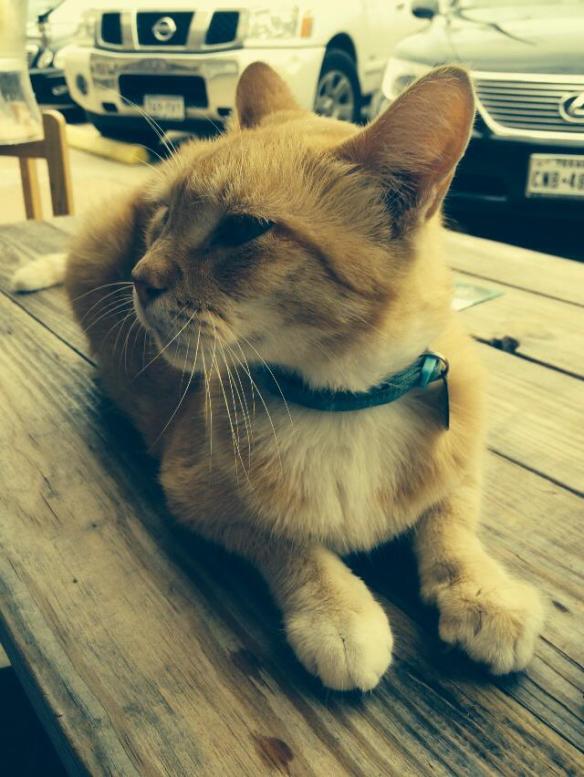
Around 7, when the mosquitoes became too much for Angela, the woman who might just be the best FOH person in Houston, if not Texas, told us that our table was ready, so we sat and waited on Peter and Catalina, who arrived about 10 minutes later.
Roost does its business in a small building, and space is a bit tight, but the atmosphere is always pleasant, lively, and the service is seamless and understated. (Much of that is the result of the professionalism exhibited by the woman I mentioned earlier.)
To the food. Since Peter and Catalina had never been to Roost, we began with the cauliflower. This is how it is described on the menu: “The famous frIed caUliFlower, boNito, miso dreSsing, pine nuts, scallion 9.” If you have not tried it, you need to. You must. The pine nuts are toasted, the bonito flakes exhibit good umami, and the dressing is something I would drink from a tall glass.
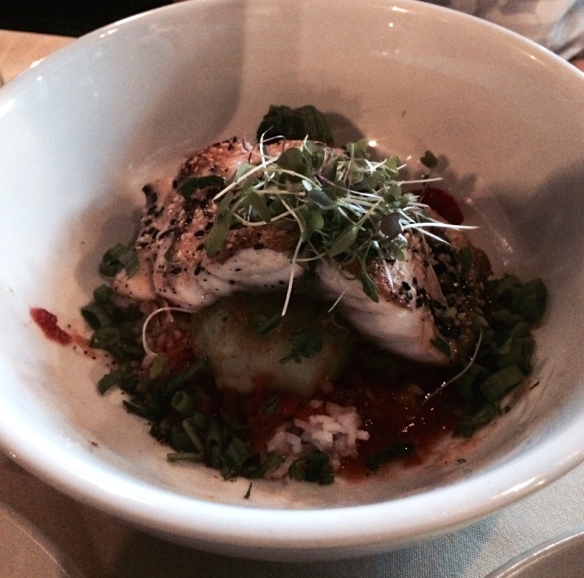
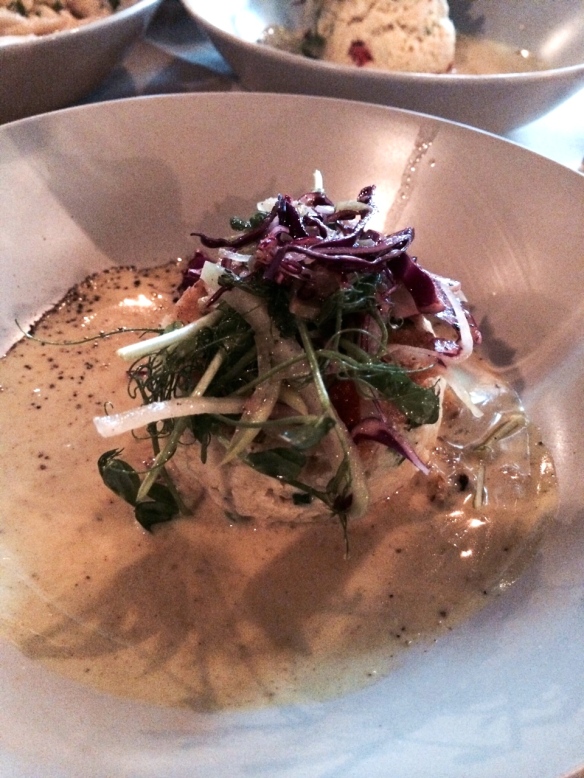
We decided to share everything, and from the cauliflower went on to: yell0w corn cakes, jumbo crab mEat, artichoke ragOut, paragon cheese 14; h0use made sPanakopita empanadas, garlicky tzatZiki, fennel & pine nUts 11; roasted gUlf fish, sweet n’ sour toMato broth, bok choy, coconut rice 24; ALL-crab-cakes, Thai curry sauce, cabbage & chayOte squash slaw, pEa shoots 29; and paulie’s pasta, r0asted peaches, goat’s cheese, rosEmary lemon butter 19.
Peter, who has a threshold for dill, found the sauces to be excellent, and I agreed with him, From the cauliflower to the Thai curry on the crab cake dish to the artichoke ragout, every taste was as it should have been. The drum was firm, the pasta was al dente (though I found the rosemary a bit much), and the crab in the cakes was as good as any I have ever had.
We ended the meal with C0ffee n’ donut hOles, crushed pistAchios, salted carAmel, coFfee ice cream 7. Like the cauliflower dish, this dessert is always on the menu at Roost, and for good reason. Not overly sweet, crisp and warm and moist doughnut holes, and really good coffee ice cream.
If Roost is new to you, you can do much much worse in Houston, and often you cannot do better. It really is a place approaching perfection.
Several years ago I spent some time in Seattle, there for a high school reunion and to visit Ron and Laura, great friends of mine with whom I worked in New York. One day we went to take a look at the salmon ladders, because those great fish were on their upstream homecoming. It was a magnificent site; I had not seen that many wild salmon since I lived in Alaska.
That visit was on my mind recently when I lucked upon some wild Coho salmon and decided to put a rub on a filet and broil it. I think it is a shame that so many people have never tasted a wild salmon.
I left the rub on the filet, at room temperature, for about 45 minutes, then broiled the fish for 8 minutes or so. (Be sure to remove all the pin bones.)
I have a friend named Mike Pitzen. I have known him for a long time, going on 30 years. He is a good man, and he is funny, with a sense of humor formed by a rural Wisconsin childhood, an education at the University of Wisconsin, and a levelheaded and pragmatic approach to life. We worked together as counselors at Space Camp, took part in a high-speed chase with Officer Wiley Bibb on an interstate highway in Alabama, and, yesterday, we grilled some very fine meat in Houston.
Mike has lived here for about 13 years now, and when I decided to move to Houston, this past year, one of the things I looked forward to was reuniting with him. I had not seen Mike in a long while, for perhaps eight years or more, and since I’ve been in Texas we have had several long lunches and conversations over beers, and Angela and I have enjoyed getting to know his family, Krista and Holt. I am glad he is here.
I received a call from Mike several days ago during which he told me, “Come over around 4 and we’ll fire up the grills and burn some meat.” Angela and I headed over to their house and upon arriving saw two Weber Kettle grills ready for some proteins. Mike had rubbed a brisket, and it and some ribs were on the smoke. Angela and I brought some jumbo shrimp, and I got busy marinading them, in preparation of wrapping them in bacon and giving them a nice sear. We added a giant sausage link to the mix, and two chickens, one of which we cooked in the beer-can method. Mike rubbed his bird with a mixture of oil and spices, and I put some garlic slivers under the skin of mine and stuffed its cavity with fresh rosemary and a lemon. We talked, drank some beer, kept up with the match between The Netherlands and Costa Rica, and ate some very good meat.


Recent Comments